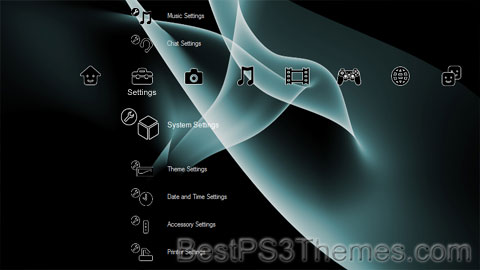
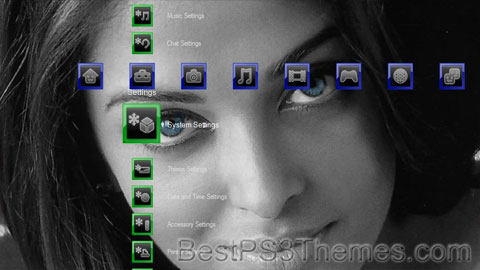
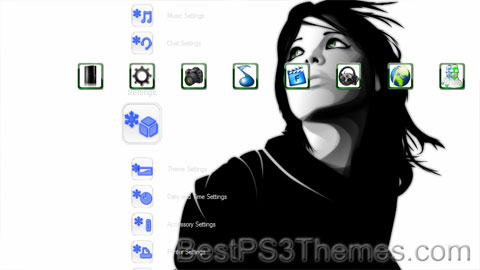
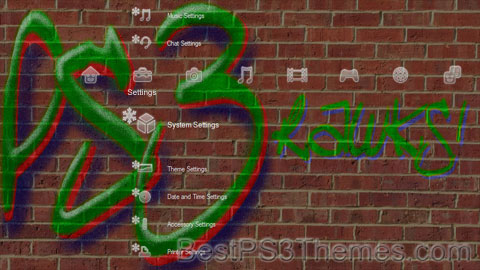
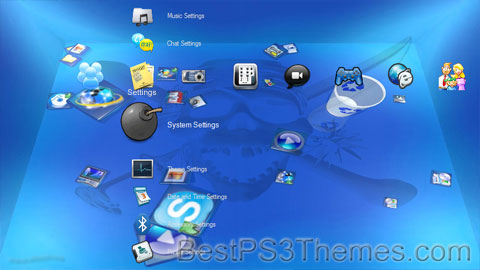
This program unpacks Playstation 3 Theme files (.p3t) so that you can touch-up an existing theme to your likings or use a certain wallpaper from it (as many themes have multiple). But remember, if you use content from another theme and release it, be sure to give credit!
Download p3textractor.zip from above. Extract the files to a folder with a program such as WinZip or WinRAR. Now there are multiple ways to extract the theme.
The first way is to simply open the p3t file with p3textractor.exe. If you don’t know how to do this, right click the p3t file and select Open With. Alternatively, open the p3t file and it will ask you to select a program to open with. Click Browse and find p3textractor.exe from where you previously extracted it to. It will open CMD and extract the theme to extracted.[filename]. After that, all you need to do for any future p3t files is open them and it will extract.
The second way is very simple. Just drag the p3t file to p3textractor.exe. It will open CMD and extract the theme to extracted.[filename].
For the third way, first put the p3t file you want to extract into the same folder as p3textractor.exe. Open CMD and browse to the folder with p3extractor.exe. Enter the following: p3textractor filename.p3t [destination path]Replace filename with the name of the p3t file, and replace [destination path] with the name of the folder you want the files to be extracted to. A destination path is not required. By default it will extract to extracted.filename.
This page is a redirect. The following categories are used to track and monitor this redirect:
From other capitalisation: This is a redirect from a title with another method of capitalisation. It leads to the title in accordance with the Wikipedia naming conventions for capitalisation, or it leads to a title that is associated in some way with the conventional capitalisation of this redirect title. This may help writing, searching and international language issues.
If this redirect is an incorrect capitalisation, then {{R from miscapitalisation}} should be used instead, and pages that use this link should be updated to link directly to the target. Miscapitalisations can be tagged in any namespace.
Use this rcat to tag onlymainspace redirects; when other capitalisations are in other namespaces, use {{R from modification}}instead.
When appropriate, protection levels are automatically sensed, described and categorized.
This program unpacks Playstation 3 Theme files (.p3t) so that you can touch-up an existing theme to your likings or use a certain wallpaper from it (as many themes have multiple). But remember, if you use content from another theme and release it, be sure to give credit!
Download p3textractor.zip from above. Extract the files to a folder with a program such as WinZip or WinRAR. Now there are multiple ways to extract the theme.
The first way is to simply open the p3t file with p3textractor.exe. If you don’t know how to do this, right click the p3t file and select Open With. Alternatively, open the p3t file and it will ask you to select a program to open with. Click Browse and find p3textractor.exe from where you previously extracted it to. It will open CMD and extract the theme to extracted.[filename]. After that, all you need to do for any future p3t files is open them and it will extract.
The second way is very simple. Just drag the p3t file to p3textractor.exe. It will open CMD and extract the theme to extracted.[filename].
For the third way, first put the p3t file you want to extract into the same folder as p3textractor.exe. Open CMD and browse to the folder with p3extractor.exe. Enter the following: p3textractor filename.p3t [destination path]Replace filename with the name of the p3t file, and replace [destination path] with the name of the folder you want the files to be extracted to. A destination path is not required. By default it will extract to extracted.filename.
This disambiguation page lists articles associated with the title Green Eyes. If an internal link led you here, you may wish to change the link to point directly to the intended article.
Iron, shown here as fragments and a 1 cm3 cube, is an example of a chemical element that is a metal.A metal in the form of a gravy boat made from stainless steel, an alloy largely composed of iron, carbon, and chromium
A metal (from Ancient Greekμέταλλον (métallon) 'mine, quarry, metal') is a material that when polished, or fractured, shows a lustrous appearance, and conducts electricity and heat relatively well. These properties are all associated with having electrons available at the Fermi level, as against nonmetallic materials which do not.[1]: Chpt 8 & 19 [2]: Chpt 7 & 8 Metals are typically ductile (can be drawn into wires) and malleable (they can be hammered into thin sheets).[3]
A metal conducts electricity at a temperature of absolute zero,[5] which is a consequence of the states at the Fermi energy.[1][2] Many elements and compounds become metallic under high pressures, for example, iodine gradually becomes a metal at a pressure of between 40 and 170 thousand times atmospheric pressure. Sodium becomes a nonmetal at pressure of just under two million times atmospheric pressure, and at even higher pressures it is expected to become a metal again
When discussing the periodic table and some chemical properties the term metal is often used to denote those elements which in pure form and at standard conditions are metals in the sense of electrical conduction mentioned above. The related term metallic may also be used for types of dopant atoms or alloying elements.
In astronomy metal refers to all chemical elements in a star that are heavier than helium. In this sense the first four "metals" collecting in stellar cores through nucleosynthesis are carbon, nitrogen, oxygen, and neon. A star fuses lighter atoms, mostly hydrogen and helium, into heavier atoms over its lifetime. The metallicity of an astronomical object is the proportion of its matter made up of the heavier chemical elements.[6][7]
The strength and resilience of some metals has led to their frequent use in, for example, high-rise building and bridge construction, as well as most vehicles, many home appliances, tools, pipes, and railroad tracks. Precious metals were historically used as coinage, but in the modern era, coinage metals have extended to at least 23 of the chemical elements.[8] There is also extensive use of multi-element metals such as titanium nitride or degenerate semiconductors in the semiconductor industry.
The history of refined metals is thought to begin with the use of copper about 11,000 years ago. Gold, silver, iron (as meteoric iron), lead, and brass were likewise in use before the first known appearance of bronze in the fifth millennium BCE. Subsequent developments include the production of early forms of steel; the discovery of sodium—the first light metal—in 1809; the rise of modern alloy steels; and, since the end of World War II, the development of more sophisticated alloys.
Most metals are shiny and lustrous, at least when polished, or fractured. Sheets of metal thicker than a few micrometres appear opaque, but gold leaf transmits green light. This is due to the electrons which reflect light.[1][2]
Although most elemental metals have higher densities than nonmetals,[9] is a wide variation in their densities, lithium being the least dense (0.534 g/cm3) and osmium (22.59 g/cm3) the most dense. (Some of the 6d transition metals are expected to be denser than osmium, but predictions on their densities vary widely in the literature, and in any case their known isotopes are too unstable for bulk production to be possible.) Magnesium, aluminium and titanium are light metals of significant commercial importance. Their respective densities of 1.7, 2.7, and 4.5 g/cm3 can be compared to those of the older structural metals, like iron at 7.9 and copper at 8.9 g/cm3. An iron ball would thus weigh about as much as three aluminum balls of equal volume.
A metal rod with a hot-worked eyelet. Hot-working exploits the capacity of metal to be plastically deformed.
Metals are typically malleable and ductile, deforming under stress without cleaving.[9] The nondirectional nature of metallic bonding contributes to the ductility of most metallic solids, where the Peierls stress is relatively low allowing for dislocation motion, and there are also many combinations of planes and directions for plastic deformation.[10] Due to their having close packed arrangements of atoms the Burgers vector of the dislocations are fairly small, which also means that the energy needed to produce one is small.[3][10] In contrast, in an ionic compound like table salt the Burgers vectors are much larger and the energy to move a dislocation is far higher.[3] Reversible elastic deformation in metals can be described well by Hooke's Law for the restoring forces, where the stress is linearly proportional to the strain.[11]
The atoms of simple metallic substances are often in one of three common crystal structures, namely body-centered cubic (bcc), face-centered cubic (fcc), and hexagonal close-packed (hcp). In bcc, each atom is positioned at the center of a cube of eight others. In fcc and hcp, each atom is surrounded by twelve others, but the stacking of the layers differs. Some metals adopt different structures depending on the temperature.[12]
Body-centered cubic crystal structure, with a 2-atom unit cell, as found in e.g. chromium, iron, and tungsten
Face-centered cubic crystal structure, with a 4-atom unit cell, as found in e.g. aluminum, copper, and gold
Hexagonal close-packed crystal structure, with a 6-atom unit cell, as found in e.g. titanium, cobalt, and zinc
Here, height is energy while width is the density of available states for a certain energy in the material listed. The shading follows the Fermi–Dirac distribution (black=all states filled, white=no state filled).
The Fermi levelEF is the energy level at which the electrons are in a position to interact with energy levels above them. In metals and semimetals the Fermi levelEF lies inside at least one band of energy states.
The electronic structure of metals means they are relatively good conductors of electricity. The electrons all have different momenta, which average to zero when there is no external voltage. When a voltage is applied some move a little faster in a given direction, some a little slower so there is a nett drift velocity which leads to an electric current.[1][2]Quantum mechanics dictates that one can only have one electron in a given states, the Pauli exclusion principle.[14] Therefore there have to be empty states available at the highest occupied energies as sketched in the Figure. In a semiconductor like silicon or a nonmetal like strontium titanate there is an energy gap between the highest filled states of the electrons and the lowest unfilled. Consequently, semiconductors and nonmetals are relatively poor conductors, although they can carry some current when doped with elements that introduce additional energy states or at higher temperatures.[15]
The elemental metals have electrical conductivity values of from 6.9 × 10³S/cm for manganese to 6.3 × 10⁵ S/cm for silver. In contrast, a semiconducting metalloid such as boron has an electrical conductivity 1.5 × 10⁻⁶ S/cm. With one exception, metallic elements reduce their electrical conductivity when heated. Plutonium increases its electrical conductivity when heated in the temperature range of around −175 to +125 °C, with anomalously large thermal expansion coefficient and a phase change from monoclinic to face-centered cubic near 100 °C.[16]
Metals are relatively good conductors of heat. At higher temperatures they can occupy slightly higher energy levels which are given by Fermi–Dirac statistics.[2][15] These have slightly higher momenta (kinetic energy) so can pass on thermal energy.
The contribution of a metal's electrons to its heat capacity and thermal conductivity, and the electrical conductivity of the metal itself can be approximately calculated from the free electron model.[2] However, this does not take into account the detailed structure of the metal's ion lattice. Taking into account the positive potential caused by the arrangement of the ion cores enables consideration of the electronic band structure and binding energy of a metal. Various models are applicable, the simplest being the nearly free electron model.[2] Modern methods such as density functional theory are typically used.
The elements which form metals usually form cations through electron loss.[9] Most will react with oxygen in the air to form oxides over various timescales (potassium burns in seconds while iron rusts over years) which depend upon whether the native oxide forms a passivation layer that acts as a
Shilajit or black asphaltum, an organic-based clay
Topics referred to by the same term
This disambiguation page lists articles associated with the title Asphalt. If an internal link led you here, you may wish to change the link to point directly to the intended article.
Rolex SA (/ˈroʊlɛks/) is a Swiss watch brand and manufacturer based in Geneva, Switzerland.[3] Founded in 1905 as Wilsdorf and Davis by German businessman Hans Wilsdorf and his brother-in-law Alfred Davis in London, the company registered Rolex as the brand name of its watches in 1908 and became Rolex Watch Co. Ltd. in 1915.[4][5][6][7] After World War I, the company moved its base of operations to Geneva because of the unfavorable economy in the United Kingdom. In 1920, Hans Wilsdorf registered Montres Rolex SA in Geneva as the new company name (montre is French for clock or watch); it later became Rolex SA.[3][5][8][9] Since 1960, the company has been owned by the Hans Wilsdorf Foundation, a private family trust.[6][10][11]
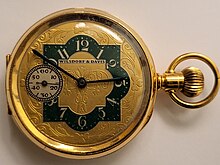
A clock near the Congressional Country Club manufactured by RolexA Wilsdorf & Davis pocket watch. Wilsdorf & Davis was the precursor to what would become Rolex
Alfred Davis and his brother-in-law Hans Wilsdorf founded Wilsdorf and Davis, the company that would eventually become Rolex SA, in London in 1905.[15] Wilsdorf and Davis's main commercial activity at the time involved importing Hermann Aegler's Swiss movements to England and placing them in watch cases made by Dennison and others. These early wristwatches were sold to many jewellers, who then put their own names on the dial. The earliest watches from Wilsdorf and Davis were usually hallmarked "W&D" inside the caseback.
In 1908, Wilsdorf registered the trademark "Rolex", which became the brand name of watches from Wilsdorf and Davis. He opened an office in La Chaux-de-Fonds, Switzerland.[5][15][16] Wilsdorf wanted the brand name to be easily pronounceable in any language, and short enough to fit on the face of a watch.[4][17] He also thought that the name "Rolex" was onomatopoeic, sounding like a watch being wound.[4][17]
During World War I, Rolex manufactured trench watches.[18][better source needed] In November 1915, the company changed its name to Rolex Watch Co. Ltd.[7] In 1919, Hans Wilsdorf moved the company from England to Geneva, Switzerland, because of heavy post-war taxes levied on luxury imports and high export duties on the silver and gold used for the watch cases. In 1919 the company's name was officially changed to Montres Rolex SA and later in 1920 to Rolex SA.[9][11][15]
With administrative worries attended to, Wilsdorf turned the company's attention to a marketing challenge: the infiltration of dust and moisture under the dial and crown, which damaged the movement. To address this problem, in 1926 a third-party casemaker produced a waterproof and dustproof wristwatch for Rolex, giving it the name "Oyster". The original patent attributed to Paul Perregaux and Georges Peret, that allowed the watch to be adjusted while maintaining protection from water ingress was purchased by Rolex and heavily marketed.[19] The watch featured a hermetically sealed case which provided optimal protection for the movement.[20]
As a demonstration, Rolex submerged Oyster models in aquariums, which it displayed in the windows of its main points of sale. In 1927, British swimmer Mercedes Gleitze swam the English Channel with an Oyster on her necklace, becoming the first Rolex ambassador. To celebrate the feat, Rolex published a full-page advertisement on the front page of the Daily Mail for every issue for a whole month proclaiming the watch's success during the ten-hour-plus swim.[20]
In 1931, Rolex patented a self-winding mechanism called a Perpetual rotor, a semi-circular plate that relies on gravity to move freely. In turn, the Oyster watch became known as the Oyster Perpetual.[20]
Upon the death of his wife in 1944, Wilsdorf established the Hans Wilsdorf Foundation, a private trust, in which he left all of his Rolex shares, ensuring that some of the company's income would go to charity. Wilsdorf died in 1960, and since then the trust has owned and run Rolex SA.[11]
The Hans Wilsdorf Foundation, which privately owns Rolex SA, is a registered Swiss charitable foundation and pays a lower tax rate.[21] In 2011, a spokesman for Rolex declined to provide evidence regarding the amount of charitable donations made by the Wilsdorf Foundation, which brought up several scandals due to the lack of transparency.[21] In Geneva where the company is based, it is said to have gifted, among many things, two housing buildings to social institutions of Geneva.[22]
Rolex SA offers products under the Rolex and Tudor brands. Montres Tudor SA has designed, manufactured and marketed Tudor watches since 6 March 1946.[23] Rolex founder Hans Wilsdorf conceived Tudor to create a product for authorized Rolex dealers to sell that offered the reliability and dependability of a Rolex, but at a lower price.[24] The number of Rolex watches was limited by the rate that they could produce in-house Rolex movements, thus Tudor watches were originally equipped with third-party standard movements supplied by ETA SA while using Rolex-quality cases and bracelets.[25] Since 2015, Tudor has begun to manufacture watches with in-house movements. The first model introduced with an in-house movement was the Tudor North Flag. Following this, updated versions of the Tudor Pelagos and Tudor Heritage Black Bay have also been fitted with an in-house caliber.[25][26]
Tudor watches are marketed and sold in most countries around the world. Montres Tudor SA discontinued sales of Tudor-branded watches in the United States in 2004, but Tudor returned to the United States market in the summer of 2013, and to the UK in 2014.[27][28]
Each Rolex comes with a unique serial number, which can help indicate its approximate production period. Serial numbers were first introduced in 1926 and were issued sequentially, until 1954, when Rolex restarted from #999,999 to #0. In 1987, there was an addition of one letter to a 6-digit serial number and in 2010, to the present date Rolex introduced random serial numbers.[29][30]
While Rolex mostly produces mechanical watches, it also participated in development of the original quartz watch movements. Although Rolex has made very few quartz models for its Oyster line, the company's engineers were instrumental in design and implementation of the technology during the late 1960s and early 1970s. In 1968, Rolex collaborated with a consortium of 16 Swiss watch manufacturers to develop the Beta 21 quartz movement used in their Rolex Quartz Date 5100 alongside other manufactures including the Omega Electroquartz watches.[31] Within about five years of research, design and development, Rolex created the "clean-slate" 5035/5055 movement that would eventually power the Rolex Oysterquartz.[32]
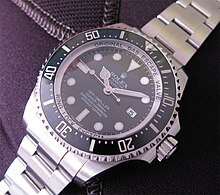
Material-wise, Rolex first used its "Cerachrom" ceramic bezel on the GMT-Master II in 2005, and has since then implemented ceramic bezel inserts across the range of professional sports watches. They are available on the Submariner, Sea Dweller, Deepsea, GMT Master II and Daytona models. In contrast to the aluminium bezel which it replaced, the ceramic bezel color does not wear out from exposure to UV-light and is scratch resistant.[33]
Rolex uses 904L grade stainless steel; in contrast, most Swiss watches are made with 316L grade steel. Rolex uses the higher grade, as it is more resistant to corrosion and when polished, leaves a more attractive lustre.[33]
In general, Rolex has three watch lines: Oyster Perpetual, Professional and Cellini (the Cellini line is Rolex's line of "dress" watches). The primary bracelets for the Oyster line are named Jubilee, Oyster, President, and Pearlmaster. The watch straps on the models are usually either stainless steel, yellow gold, white gold, or rose gold. In the United Kingdom, the retail price for the stainless steel 'Pilots' range (such as the GMT Master II) starts from £5,600. Diamond inlay watches are more expensive. The book Vintage Wristwatches by Antiques Roadshow's Reyne Haines listed a price estimate of vintage Rolex watches that ranged between US$650 and US$75,000, while listing vintage Tudors between US$250 and US$9,000.[34]
Rolex founder Hans Wilsdorf created the Air-Prince line to honor RAF pilots of the Battle of Britain, releasing the first model in 1958. By 2007, the 1142XX iteration of the Air-King featured a COSC-certified movement in a 34mm case, considered by some a miniaturized variant of the 39mm Rolex Explorer as both watches featured very similar styling cues; the 34mm Air-King lineup was the least expensive series of Oyster Perpetual. In 2014 the Air-King was dropped, making the Oyster Perpetual 26/31/34/36/39 the entry-level Rolex line. In 2016 Rolex reintroduced the Air-King, available as a single model (number 116900), largely similar to its predecessors but with a larger 40mm case, and a magnetic shield found on the Rolex Milgauss; indeed the new 40mm Air-King is slightly cheaper than the 39mm Explorer (the Explorer lacks the magnetic shield but its movement has Paraflex shock absorbers that are not found in the Air-King's movement).[35][36][37][38][39]
The name of the watch line in catalogs is often "Rolex Oyster ______" or "Rolex Oyster Perpetual ______"; Rolex Oyster and Oyster Perpetual are generic names and not specific product lines, except for the Oyster Perpetual 26/31/34/36/39/41 and Oyster Perpetual Date 34. The Rolex Oyster Perpetual watch is a direct descendant of the original watertight Rolex Oyster watch created in 1926.
Within the Oyster Perpetual lineup, there are three different movements; the 39 features the Calibre 3132 movement with the Parachrom hairspring and Paraflex shock absorbers (the Oyster Perpetual 39 is a variant of the Rolex Explorer 39mm, sharing the same case, bracelet and clasp, bezel, and movement, with a different dial and different hands), while the 34 and 36 models have the Caliber 3130 featuring the Parachrom hairspring, and the smallest 28 and 31 models have Calibre 2231.[40] The Oyster Perpetual Date 34 (or simply Date 34) adds a date display and date movement, plus the options of a white gold fluted bezel and diamonds on the dial.
Certain models from the Date and Datejust ranges are almost identical, however the Datejust have 36 mm and 41 mm cases paired with a 20 mm bracelet, compared with the Date's 34 mm case and 19 mm bracelet. Modern versions of the Oyster Perpetual Date and Datejust models share Rolex's 3135 movement, with the most recent change to the 3135 movement being introduction of Rolex's "parachrom bleu" hairspring, which provides increased accuracy. As the Date and Datejust share a movement, both have the ability to adjust the date forward one day at a time without adjusting the time; this feature is not confined to the Datejust. Compared with the Date, the Datejust has a much wider range of customization options, including other metals beyond stainless steel, various materials for the dial, and optional diamonds on the dial and bezel. The Datejust II, which was released in 2009, has a bigger case (41mm diameter) than the standard Datejust and features an updated movement, being only available in steel with white, yellow or rose gold on an Oyster bracelet.[41] In 2016, Rolex released the Datejust 41, which has the same 41mm diameter case as the Datejust II, however the Datejust 41 has smaller indexes and a thinner bezel compared to the Datejust II
The Explorer (1953) and Explorer II (1971) were developed specifically for explorers who would navigate rough terrain, such as the world-famous Mount Everest expeditions. Indeed, the Rolex Explorer was launched to celebrate the successful ascent of Everest in 1953 by the expeditionary team led by Sir John Hunt. (That expedition was supplied with watches from both Rolex and Smiths; it was a Smiths watch, rather than a Rolex, which Sir Edmund wore to the summit.)[43]
The 39 mm Rolex Explorer was designed as a "tool watch" for rugged use, hence its movement has Paraflex shock absorbers which give them higher shock resistance than other Rolex watches.[39] The 42mm Rolex Explorer II has some significant differences from the 39mm Explorer; the Explorer II adds a date function, and an orange 24-hour hand which is paired with the fixed bezel's black 24-hour markers[44] for situations underground or around the poles where day cannot be distinguished from night.
Another iconic model is the Rolex GMT Master (1955), originally developed at the request of Pan Am Airways to provide its crews with a dual-time watch that could be used to display local time and GMT (Greenwich Mean Time), which was the international time standard for aviation at that time (and still is in its modern variant of Universal Time Coordinated (UTC) or Zulu Time) and was needed for astronavigation (celestial navigation) during longer flights.[11]
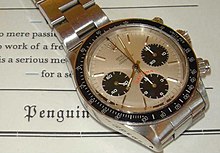
On 26 October 2017....., a Rolex Daytona (Ref. 6239) wristwatch, manufactured in 1968, was sold by Phillips in its New York auction for US$17.75 million.[45][46][47] The watch was originally purchased by Joanne Woodward in 1968 and was given by Joanne to her husband Paul Newman as a gift.[48] The auction price set a record at $15.5 million, plus buyer's premium of 12.5%, for a final price of $17,752,500 in New York City.[49] As of 2018, it is the most expensive wristwatch and the second most expensive watch ever sold at auction.[47][50][51] Notably, "[a]t the time that Newman gave the watch to James Cox [as a gift], the watch was selling for about $200."[52][53]
On 28 May 2018, a Rolex Daytona "Unicorn" Ref. 6265 was sold in auction by Phillips for US$5.937 million in Geneva, making it the second most expensive Rolex timepiece ever sold at auction (as of 2018).[54][55]
The most expensive Rolex (in terms of retail price) ever produced by the Rolex factory was the GMT Ice reference 116769TBR with a retail price of US$485,350.[56]
Jacques Piccard and Don Walsh had a specially designed experimental Rolex Oyster Perpetual Deep-Sea Special strapped to the outside of their bathyscaphe during the 1960 Challenger Deep dive to a world-record depth of 10,916 metres (35,814 ft).[62] When James Cameron conducted a similar dive in 2012, a specially designed and manufactured Rolex Oyster Perpetual Sea-Dweller Deep Sea Challenge watch was being "worn" by his submarine's robotic arm.[63]
Mercedes Gleitze was the first British woman to swim the English Channel on 7 October 1927. However, as John E. Brozek (author of The Rolex Report: An Unauthorized Reference Book for the Rolex Enthusiast) points out in his article "The Vindication Swim, Mercedes Gleitze and Rolex take the plunge", some doubts were cast on her achievement when a hoaxer claimed to have made a faster swim only four days later. Hence Gleitze attempted a repeat swim with extensive publicity on 21 October, dubbed the "Vindication Swim". For promotional purposes, Wilsdorf offered her one of the earliest Rolex Oysters if she would wear it during the attempt. After more than 10 hours, in water that was much colder than during her first swim, she was pulled from the sea semi-conscious seven miles short of her goal. Although she did not complete the second crossing, a journalist for The Times wrote, "Having regard to the general conditions, the endurance of Miss Gleitze surprised the doctors, journalists and experts who were present, for it seemed unlikely that she would be able to withstand the cold for so long. It was a good performance." As she sat in the boat, the same journalist made a discovery and reported it as follows: "Hanging round her neck by a ribbon on this swim, Miss Gleitze carried a small gold watch, which was found this evening to have kept good time throughout." When examined closely, the watch was found to be dry inside and in perfect condition. One month later, on 24 November 1927, Wilsdorf launched the Rolex Oyster watch in the United Kingdom with a full front page Rolex advertisement in the Daily Mail.
Among the company's notable improvements and innovations are:
In 1926, Rolex produced the Oyster case. While they claim this was the first reliable waterproof wristwatch case based on a screw-down crown it was not; Depollier's case was patented 8 years earlier.[64] To this end, Rolex acquired the Perragaux-Perret screw-down patent, added a clutch and combined the screw-down crown with a threaded case back and bezel.[65] Wilsdorf even had a specially made Rolex watch (the watch was called the "DeepSea") attached to the side of Trieste, which went to the bottom of the Mariana Trench. The watch survived and tested as having kept perfect time during its descent and ascent. This was confirmed by a telegram sent to Rolex the following day saying "Am happy to confirm that even at 11,000 metres your watch is as precise as on the surface. Best regards, Jacques Piccard".[11] Earlier waterproof watches such as the "Submarine Watch" by Tavannes used other means to seal the case.
In 1910, the first watchmaker to earn chronometer certification for a small lady wristwatch.[11]
In 1931, released a wristwatch winding mechanism featuring a rotor, a full 360 degrees rotating weight to power the watch by the movement of the wearer's arm.[66] As well as making watch winding unnecessary, it also kept the power from the mainspring more consistent, resulting in more reliable timekeeping. Fully rotating weights later became part of the standard winding mechanism of self-winding wristwatches. A preceding self-winding mechanism by Harwood instead used a weight that moved in a 270 degrees arc hitting buffer springs on both sides.[67]
In 1945, introduced the first chronometer wristwatch with an automatically changing date on the dial (Rolex Datejust Ref. 4467).[17] An earlier wristwatch with a date changing mechanism by Mimo was not chronometer certified.
In 1953, released a case waterproof to 100 m (330 ft) in the Rolex Oyster Perpetual Submariner Ref. 6204. Although this has been commonly publicized as the first diving watch, in 1932 Omega had released the Marine, which could stand 135mts, 35mts more than the 1953 Rolex Submariner. Blancpain produced their Fifty Fathoms watch in 1953, 10 months before the Rolex Submariner.[68]
In 1954, produced a wristwatch which showed two time zones at once in the Rolex GMT Master ref. 6542.[69] Yet again, it was not the first company to do so, as the Longines DualTime preceded the GMT by a full quarter of a century.[70]
In 1956, Rolex made a wristwatch with an automatically changing day and date on the dial in the Rolex Day-Date.[71]
By the start of World War II, Royal Air Force pilots were buying Rolex watches to replace their inferior standard-issue watches; however, when captured and sent to prisoner of war (POW) camps, their watches were confiscated.[17] When Hans Wilsdorf heard of this, he offered to replace all watches that had been confiscated and not require payment until the end of the war, if the officers would write to Rolex and explain the circumstances of their loss and where they were being held. Wilsdorf was in personal charge of the scheme.[72][73] As a result of this, an estimated 3,000 Rolex watches were ordered by British officers in the officer camp Oflag VII-B in Bavaria alone.[72] This had the effect of raising the morale among the allied POWs because it indicated that Wilsdorf did not believe that the Axis powers would win the war.[72][74] American servicemen heard about this when stationed in Europe during WWII and this helped open up the American market to Rolex after the war.[17]
On 10 March 1943, while still a prisoner of war, Corporal Clive James Nutting, one of the organizers of the Great Escape, ordered a stainless steel Rolex Oyster 3525 Chronograph (valued at a current equivalent of £1,200) by mail directly from Hans Wilsdorf in Geneva, intending to pay for it with money he saved working as a shoemaker at the camp.[72][74][75] The watch (Rolex watch no. 185983)[75][76] was delivered to Stalag Luft III on 10 July that year along with a note from Wilsdorf apologising for any delay in processing the order and explaining that an English gentleman such as Corporal Nutting "should not even think" about paying for the watch before the end of the war.[72][74] Wilsdorf is reported to have been impressed with Nutting because, although not an officer, he had ordered the expensive Rolex 3525 Oyster chronograph while most other prisoners ordered the much cheaper Rolex Speed King model which was popular because of its small size.[72] The watch is believed to have been ordered specifically to be used in the Great Escape when, as a chronograph, it could have been used to time patrols of prison guards or time the 76 ill-fated escapees through tunnel 'Harry' on 24 March 1944.[72][74][77] Eventually, after the war, Nutting was sent an invoice of only £15 for the watch, because of currency export controls in England at the time.[74] The watch and associated correspondence between Wilsdorf and Nutting were sold at an auction for £66,000 in May 2007, while at an earlier auction in September 2006 the same watch fetched A$54,000.[74][76] Nutting served as a consultant for both the 1950 film The Wooden Horse and the 1963 film The Great Escape.[72]
In a famous murder case, the Rolex on Ronald Platt's wrist eventually led to the arrest of his murderer,
Graffiti (plural; singular graffiti or graffito, the latter rarely used except in archeology) is art that is written, painted or drawn on a wall or other surface, usually without permission and within public view.[1][2] Graffiti ranges from simple written "monikers" to elaborate wall paintings, and has existed since ancient times, with examples dating back to ancient Egypt, ancient Greece, and the Roman Empire (see also mural).[3]
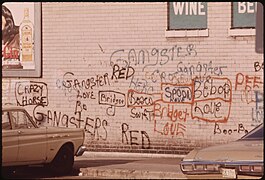
Graffiti is a controversial subject. In most countries, marking or painting property without permission is considered by property owners and civic authorities as defacement and vandalism, which is a punishable crime, citing the use of graffiti by street gangs to mark territory or to serve as an indicator of gang-related activities.[4] Graffiti has become visualized as a growing urban "problem" for many cities in industrialized nations, spreading from the New York City subway system and Philadelphia in the early 1970s to the rest of the United States and Europe and other world regions.[5]
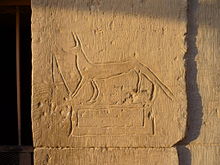
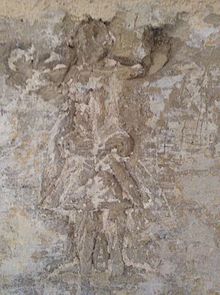
"Graffiti" (usually both singular and plural) and the rare singular form "graffito" are from the Italian word graffiato ("scratched").[6][1][2] The term "graffiti" is used in art history for works of art produced by scratching a design into a surface. A related term is "sgraffito",[7] which involves scratching through one layer of pigment to reveal another beneath it. This technique was primarily used by potters who would glaze their wares and then scratch a design into them. In ancient times graffiti were carved on walls with a sharp object, although sometimes chalk or coal were used. The word originates from Greek γράφειν—graphein—meaning "to write".[8]
The term graffiti originally referred to the inscriptions, figure drawings, and such, found on the walls of ancient sepulchres or ruins, as in the Catacombs of Rome or at Pompeii. Historically, these writings were not considered vandalism,[9] which today is considered part of the definition of graffiti.[10]
The only known source of the Safaitic language, an ancient form of Arabic, is from graffiti: inscriptions scratched on to the surface of rocks and boulders in the predominantly basalt desert of southern Syria, eastern Jordan and northern Saudi Arabia. Safaitic dates from the first century BC to the fourth century AD.[11][12]
Some of the oldest cave paintings in the world are 40,000 year old ones found in Australia.[9] The oldest written graffiti was found in ancient Rome around 2500 years ago.[13] Most graffiti from the time was boasts about sexual experiences.[14] Graffiti in Ancient Rome was a form of communication, and was not considered vandalism.[9]
Ancient tourists visiting the 5th-century citadel at Sigiriya in Sri Lanka write their names and commentary over the "mirror wall", adding up to over 1800 individual graffiti produced there between the 6th and 18th centuries.[15] Most of the graffiti refer to the frescoes of semi-nude females found there. One reads:
Wet with cool dew drops
fragrant with perfume from the flowers
came the gentle breeze
jasmine and water lily
dance in the spring sunshine
side-long glances
of the golden-hued ladies
stab into my thoughts
heaven itself cannot take my mind
as it has been captivated by one lass
among the five hundred I have seen here.[16]
Among the ancient political graffiti examples were Arab satirist poems. Yazid al-Himyari, an Umayyad Arab and Persian poet, was most known for writing his political poetry on the walls between Sajistan and Basra, manifesting a strong hatred towards the Umayyad regime and its walis, and people used to read and circulate them very widely.[17][clarification needed]
The oldest known example of graffiti monikers found on traincars created by hobos and railworkers since the late 1800s. The Bozo Texino monikers were documented by filmmaker Bill Daniel in his 2005 film, Who is Bozo Texino?.[24][25]
In World War II, an inscription on a wall at the fortress of Verdun was seen as an illustration of the US response twice in a generation to the wrongs of the Old World:[26][27]
Austin White – Chicago, Ill – 1918
Austin White – Chicago, Ill – 1945
This is the last time I want to write my name here.
During World War II and for decades after, the phrase "Kilroy was here" with an accompanying illustration was widespread throughout the world, due to its use by American troops and ultimately filtering into American popular culture. Shortly after the death of Charlie Parker (nicknamed "Yardbird" or "Bird"), graffiti began appearing around New York with the words "Bird Lives".[28]
World War II graffiti
Soldier with tropical fantasy graffiti (1943–1944)
Soviet Army graffiti in the ruins of the Reichstag, in Berlin (1945)
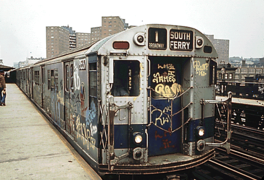
Modern graffiti art has its origins with young people in 1960s and 70s in New York City and Philadelphia. Tags were the first form of stylised contemporary graffiti. Eventually, throw-ups and pieces evolved with the desire to create larger art. Writers used spray paint and other kind of materials to leave tags or to create images on the sides subway trains.[29] and eventually moved into the city after the NYC metro began to buy new trains and paint over graffiti.[30]
While the art had many advocates and appreciators—including the cultural critic Norman Mailer—others, including New York City mayor Ed Koch, considered it to be defacement of public property, and saw it as a form of public blight.[31] The ‘taggers’ called what they did ‘writing’—though an important 1974 essay by Mailer referred to it using the term ‘graffiti.’[31]
Contemporary graffiti style has been heavily influenced by hip hop culture[32] and the myriad international styles derived from Philadelphia and New York City Subway graffiti; however, there are many other traditions of notable graffiti in the twentieth century. Graffiti have long appeared on building walls, in latrines, railroad boxcars, subways, and bridges.
An early graffito outside of New York or Philadelphia was the inscription in London reading "Clapton is God" in reference to the guitarist Eric Clapton. Creating the cult of the guitar hero, the phrase was spray-painted by an admirer on a wall in Islington, north London, in the autumn of 1967.[33] The graffito was captured in a photograph, in which a dog is urinating on the wall.[34]
Films like Style Wars in the 80s depicting famous writers such as Skeme, Dondi, MinOne, and ZEPHYR reinforced graffiti's role within New York's emerging hip-hop culture. Although many officers of the New York City Police Department found this film to be controversial, Style Wars is still recognized as the most prolific film representation of what was going on within the young hip hop culture of the early 1980s.[35] Fab5 Freddy and Futura 2000 took hip hop graffiti to Paris and London as part of the New York City Rap Tour in 1983.[36]
Commercialization and entrance into mainstream pop culture[edit]
With the popularity and legitimization of graffiti has come a level of commercialization. In 2001, computer giant IBM launched an advertising campaign in Chicago and San Francisco which involved people spray painting on sidewalks a peace symbol, a heart, and a penguin (Linux mascot), to represent "Peace, Love, and Linux." IBM paid Chicago and San Francisco collectively US$120,000 for punitive damages and clean-up costs.[37][38]
In 2005, a similar ad campaign was launched by Sony and executed by its advertising agency in New York, Chicago, Atlanta, Philadelphia, Los Angeles, and Miami, to market its handheld PSP gaming system. In this campaign, taking notice of the legal problems of the IBM campaign, Sony paid building owners for the rights to paint on their buildings "a collection of dizzy-eyed urban kids playing with the PSP as if it were a skateboard, a paddle, or a rocking horse".[38]
Tristan Manco wrote that Brazil "boasts a unique and particularly rich, graffiti scene ... [earning] it an international reputation as the place to go for artistic inspiration". Graffiti "flourishes in every conceivable space in Brazil's cities". Artistic parallels "are often drawn between the energy of São Paulo today and 1970s New York". The "sprawling metropolis", of São Paulo has "become the new shrine to graffiti"; Manco alludes to "poverty and unemployment ... [and] the epic struggles and conditions of the country's marginalised peoples", and to "Brazil's chronic poverty", as the main engines that "have fuelled a vibrant graffiti culture". In world terms, Brazil has "one of the most uneven distributions of income. Laws and taxes change frequently". Such factors, Manco argues, contribute to a very fluid society, riven with those economic divisions and social tensions that underpin and feed the "folkloric vandalism and an urban sport for the disenfranchised", that is South American graffiti art.[39]
A graffiti piece by the artist DeDe found in Tel Aviv
Prominent Brazilian writers include Os Gêmeos, Boleta, Nunca, Nina, Speto, Tikka, and T.Freak.[40] Their artistic success and involvement in commercial design ventures[41] has highlighted divisions within the Brazilian graffiti community between adherents of the cruder transgressive form of pichação and the more conventionally artistic values of the practitioners of grafite.[42]
Graffiti in the Middle East has emerged slowly, with taggers operating in Egypt, Lebanon, the Gulf countries like Bahrain or the United Arab Emirates,[43]Israel, and in Iran. The major Iranian newspaper Hamshahri has published two articles on illegal writers in the city with photographic coverage of Iranian artist A1one's works on Tehran walls. Tokyo-based design magazine, PingMag, has interviewed A1one and featured photographs of his work.[44] The Israeli West Bank barrier has become a site for graffiti, reminiscent in this sense of the Berlin Wall. Many writers in Israel come from other places around the globe, such as JUIF from Los Angeles and DEVIONE from London. The religious reference "נ נח נחמ נחמן מאומן" ("Na Nach Nachma Nachman Meuman") is commonly seen in graffiti around Israel.
Graffiti has played an important role within the street art scene in the Middle East and North Africa (MENA), especially following the events of the Arab Spring of 2011 or the Sudanese Revolution of 2018/19.[45] Graffiti is a tool of expression in the context of conflict in the region, allowing people to raise their voices politically and socially. Famous street artist Banksy has had an important effect in the street art scene in the MENA area, especially in Palestine where some of his works are located in the West Bank barrier and Bethlehem.[46]
There are also a large number of graffiti influences in Southeast Asian countries that mostly come from modern Western culture, such as Malaysia, where graffiti have long been a common sight in Malaysia's capital city, Kuala Lumpur. Since 2010, the country has begun hosting a street festival to encourage all generations and people from all walks of life to enjoy and encourage Malaysian street culture.[47]
This program unpacks Playstation 3 Theme files (.p3t) so that you can touch-up an existing theme to your likings or use a certain wallpaper from it (as many themes have multiple). But remember, if you use content from another theme and release it, be sure to give credit!
Download p3textractor.zip from above. Extract the files to a folder with a program such as WinZip or WinRAR. Now there are multiple ways to extract the theme.
The first way is to simply open the p3t file with p3textractor.exe. If you don’t know how to do this, right click the p3t file and select Open With. Alternatively, open the p3t file and it will ask you to select a program to open with. Click Browse and find p3textractor.exe from where you previously extracted it to. It will open CMD and extract the theme to extracted.[filename]. After that, all you need to do for any future p3t files is open them and it will extract.
The second way is very simple. Just drag the p3t file to p3textractor.exe. It will open CMD and extract the theme to extracted.[filename].
For the third way, first put the p3t file you want to extract into the same folder as p3textractor.exe. Open CMD and browse to the folder with p3extractor.exe. Enter the following: p3textractor filename.p3t [destination path]Replace filename with the name of the p3t file, and replace [destination path] with the name of the folder you want the files to be extracted to. A destination path is not required. By default it will extract to extracted.filename.
This program unpacks Playstation 3 Theme files (.p3t) so that you can touch-up an existing theme to your likings or use a certain wallpaper from it (as many themes have multiple). But remember, if you use content from another theme and release it, be sure to give credit!
Download p3textractor.zip from above. Extract the files to a folder with a program such as WinZip or WinRAR. Now there are multiple ways to extract the theme.
The first way is to simply open the p3t file with p3textractor.exe. If you don’t know how to do this, right click the p3t file and select Open With. Alternatively, open the p3t file and it will ask you to select a program to open with. Click Browse and find p3textractor.exe from where you previously extracted it to. It will open CMD and extract the theme to extracted.[filename]. After that, all you need to do for any future p3t files is open them and it will extract.
The second way is very simple. Just drag the p3t file to p3textractor.exe. It will open CMD and extract the theme to extracted.[filename].
For the third way, first put the p3t file you want to extract into the same folder as p3textractor.exe. Open CMD and browse to the folder with p3extractor.exe. Enter the following: p3textractor filename.p3t [destination path]Replace filename with the name of the p3t file, and replace [destination path] with the name of the folder you want the files to be extracted to. A destination path is not required. By default it will extract to extracted.filename.