Brotherhood of Death

Brotherhood of Death theme by Thornatos

Download: BrotherhoodOfDeath.p3t
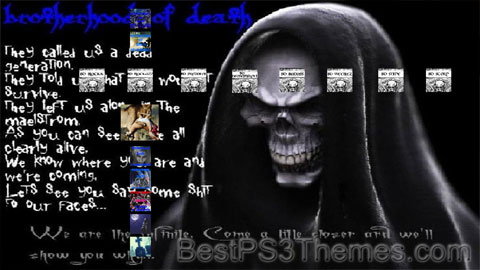
Brotherhood of Death Theme
(3 backgrounds, wallpapers SD only)

Brotherhood of Death
Directed byRichard F. Barker and Bill Berry
Produced byRonald K. Goldman
StarringRoy Jefferson
Le Tari
Haskell Anderson
Release date
  • 1976 (1976)
Running time
78 minutes
CountryUnited States
LanguageEnglish
Budget$200,000-$250,000 USD

Brotherhood of Death is a low-budget 1976 action film in the blaxploitation genre, directed by Richard F. Barker and Bill Berry, and starring Roy Jefferson, Le Tari, and Haskell Anderson. The film featured appearances by several members, including Jefferson, of the Washington Redskins professional football team of the National Football League.

Plot[edit]

In the mid-to-late 1960s, three young men leave their small Southern hometown to join the United States Army and fight in the Vietnam War. Upon their return home, they take up the cause of battling the racial injustices prevalent in the town. When the town's Ku Klux Klan members offer a murderously violent reaction to their efforts, the trio uses the lessons they learned in the army, fighting the Vietcong, to conduct an all-out war against the Klan.

Cast[edit]

  • Roy Jefferson as Raymond Moffat
  • Le Tari as Ned Tiese
  • Haskell Anderson as Junior Moffat
  • Mike Thomas as Newton "Newt" Biggars
  • Mick Hodge as "Ace"
  • Ron David as Leroy Winniford
  • Rick Ellis as Harold Turner
  • Brian Donohue as Deputy Myrick
  • Ed Heath as Preacher
  • Mike Bass as Captain Quinn
  • Bryan Clark as Sheriff
  • Kandy Hooker as Louise Freeman
  • Mark Robinson as Dope Dealer Soldier
  • Vacountess E. Payne as Rose
  • Jon Feather as Army Instructor
  • Holly Hjretberg as Leroy's Girlfriend
  • Barbara Cherry as Raymond's Girlfriend

Production[edit]

The film was the brainchild of its executive producer, Ronald K. Goldman, a Washington, D.C. native and a veteran of blaxploitation film production. Guided by his previous experiences, Goldman devised a plan to make a film with a very low budget, to be produced entirely outside of the Hollywood establishment, and which he felt highly confident would still prove to be profitable.[1]

Specifically, Goldman had deemed the quality of the acting in blaxploitation films to be unimpressive, even in those films which had been financially successful. Reasoning that even untrained actors could provide performances of similar quality, Goldman leveraged the fact that he knew some members of the Washington Redskins football team and convinced them to appear in his film. He thus gained some marquee value from their sports celebrity status without having to pay the higher salaries that would have been required to employ experienced actors who would have generated a similar level of public interest.[1]

Knights of the Ku Klux Klan (KKKK) billboard shown in Brotherhood of Death

Goldman saved additional money by hiring a first-time director and having nearly the entire film shot in Montgomery County, near Washington.[1] One exception was an actual Ku Klux Klan recruitment highway billboard which was featured in the film, suggesting the level of the Klan's support and influence in the town depicted in the movie. Such billboards were a relatively common sight in the South during the mid-1960s time period that served as the film's setting. However, by the time of filming in 1976, the majority of them had been removed. The billboard that was ultimately used in the movie (shown right) was filmed at its location on U.S. Route 70 at the city limits of Smithfield, North Carolina. The sign was maintained there until the late 1970s, making Smithfield one of the last towns that the filmmakers could have found which continued to have such a sign displayed.[2][3][4]

The bar sequences were filmed at the Disabled American Veterans, Chapter #7 club house, located on Maryland Route 197 in Bowie, Maryland under the leadership of John "Jack" Federici, who appeared in the film with several other disabled war veterans.[citation needed]

Reception[edit]

According to Goldman, his financial strategy of pursuing a very low budget succeeded in ensuring the profitability of Brotherhood of Death. Goldman reported that the film brought in approximately $1 million USD, after having been made at a cost of between $200,000 and $250,000.[1] Nonetheless, the film was widely panned by critics, did not find a lasting place in the public consciousness, and became one of the essentially forgotten entries of the blaxploitation film era.[1]

Among those who liked the film, however, was director Quentin Tarantino, and he would eventually give the film a renewed exposure. Tarantino has twice screened Brotherhood of Death at the Quentin Tarantino Film Festival, and the news of his advocacy of the film was among the factors that led to the decision to release it on DVD in 2005.[1] Since then, it has aired numerous times on the Independent Film Channel (IFC) cable television network, with IFC's Matt Singer having expressed admiration for the movie.[5]

Misidentification of the cast[edit]

The liner notes in the DVD release of Brotherhood of Death incorrectly ascribe Tari's and Anderson's leading roles to Redskins players Mike Bass and Mike Thomas. Although Bass and Thomas were among the football players who appeared in the film, Jefferson was the only one of the three leading actors who was a Redskins player. Some reviewers, such as online film critic Harry Knowles, have similarly misidentified Redskins receiver Larry Jones as one of the three leading actors.[6] In keeping with Goldman's plan to utilize the players' marquee value as famed sports stars, the film's one-sheet and other promotional materials featured the football players — even those with smaller roles — over unknown leading actors Tari and Anderson, perhaps contributing to the later misconceptions.[7][8] In more recent years, Brotherhood of Death was made available as a dual release DVD with Fred Williamson's One Down, Two to Go. Due to misleading crediting of the films on this release, the lead role in Brotherhood of Death was attributed to Fred Williamson, who in fact had no involvement in the feature.

References[edit]

  1. ^ a b c d e f McKenna, Dave. (2005, March 4–10). "The Bad, the Bad, and the Ugly", Washington City Paper
  2. ^ Locke, Mandy. (2006, October 5). "Judge to address swindling claim[permanent dead link]", The News & Observer
    "Ethridge began working in Smithfield in the mid-1970s, one of two lawyers who were the first blacks to set up a practice in Johnston County. In those days, a billboard greeted people driving into town on U.S. 70 with the words 'The KKKK welcomes you to Smithfield'"
  3. ^ Sims, Patsy. The Klan, Chapter 3, (New York: Stein and Day, 1978). ISBN 978-0-8128-2268-7
    "Only half the sign was left ... Before earlier high winds ripped it apart the billboard had proclaimed: THIS IS KLAN COUNTRY. The remnant was a faded reminder of a time in the mid-sixties when North Carolina was referred to as 'Klansville, U.S.A.' ... Similar billboards encouraging motorists to JOIN & SUPPORT UNITED KLANS OF AMERICA INC. became as commonplace as Chamber of Commerce and Rotary Club greetings ... Now most of the billboards had disappeared from the highways, ... There was [still] a sign farther up Route 70, next to the Smithfield city limits; another outside Goldsboro on 117 North; and this ravaged one, southeast of Raleigh, near Princeton."
  4. ^ Associated Press. (1977, May 25)., "Smithfield Landmark, Klan Sign, Scheduled to Be Torn down" Times-News, Page 6
  5. ^ Singer, Matt. (2009, February). "Four Blaxploitation Films Off the Beaten Path", ifc.com
  6. ^ Knowles, Harry. (2001, August 24). "QT5 - Good Ol Boy Night (well not exactly) - DIXIE DYNAMITE and the amazing BROTHERHOOD OF DEATH", Ain't It Cool News
    "The three lead heroes Roy Jefferson, Mike Bass and Larry Jones of the Washington Redskins are absolutely charismatic as all hell in this flick."
  7. ^ Image of Brotherhood of Death movie one-sheet
  8. ^ Photocopied images of Brotherhood of Death promotional items

External links[edit]

lava55677’s Custom Theme

Custom theme by lava55677

Download: lava55677sCustomTheme.p3t

lava55677’s Custom Theme
(2 backgrounds)

P3T Unpacker v0.12
Copyright (c) 2007. Anoop Menon

This program unpacks Playstation 3 Theme files (.p3t) so that you can touch-up an existing theme to your likings or use a certain wallpaper from it (as many themes have multiple). But remember, if you use content from another theme and release it, be sure to give credit!

Download for Windows: p3textractor.zip

Instructions:

Download p3textractor.zip from above. Extract the files to a folder with a program such as WinZip or WinRAR. Now there are multiple ways to extract the theme.

The first way is to simply open the p3t file with p3textractor.exe. If you don’t know how to do this, right click the p3t file and select Open With. Alternatively, open the p3t file and it will ask you to select a program to open with. Click Browse and find p3textractor.exe from where you previously extracted it to. It will open CMD and extract the theme to extracted.[filename]. After that, all you need to do for any future p3t files is open them and it will extract.

The second way is very simple. Just drag the p3t file to p3textractor.exe. It will open CMD and extract the theme to extracted.[filename].

For the third way, first put the p3t file you want to extract into the same folder as p3textractor.exe. Open CMD and browse to the folder with p3extractor.exe. Enter the following:
p3textractor filename.p3t [destination path]Replace filename with the name of the p3t file, and replace [destination path] with the name of the folder you want the files to be extracted to. A destination path is not required. By default it will extract to extracted.filename.

KSA(02)

KSA(02) theme by Waleed Almalki

Download: KSA02.p3t

KSA(02) Theme
(4 backgrounds)

P3T Unpacker v0.12
Copyright (c) 2007. Anoop Menon

This program unpacks Playstation 3 Theme files (.p3t) so that you can touch-up an existing theme to your likings or use a certain wallpaper from it (as many themes have multiple). But remember, if you use content from another theme and release it, be sure to give credit!

Download for Windows: p3textractor.zip

Instructions:

Download p3textractor.zip from above. Extract the files to a folder with a program such as WinZip or WinRAR. Now there are multiple ways to extract the theme.

The first way is to simply open the p3t file with p3textractor.exe. If you don’t know how to do this, right click the p3t file and select Open With. Alternatively, open the p3t file and it will ask you to select a program to open with. Click Browse and find p3textractor.exe from where you previously extracted it to. It will open CMD and extract the theme to extracted.[filename]. After that, all you need to do for any future p3t files is open them and it will extract.

The second way is very simple. Just drag the p3t file to p3textractor.exe. It will open CMD and extract the theme to extracted.[filename].

For the third way, first put the p3t file you want to extract into the same folder as p3textractor.exe. Open CMD and browse to the folder with p3extractor.exe. Enter the following:
p3textractor filename.p3t [destination path]Replace filename with the name of the p3t file, and replace [destination path] with the name of the folder you want the files to be extracted to. A destination path is not required. By default it will extract to extracted.filename.

KSA(01)

KSA(01) theme by Waleed Almalki

Download: KSA01.p3t

KSA(01) Theme
(5 backgrounds)

P3T Unpacker v0.12
Copyright (c) 2007. Anoop Menon

This program unpacks Playstation 3 Theme files (.p3t) so that you can touch-up an existing theme to your likings or use a certain wallpaper from it (as many themes have multiple). But remember, if you use content from another theme and release it, be sure to give credit!

Download for Windows: p3textractor.zip

Instructions:

Download p3textractor.zip from above. Extract the files to a folder with a program such as WinZip or WinRAR. Now there are multiple ways to extract the theme.

The first way is to simply open the p3t file with p3textractor.exe. If you don’t know how to do this, right click the p3t file and select Open With. Alternatively, open the p3t file and it will ask you to select a program to open with. Click Browse and find p3textractor.exe from where you previously extracted it to. It will open CMD and extract the theme to extracted.[filename]. After that, all you need to do for any future p3t files is open them and it will extract.

The second way is very simple. Just drag the p3t file to p3textractor.exe. It will open CMD and extract the theme to extracted.[filename].

For the third way, first put the p3t file you want to extract into the same folder as p3textractor.exe. Open CMD and browse to the folder with p3extractor.exe. Enter the following:
p3textractor filename.p3t [destination path]Replace filename with the name of the p3t file, and replace [destination path] with the name of the folder you want the files to be extracted to. A destination path is not required. By default it will extract to extracted.filename.

Shadow

Shadow theme by J3ff

Download: Shadow.p3t

Shadow Theme
(1 background, background HD only)

Shadows of visitors to the Eiffel Tower, viewed from the first platform
Park fence shadow is distorted by an uneven snow surface.
Shadows from cumulus clouds thick enough to block sunlight

A shadow is a dark area where light from a light source is blocked by an object. It occupies all of the three-dimensional volume behind an object with light in front of it. The cross section of a shadow is a two-dimensional silhouette, or a reverse projection of the object blocking the light.

Point and non-point light sources[edit]

Umbra, penumbra and antumbra

A point source of light casts only a simple shadow, called an "umbra". For a non-point or "extended" source of light, the shadow is divided into the umbra, penumbra, and antumbra. The wider the light source, the more blurred the shadow becomes. If two penumbras overlap, the shadows appear to attract and merge. This is known as the shadow blister effect.

The outlines of the shadow zones can be found by tracing the rays of light emitted by the outermost regions of the extended light source. The umbra region does not receive any direct light from any part of the light source and is the darkest. A viewer located in the umbra region cannot directly see any part of the light source.

By contrast, the penumbra is illuminated by some parts of the light source, giving it an intermediate level of light intensity. A viewer located in the penumbra region will see the light source, but it is partially blocked by the object casting the shadow.

If there is more than one light source, there will be several shadows, with the overlapping parts darker, and various combinations of brightnesses or even colors. The more diffuse the lighting is, the softer and more indistinct the shadow outlines become until they disappear. The lighting of an overcast sky produces few visible shadows.

The absence of diffusing atmospheric effects in the vacuum of outer space produces shadows that are stark and sharply delineated by high-contrast boundaries between light and dark.

For a person or object touching the surface where the shadow is projected (e.g. a person standing on the ground, or a pole in the ground) the shadows converge at the point of contact.

A shadow shows, apart from distortion, the same image as the silhouette when looking at the object from the sun-side, hence the mirror image of the silhouette seen from the other side.

Astronomy[edit]

Three moons (Callisto, Europa and Io) and their shadows parade across Jupiter.[1]

The names umbra, penumbra and antumbra are often used for the shadows cast by astronomical objects, though they are sometimes used to describe levels of darkness, such as in sunspots. An astronomical object casts human-visible shadows when its apparent magnitude is equal or lower than -4.[2] The only astronomical objects able to project visible shadows onto Earth are the Sun, the Moon, and in the right conditions, Venus or Jupiter.[3][4] Night is caused by the hemisphere of a planet facing its orbital star blocking its sunlight.

A shadow cast by the Earth onto the Moon is a lunar eclipse. Conversely, a shadow cast by the Moon onto the Earth is a solar eclipse.[5]

Daytime variation[edit]

The sun casts shadows that change dramatically through the day. The length of a shadow cast on the ground is proportional to the cotangent of the sun's elevation angle—its angle θ relative to the horizon. Near sunrise and sunset, when θ = 0° and cot(θ) = ∞, shadows can be extremely long. If the sun passes directly overhead (only possible in locations between the Tropics of Cancer and Capricorn), then θ = 90°, cot(θ) = 0, and shadows are cast directly underneath objects.

Such variations have long aided travellers during their travels, especially in barren regions such as the Arabian Desert.[6]

Propagation speed[edit]

Steam phase eruption of Castle Geyser in Yellowstone National Park casts a shadow on its own steam. Crepuscular rays are also visible.

The farther the distance from the object blocking the light to the surface of projection, the larger the silhouette (they are considered proportional). Also, if the object is moving, the shadow cast by the object will project an image with dimensions (length) expanding proportionally faster than the object's own rate of movement. The increase of size and movement is also true if the distance between the object of interference and the light source are closer. This, however, does not mean the shadow may move faster than light, even when projected at vast distances, such as light years. The loss of light, which projects the shadow, will move towards the surface of projection at light speed.

Although the edge of a shadow appears to "move" along a wall, in actuality the increase of a shadow's length is part of a new projection that propagates at the speed of light from the object of interference. Since there is no actual communication between points in a shadow (except for reflection or interference of light, at the speed of light), a shadow that projects over a surface of large distances (light years) cannot convey information between those distances with the shadow's edge.[7]

Color[edit]

Visual artists are usually very aware of colored light emitted or reflected from several sources, which can generate complex multicolored shadows. Chiaroscuro, sfumato, and silhouette are examples of artistic techniques which make deliberate use of shadow effects.[8]

During the daytime, a shadow cast by an opaque object illuminated by sunlight has a bluish tinge. This happens because of Rayleigh scattering, the same property that causes the sky to appear blue. The opaque object is able to block the light of the sun, but not the ambient light of the sky which is blue as the atmosphere molecules scatter blue light more effectively. As a result, the shadow appears bluish.[9]

Dimension[edit]

Fog shadow of the south tower of the Golden Gate Bridge

A shadow occupies a three-dimensional volume of space, but this is usually not visible until it projects onto a reflective surface. A light fog, mist, or dust cloud can reveal the 3D presence of volumetric patterns in light and shadow.

Fog shadows may look odd to viewers who are not used to seeing shadows in three dimensions. A thin fog is just dense enough to be illuminated by the light that passes through the gaps in a structure or in a tree. As a result, the path of an object's shadow through the fog becomes visible as a darkened volume. In a sense, these shadow lanes are the inverse of crepuscular rays caused by beams of light, they're caused by the shadows of solid objects.

Theatrical fog and strong beams of light are sometimes used by lighting designers and visual artists who seek to highlight three-dimensional aspects of their work.

Inversion[edit]

Oftentimes shadows of chain-linked fences and other such objects become inverted (light and dark areas are swapped) as they get farther from the object. A chain-link fence shadow will start with light diamonds and shadow outlines when it is touching the fence, but it will gradually blur. Eventually, if the fence is tall enough, the light pattern will go to shadow diamonds and light outlines.

Photography[edit]

Moonlight shadow of a photographer

In photography, which is essentially recording patterns of light, shade, and color, "highlights" and "shadows" are the brightest and darkest parts, respectively, of a scene or image. Photographic exposure must be adjusted (unless special effects are wanted) to allow the film or sensor, which has limited dynamic range, to record detail in the highlights without them being washed out, and in the shadows without their becoming undifferentiated black areas.

On satellite imagery and aerial photographs, taken vertically, tall buildings can be recognized as such by their long shadows (if the photographs are not taken in the tropics around noon), while these also show more of the shape of these buildings.

Analogous concepts[edit]

Shadow as a term is often used for any occlusion or blockage, not just those with respect to light. For example, a rain shadow is a dry area, which with respect to the prevailing wind direction, is beyond a mountain range; the elevated terrain impedes rainclouds from entering the dry zone. An acoustic shadow occurs when a direct sound has been blocked or diverted around a given area.

Cultural aspects[edit]

Shadows often appear in mythical or cultural contexts. Sometimes in a malevolent light, other times not. An unattended shade was thought by some cultures to be similar to that of a ghost. The name for the fear of shadows is "sciophobia" or "sciaphobia".

Chhaya is the Hindu goddess of shadows.

In heraldry, when a charge is supposedly shown "in the shadow" (the appearance is of the charge merely being outlined in a neutral tint rather than being of one or more tinctures different from the field on which it is placed), it is technically described as "umbrated". Supposedly, only a limited number of specific charges can be so depicted.[citation needed]

Shadows are often linked with darkness and evil; in common folklore, like shadows who come to life, are often evil beings trying to control the people they reflect. The film Upside-Down Magic features an antagonistic shadow spirit who possesses people.

Ancient Egyptians surmised that a shadow, which they called šwt (shut), contains something of the person it represents because it is always present. Through this association, statues of people and deities were sometimes referred to as shadows.

In a commentary to The Egyptian Book of the Dead (BD), Egyptologist Ogden Goelet, Jr. discusses the forms of the shadow: "In many BD papyri and tombs the deceased is depicted emerging from the tomb by day in shadow form, a thin, black, featureless silhouette of a person. The person in this form is, as we would put it, a mere shadow of his former existence, yet nonetheless still existing. Another form the shadow assumes in the BD, especially in connection with gods, is an ostrich-feather sun-shade, an object which would create a shadow."[10]

Energy generating[edit]

Scientists from the National University of Singapore presented a shadow-effect energy generator (SEG), which consists of cells of gold deposited on a silicon wafer attached on a plastic film. The generator has a power density of 0.14 μW cm−2 under indoor conditions (0.001 sun).[11]

Gallery[edit]

See also[edit]

References[edit]

  1. ^ "March of the moons". Archived from the original on 28 July 2015. Retrieved 24 June 2015.
  2. ^ NASA Science Question of the Week. Gsfc.nasa.gov (7 April 2006). Retrieved on 26 April 2013.
  3. ^ "Young astronomer captures a shadow cast by Jupiter : Bad Astronomy". Blogs.discovermagazine.com. 18 November 2011. Archived from the original on 2 July 2013. Retrieved 27 May 2013.
  4. ^ Duncan, J. C. (1906). "Jupiter casting a Shadow". Popular Astronomy. 14: 123. Bibcode:1906PA.....14..123D. Retrieved 21 May 2024.
  5. ^ "Lunar Eclipse vs Solar Eclipse". www.moonconnection.com. Retrieved 27 November 2019.
  6. ^ The Edinburgh monthly review. 1820. p. 372.
  7. ^ Philip Gibbs (1997) Is Faster-Than-Light Travel or Communication Possible? Archived 10 March 2010 at the Wayback Machine math.ucr.edu
  8. ^ Maughan, William (14 August 2013). The Artist's Complete Guide to Drawing the Head. Clarkson Potter/Ten Speed. ISBN 978-0-7704-3473-1.
  9. ^ Question Board – Questions about Light. Pa.uky.edu. Retrieved on 26 April 2013.
  10. ^ Goelet, Ogden Jr. (1994). The Egyptian Book of the dead: the Book of going forth by day: being the Papyrus of Ani (royal scribe of the divine offerings), written and illustrated circa 1250 B.C.E., by scribes and artists unknown, including the balance of chapters of the books of the dead known as the Theban recension, compiled from ancient texts, dating back to the roots of Egyptian civilization (1st ed.). Chronicle Books. p. 152. ISBN 0811807673.
  11. ^ Qian Zhang; et al. (2020). "Energy harvesting from shadow-effect". Energy & Environmental Science. doi:10.1039/D0EE00825G.

External links[edit]