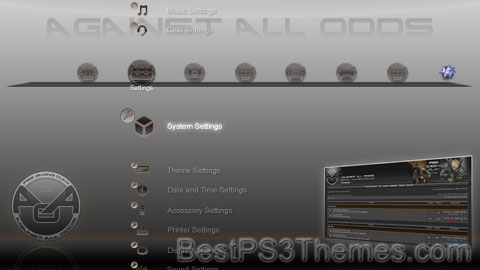
Matthew MC theme by matt20491
Download: MatthewMC.p3t
The #1 spot for Playstation themes!
MGS4-OTC theme by Kaine
Download: MGS4-OTC_2.p3t
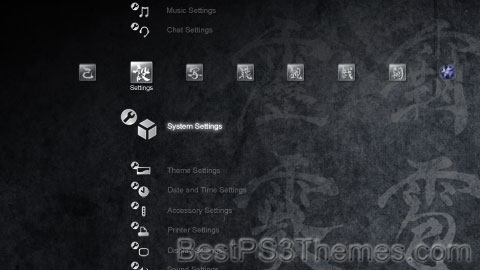
(4 backgrounds)
P3T Unpacker v0.12
Copyright (c) 2007. Anoop Menon
This program unpacks Playstation 3 Theme files (.p3t) so that you can touch-up an existing theme to your likings or use a certain wallpaper from it (as many themes have multiple). But remember, if you use content from another theme and release it, be sure to give credit!
Download for Windows: p3textractor.zip
Instructions:
Download p3textractor.zip from above. Extract the files to a folder with a program such as WinZip or WinRAR. Now there are multiple ways to extract the theme.
The first way is to simply open the p3t file with p3textractor.exe. If you don’t know how to do this, right click the p3t file and select Open With. Alternatively, open the p3t file and it will ask you to select a program to open with. Click Browse and find p3textractor.exe from where you previously extracted it to. It will open CMD and extract the theme to extracted.[filename]. After that, all you need to do for any future p3t files is open them and it will extract.
The second way is very simple. Just drag the p3t file to p3textractor.exe. It will open CMD and extract the theme to extracted.[filename].
For the third way, first put the p3t file you want to extract into the same folder as p3textractor.exe. Open CMD and browse to the folder with p3extractor.exe. Enter the following:
p3textractor filename.p3t [destination path]Replace filename with the name of the p3t file, and replace [destination path] with the name of the folder you want the files to be extracted to. A destination path is not required. By default it will extract to extracted.filename.
Motorstorm: Pacific Rift theme by Louxx
Download: MotorstormPacificRift.p3t
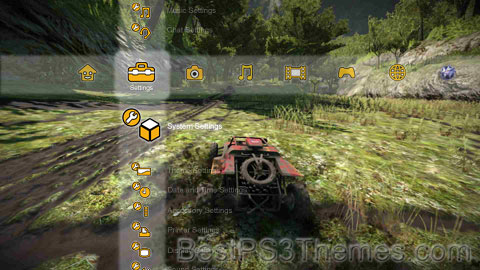
(7 backgrounds)
P3T Unpacker v0.12
Copyright (c) 2007. Anoop Menon
This program unpacks Playstation 3 Theme files (.p3t) so that you can touch-up an existing theme to your likings or use a certain wallpaper from it (as many themes have multiple). But remember, if you use content from another theme and release it, be sure to give credit!
Download for Windows: p3textractor.zip
Instructions:
Download p3textractor.zip from above. Extract the files to a folder with a program such as WinZip or WinRAR. Now there are multiple ways to extract the theme.
The first way is to simply open the p3t file with p3textractor.exe. If you don’t know how to do this, right click the p3t file and select Open With. Alternatively, open the p3t file and it will ask you to select a program to open with. Click Browse and find p3textractor.exe from where you previously extracted it to. It will open CMD and extract the theme to extracted.[filename]. After that, all you need to do for any future p3t files is open them and it will extract.
The second way is very simple. Just drag the p3t file to p3textractor.exe. It will open CMD and extract the theme to extracted.[filename].
For the third way, first put the p3t file you want to extract into the same folder as p3textractor.exe. Open CMD and browse to the folder with p3extractor.exe. Enter the following:
p3textractor filename.p3t [destination path]Replace filename with the name of the p3t file, and replace [destination path] with the name of the folder you want the files to be extracted to. A destination path is not required. By default it will extract to extracted.filename.
New York Knicks – NBA theme by Jewelz
Download: NewYorkKnicksNBA.p3t
(4 backgrounds)
P3T Unpacker v0.12
Copyright (c) 2007. Anoop Menon
This program unpacks Playstation 3 Theme files (.p3t) so that you can touch-up an existing theme to your likings or use a certain wallpaper from it (as many themes have multiple). But remember, if you use content from another theme and release it, be sure to give credit!
Download for Windows: p3textractor.zip
Instructions:
Download p3textractor.zip from above. Extract the files to a folder with a program such as WinZip or WinRAR. Now there are multiple ways to extract the theme.
The first way is to simply open the p3t file with p3textractor.exe. If you don’t know how to do this, right click the p3t file and select Open With. Alternatively, open the p3t file and it will ask you to select a program to open with. Click Browse and find p3textractor.exe from where you previously extracted it to. It will open CMD and extract the theme to extracted.[filename]. After that, all you need to do for any future p3t files is open them and it will extract.
The second way is very simple. Just drag the p3t file to p3textractor.exe. It will open CMD and extract the theme to extracted.[filename].
For the third way, first put the p3t file you want to extract into the same folder as p3textractor.exe. Open CMD and browse to the folder with p3extractor.exe. Enter the following:
p3textractor filename.p3t [destination path]Replace filename with the name of the p3t file, and replace [destination path] with the name of the folder you want the files to be extracted to. A destination path is not required. By default it will extract to extracted.filename.
Persona 4 theme by DarKaoZ
Download: Persona4.p3t
(9 backgrounds)
| Persona 4 | |
|---|---|
 Original cover art | |
| Developer(s) | Atlus |
| Publisher(s) |
|
| Director(s) | Katsura Hashino |
| Designer(s) |
|
| Programmer(s) | Yujiro Kosaka |
| Artist(s) | Shigenori Soejima |
| Writer(s) |
|
| Composer(s) | Shoji Meguro |
| Series | Persona |
| Platform(s) | |
| Release | |
| Genre(s) | Role-playing, social simulation |
| Mode(s) | Single-player |
Persona 4,[a] released outside Japan as Shin Megami Tensei: Persona 4, is a 2008 role-playing video game by Atlus. It is chronologically the fifth installment in the Persona series, itself a part of the larger Megami Tensei franchise, and was released for the PlayStation 2 in Japan in July 2008, North America in December 2008, and in Europe and Australia in March 2009 as one of the final major exclusives for the system. It was re-released as a PlayStation 2 Classic for the PlayStation 3 in April 2014. Persona 4 takes place in a fictional Japanese countryside and is indirectly related to earlier Persona games. The player-named protagonist is a high-school student who moved into the countryside from the city for a year. During his year-long stay, he becomes involved in investigating mysterious murders with a group of friends while harnessing the power to summon physical manifestations of their psyches known as a Persona.
The plot of Persona 4 was inspired by the work of mystery novelists owing to its murder mystery premise. The rural setting was based on a town on the outskirts of Mount Fuji and intended as a "'nowhere' place" and is the central setting to have players sympathize with the daily life of the characters. The developers added many in-game events to prevent the game from becoming stale. During localization, numerous alterations to Japanese cultural references were made to preserve the effect as much as possible. The release of Persona 4 in Japan was accompanied by merchandise such as character costumes and accessories. The game's music was primarily composed by Shoji Meguro, with vocals performed by Shihoko Hirata. The North American and European releases came with a soundtrack CD with selected music from the game.
Persona 4 received critical acclaim and is considered one of the best video games ever made, with praise given towards its gameplay, story, emotional depth, characters, and music. An enhanced version of the game, Persona 4 Golden, was released for PlayStation Vita in 2012 and Windows in 2020, selling 2.5 million copies worldwide; ports for Nintendo Switch, PlayStation 4, Xbox One, and Xbox Series X/S were released in January 2023. Various other manga and light novel adaptations and spin-offs have been produced. An anime adaptation by AIC ASTA, Persona 4: The Animation, began airing in Japan in October 2011, with an anime of Persona 4 Golden airing in July 2014. The game also spawned two fighting game sequels, Persona 4 Arena and Persona 4 Arena Ultimax, as well as a rhythm game, Persona 4: Dancing All Night. Party members from Persona 4 are prominently featured as playable characters in Persona Q: Shadow of the Labyrinth (2014) and Persona Q2: New Cinema Labyrinth (2018).

Persona 4 blends traditional RPG gameplay with simulation elements.[1] The player controls the game's protagonist, a teenage boy who is named by the player, who comes to the town of Inaba for a year.[2] Gameplay is divided between the real world of Inaba, where the protagonist carries out his daily life, and the mysterious "TV World", where various dungeons filled with monsters known as Shadows await. With the exception of scripted events, such as plot progression or special events, players can choose to spend their day how they like, be it participating in various real world activities, such as joining school clubs, taking part-time jobs, or reading books, or exploring the TV World's dungeons to gain experience and items.[2][3] Days are broken up into various times of day, the most frequently recurring being "After School/Daytime" and "Evening", with most activities causing time to move on. Certain activities are limited depending on the time of day, days of the week, and the weather, with most evening activities unavailable if the player visits the TV World that day. Furthermore, some activities and dialogue choices may be limited by the protagonist's five attributes; Understanding, Diligence, Courage, Knowledge, and Expression, which can be increased by performing certain activities that build them.[1][4] Whilst the player is free to choose how to spend their time, if they fail to rescue someone who is trapped in the TV World by the time fog appears in town, which takes place after several days of consecutive rain, that person will get killed by the shadows and the game will end, forcing the player to return to a week prior.[1] As the game progresses, the protagonist forms friendships with other characters known as "Social Links", which are each represented by one of the Major Arcana. As these bonds strengthen, the Social Links increase in Rank, which grant bonuses when creating new Personas in the Velvet Room. Additionally, strengthening Social Links with the main party members grant them additional abilities, such as the ability to perform a follow-up attack or an additional ability for their Persona.[1]
The main focus of the game revolves around Personas, avatars projected from one's inner self that resemble mythological figures and represent the façades worn by individuals to face life's hardships. Each Persona possesses its own skills, as well as strengths and weaknesses to certain attributes. As Personas gain experience from battle and level up, that Persona can learn new skills, which include offensive or support abilities used in battle, or passive skills that grant the character benefits. Each Persona can carry up to eight skills at a time, with older skills needing to be forgotten in order to learn new ones. Whilst each of the main party members have their own unique Persona, which transforms into a stronger form after maxing out their Social Link, the protagonist has the "Wild Card" ability to wield multiple Personas, which he can switch between during battle to access different movesets. The player can earn new Personas from Shuffle Time, with the protagonist able to carry more Personas as he levels up.[1] Outside of the dungeons, the player can visit the Velvet Room, where players can create new Personas, or summon previously acquired Personas for a fee. New Personas are created by fusing two or more monsters to create a new one, which receives some of the skills passed down from its material monsters. The level of Personas that can be created are limited by the protagonist's current level. If the player has built up a Social Link relating to a particular Arcana, then a Persona relating to that Arcana will receive a bonus upon creation.[1][2]
Inside the TV World, the player assembles a party, consisting of the protagonist and up to three other characters, to explore randomly generated dungeons, each tailored around a victim who had been kidnapped. On each floor of a dungeon, the player may find roaming Shadows, as well as treasure chests containing items and equipment. Players progress through the dungeon by finding the stairs somewhere on each floor to progress to the next, eventually reaching the final floor where a boss enemy awaits.[1] The player enters battle upon coming into contact with a Shadow. The player can gain an advantage by attacking the Shadow from behind, whilst being attacked from behind themselves will give the enemy an advantage. Similar to the Press Turn system used in other Shin Megami Tensei games, battles are turn-based with characters fighting enemies using their equipped weapons, items, or the special skills of their Personas. Aside from the protagonist, who is controlled directly, the other characters can either be given direct commands or be assigned 'Tactics' which alter their battle AI. If the protagonist loses all of his HP, the game ends, returning players to the title screen.[1]
Offensive abilities carry several attributes, including Physical, Fire, Ice, Wind, Electricity, Light, Dark and Almighty. As well as various enemies carrying different attributes, player characters may also have strengths or weaknesses against certain attacks depending on their Persona or equipment. By exploiting an enemy's weakness or performing a critical attack, the player can knock them over, granting the attacking character an additional move, whilst the enemy may also be granted an additional move if they target a player character's weakness. If the player knocks all of the enemies down, they may be granted the opportunity to perform an "All-Out Attack", in which all the players rush the downed enemies to inflict heavy damage.[1] Following a battle, players gain experience points, money, and items from their battle. Sometimes after a battle, the player may participate in a mini-game known as "Shuffle: Time" and "Arcana Chance", which can grant player new Personas or various bonuses respectively.[1]
Persona 4 takes place in the fictional, rural Japanese town of Inaba (稲羽市, Inaba-shi), which lies among floodplains and has its own high school and shopping districts. Unexplained murders have taken place in the small town, where bodies are found dangling from television antennas and their cause of death being unknown.[5] At the same time, rumor has begun to spread that watching a switched-off television set on rainy midnights will reveal a person's soulmate.[6] The game also follows the main characters into the TV World, a fog-shrouded realm filled with monsters called Shadows, which can only be accessed through TV sets.[7]
The protagonist is a high school student, named Yu Narukami in later media, who has recently moved from the city to attend school at Inaba. At school, he quickly becomes friends with Yosuke Hanamura, the somewhat-clumsy son of the manager of the local Junes Department Store; Chie Satonaka, an energetic girl with a strong interest in martial arts; and Yukiko Amagi, a calm and refined girl who helps out at her family's inn.[1] A few days into the game, the protagonist, Yosuke, and Chie follow the "Midnight Channel" rumor, which leads them to discover the TV World and meet Teddie, a friendly creature that appears as a hollow bear costume.[8] Using Personas, the students form an Investigation Team to investigate the connection between the TV world and the murders, and possibly capture the culprit.[9] As the game progresses, the group gains new members, including: Kanji Tatsumi, a male delinquent who has a talent for feminine hobbies;[10] Rise Kujikawa, a former teen idol trying to find her identity who moves to Inaba as a transfer student;[11] and Naoto Shirogane, a young female detective investigating the case with the local police who wears masculine clothing and presents herself as male due to fear of rejection.[12]
On April 11, 2011, Yu Narukami arrives in Inaba to live with the Dojimas, consisting of his uncle Ryotaro and his cousin Nanako, for one year, as his parents are working abroad.[13] Just after his arrival, a TV announcer is found dead, her body hanging from an antenna; Saki Konishi, the high school student who had discovered the body, is later found dead herself, hanged upside-down from a telephone pole.[14] After Yu and his friends accidentally enter the TV world, they encounter Teddie, who helps them travel freely between the TV and real worlds.[15] They awaken their Persona abilities, realizing that the murders stem from attacks by Shadows, beings native to the TV world created from repressed emotions, and are able to rescue several would-be victims. Yosuke, Chie, Yukiko, Kanji, Rise, and Teddie one by one come to accept the parts of their psyches they rejected, which manifest as giant Shadows in the TV world, allowing them to wield Personas whilst each joins the group in turn. Mitsuo Kubo, a student from another high school who disappears following the death of Kinshiro Morooka, Yu's foul-mouthed homeroom teacher, claims credit for the murders; it is eventually learned that Kubo only killed Morooka and played no part in the other murders, having murdered Morooka simply to gain credit for the other murders.[16] Naoto Shirogane, a nationally renowned "Detective Prince" investigating the case, is also rescued and gains a Persona, and joins the group who learn that "he" is actually a girl who assumed a male identity to avoid the police's sexism.[12]
Events come to a head when Ryotaro Dojima realizes Yu is involved in the case after seeing Yu reading a threatening letter from the killer.[17] Nanako is kidnapped during Yu's interrogation, leading Ryotaro to engage in a vehicular pursuit with the culprit. The chase ends as they both crash; the kidnapper escapes with Nanako through a television set in his truck, and the gravely-injured Ryotaro entrusts her rescue to the group. The group tracks them down within the TV world; the culprit, Taro Namatame, becomes Kunino-Sagiri which attacks them but is defeated, and both he and Nanako are taken to the Inaba hospital. During Nanako's stay at the hospital, the fog that appears when the Midnight Channel occurs persists in the real world beyond the deadline, causing increasing panic among Inaba's inhabitants. When Nanako appears to die, the group furiously confronts Namatame, and a pseudo-Shadow Namatame appears on the Midnight Channel to goad the devastated and emotionally vulnerable group into throwing him in; as Yu, the player must help the others realize that Namatame is not the killer by pointing out the lack of a proper motive.
Upon being questioned by the Investigation Team, Namatame explains that his kidnappings were an attempt to protect those who appeared on the Midnight Channel from the killer, not realizing that the TV world was dangerous and that trapping them within was how the murder victims were killed; he also denies sending Yu any letters. Upon looking over all of the evidence they have gathered, the Investigation Team determines that the real killer, and the writer of the threat letters, is none other than Ryotaro's assistant, Tohru Adachi, who inadvertently confirms their suspicions when confronted and flees into the TV world.[18][19] It is possible to fail to deduce the real killer's identity; doing so or killing Namatame by throwing him into the TV both result in bad endings, in which the recurring fog permanently sets in, leading to humanity's demise.[20] Killing Namatame also results in Nanako remaining dead; otherwise, she will be miraculously revived by Teddie, who undergoes a journey of self-discovery during which he realizes, and later accepts, that he is a Shadow.
Having identified Adachi as the true culprit, the party chases and locates him within the TV world. Adachi explains that his actions were out of both boredom and the belief that humanity is better off believing what it wants, revealing that he tricked Namatame into throwing people into the TV world and observed the Investigation Teams subsequent rescues for his own amusement, and that he additionally threw Mitsuo into the TV world himself in order to ensure the "game" did not end prematurely; his claims are dismissed by the party as the rantings of a madman.[21] After fighting Adachi, he is controlled by Ameno-sagiri, who reveals that the fog is harmful to people and will eventually cause humanity to fall into a permanent state of ignorance and transform into Shadows.[22] Upon his defeat, he agrees to lift the fog, congratulating the party on their resolve.[23] Defeated, the wounded Adachi agrees to assume responsibility for his actions and is arrested.[24]
The game moves forward to the day before Yu must travel home. If the player returns to the Dojima residence, the game ends with the "normal" ending, in which the party sends Yu off as he departs Inaba. Alternatively, should the player decline doing so and instead visit the party's usual reunion spot, the characters reunite and decide to investigate the unexplained origins of the Midnight Channel to end the case for good, setting the route for the original game's "true" ending. Yu confronts a gas station attendant encountered at the start of the game, who reveals herself to be Izanami-no-Okami, the "conductor" behind the game's events. The cause of the recurring fog is established as an attempt to create a world of illusion by merging the TV world with the human world, all for the "sake" of humanity.[25][26] The group tracks Izanami down within the TV world and battle her, but is at first unable to win; the defeated Yu is given strength by the bonds he has forged with those around him, and with this power awakens a new Persona—Izanagi-no-Okami—which he uses to defeat Izanami.[27] In doing so, the fog in each world is lifted, and the TV world is restored to its original form. The party sends Yu off the following day, and the game concludes with a post-credits scene depicting the group resolving to remain friends forever, as Yu examines a group photo of himself and the rest of the Team.[28]

Persona 4 Golden adds two new Social Links to the game; Adachi and Marie, a mysterious girl who becomes an assistant in the Velvet Room and wishes to uncover her lost memories. If the player advances Adachi's Social Link to a certain level, they are given the choice to withhold his identity as the killer from the rest of the Investigation Team, thus leaving the mystery unsolved and resulting in the "accomplice" ending. On Yu's final day in Inaba, he may choose to visit Adachi and destroy a crucial piece of evidence related to the case. Adachi then blackmails Yu, threatening to have him arrested for destroying evidence if he does not answer his calls. The game's ending then plays out the same as the normal ending, but after the credits, Yu passes by Adachi at a level crossing. He clutches his phone in his hand as a smirk forms on Adachi's face.
After the Investigation Team defeats Ameno-sagiri, Marie disappears from the Velvet Room; if Marie's social link has been maxed out, Margaret promises to find her for Yu. The Investigation Team decide to take a skiing trip together, during which time they stumble upon a cabin with a TV inside. The TV turns out to be a portal to the Hollow Forest, where Marie has fled to. With the Hollow Forest on the verge of collapsing, the Investigation Team rushes to save her; if they fail to do so, Marie disappears from their memories. If they succeed, they find Marie, who reveals that she is Kusumi-no-Okami, created to act as a spy for Ameno-sagiri in order to learn what humanity wished for; with Ameno-sagiri defeated, the fog has now been absorbed into her body. Marie's plan is to kill herself so that the fog will not spread over the world again, but the Investigation Team refuses to allow her to die, defeating her and freeing her from the fog's control.[29]
If the Investigation Team both rescued Marie and defeated Izanami-no-Okami, the player obtains the "Golden" ending,[Note 1] in which Marie realizes that she is actually Izanami-no-Mikoto, the true form of the goddess Izanami, who originally wished to both protect humanity and grant its wishes, but as people changed and stopped wishing for truth, her wishes splintered into her and Izanami-no-Okami. With Kunino-sagiri, Ameno-sagiri, and Izanami-no-Okami fused with her, she becomes whole again and disappears from the Velvet Room for good. After the events of the original game's true ending, the Golden ending skips to an epilogue set in late August, five months after Yu's departure, as he returns to Inaba for the summer.[Note 2] He reunites with his friends, who have all changed since the last time they all met. During a surprise party with his friends, Ryotaro, and Nanako, Yu discovers, among others, that Namatame is running for mayor in order to atone for his previous actions, that Adachi has become a model prisoner, and that Marie has a new identity as a popular TV anchor presenting the weather, which she seemingly is able to control. At Nanako's suggestion, everyone gives Yu a formal but joyful welcome "home"; as they chastise Kanji for saying something different than everyone else, Yu smiles brightly. The game ends showing a brand new group picture of Yu and his friends, including Marie, all smiling together.[30]
According to the game director Katsura Hashino, while "ideas [had been] thrown around earlier", development on Persona 4 in Japan did not begin until after the release of Persona 3.[31] The development team consisted of the team from Persona 3 and new hires which included fans of Persona 3.[32] Atlus intended to improve both the gameplay and story elements of Persona 3 for the new game, to ensure it was not seen as a "retread" of its predecessor. Hashino said that "to accomplish that, we tried to give the players of Persona 4 a definite goal and a sense of purpose that would keep motivating them as they played through the game. The murder mystery plot was our way of doing that."[31] The plot of Persona 4 was "greatly inspired", according to Hashino, by mystery novelists such as Sir Arthur Conan Doyle, Agatha Christie, and Seishi Yokomizo.[33] Persona 4 was officially unveiled in the Japanese gaming magazine Famitsu in March 2008. An article in the issue detailed the game's murder mystery premise, rural setting, and new weather forecast system. The game's North American release date was announced at the 2008 Anime Expo in Los Angeles, California.[34] Atlus would not make an add-on disc or epilogue for Persona 4, as had been done with the Persona 3 FES.[35] Persona 4 allowed players full control of characters in battle. This was due to negative comments from players about most of the player team in Persona 3 being controlled by the game's AI.[36] The amount of data the team ended up incorporating around school life, character relationships and spoken character dialogue was so large that there were fears it would not fit onto a single disc.[37] The anime cutscenes were produced by Studio Hibari.[38]
The design of Inaba is based on a town on the outskirts of Mount Fuji.[33] Its rural design was a source of conflict between Persona 4's developers, as "each staff member had their own image of a rural town", according to director Katsura Hashino. The entire staff went "location hunting" to determine Inaba's design.[32] Inaba does not represent "a country town that has tourist attractions", but rather a non-notable, "'nowhere' place". Hashino described the town as being "for better or for worse... a run-of-the-mill town".[33] Unlike other role-playing games, which may have large worlds for the player to explore, Persona 4 mostly takes place in Inaba. This reduced development costs, and enabled Atlus "to expand other portions of the game" in return. A central setting also allows players to "sympathize with the daily life that passes in the game". To prevent the setting from becoming stale, the development team established a set number of in-game events to be created to "keep the game exciting".[31] The choice of Japanese mythical figures for the characters' Personas as opposed to the Graeco-Roman deities used in earlier games was directly inspired by the new setting.[36] The appearances of Personas were based on the characters' personalities. The design team had a good deal of creative freedom while creating Personas, because although Japanese deities have well-defined character traits, their appearances are traditionally unspecified. The Shadows were created by Hashino without much outside consultation, although he had help from female staff for female Shadow selves.[37]
Despite living in the countryside, Persona 4 characters were designed to look and sound "normal" and like "modern high-schoolers", according to lead localization editor Nich Maragos. Initially, he wrote the game's cast as being "more rural than was really called for". "The characters aren't really hicks... They just happen to live in a place that's not a major metropolitan area."[39] While interviewing members of Persona 4's development team, 1UP.com editor Andrew Fitch noted that the characters from the city — Yosuke and the protagonist — have "more stylish" hair than the other characters. Art director Shigenori Soejima used hair styles to differentiate between characters from the city versus the country. "With Yosuke in particular, I gave him accessories, such as headphones and a bicycle, to make it more obvious that he was from the city."[33]
As with Persona 3, the localization of Persona 4 was handled by Yu Namba and Nich Maragos of Atlus USA. In addition, there were four translators and two further editors. The Social Links were divided equally between the translators and editors.[40] During localization of the game, character's names were altered for the international audience for familiarity, including Kuma being renamed Teddie. A similar change was done for Rise Kujikawa's stage name, "Risechie" (りせちー, Risechī) in Japan, to "Risette". Nanba also explained the change from "Community" to "Social Link", regarding the gameplay mechanic, as "community" has a different meaning in English, whereas Igor in his speeches often refers to "society" and "bonds". Names were also altered for pun and other linguistic effect including dungeon items' names, such as the "Kae Rail" becoming the "Goho-M", as the item's use of returning the player to the entrance was taken to be "go home". Some Japanese cultural references that would not transfer were also removed, such as references to Kosuke Kindaichi. There were also some issues regarding the translation of the names of Yukiko, Kanji and Rise's dungeons, as the English names were made to fit the original Japanese graphics, and the "Void Quest" dungeon's graphics were specifically made to harken back to the Famicom. He also remarked on how popular the interpretations of Kanji's Shadow were in the west, and how it did not change how the character was seen by the other audience.[41] A different change was that the main characters in the English dub referred to others members of the cast on a first-name basis, while the Japanese version differed in this regard. For the dub, the editors sometimes switched between first-name and last-name referral for dramatic effect.[42]
Atlus's senior project manager Masaru Nanba commented it was decided that "Shin Megami Tensei" was to be kept in the title of Persona 3 and Persona 4, as it was believed that they were part of the same series as Shin Megami Tensei III: Nocturne; however, the "Shin Megami Tensei" title was omitted from both Persona 4 Golden and Persona 4 Arena, as it would have been much too long. Similarly, Persona 4: The Ultimate in Mayonaka Arena and Persona 4: The Golden were shortened to the previously stated titles.[41] As with Persona 3, the honorifics used in the Japanese voice track were retained in the English dub, despite proving contentious among series fans. This was done as part of an intended trend to remain faithful to the original source material. The pronunciations of honorifics, along with the sounds of names, were a point that was carefully considered by the localization team and it took a while for the English cast to get used to them. A member of the English dub that also appeared in Persona 3 was Yuri Lowenthal. Though he had dubbed characters in Persona 3, Namba wanted him to have a larger part. His role as Yosuke ended up featuring 1000 more lines of dialogue than the other major characters. Important roles for the localization team were Teddie and Rise, as they would be the party's supports. Another element in the English script was that the use of swear words was increased over Persona 3: the first draft featured very strong language which was cut as it did not seem suited. The character Kanji was given a lot of swearing in his dialogue, due to his volatile nature. The use of swearing was carefully considered depending on the emotional situation.[40][43]
The game's original score was primarily composed, arranged, and produced by Shoji Meguro. The soundtrack features songs with vocals by Shihoko Hirata, whom Meguro felt was able to meet the range of emotion needed for the soundtrack, with the lyrics being written by Reiko Tanaka.[44] Meguro was given a rough outline of the game's plot and worked on the music in the same manner and simultaneously with the development of the story and spoken dialog, starting with the overall shape of the songs and eventually working on the finer details.[44] According to Meguro, the songs "Pursuing My True Self" and "Reach Out to the Truth" were composed to reflect the inner conflicts of the game's main characters; the former song, used as the opening theme, helped to set an understanding of the characters' conflicts, while the latter, used in battle sequences, emphasized the "strength of these characters to work through their internal struggles."[44] The "Aria of the Soul" theme used in the Velvet Room, a concept common to all the Persona games, remained relatively unchanged, with Meguro believing "the shape of the song had been well-defined" from previous games.[44] Composers Atsushi Kitajoh and Ryota Kozuka also contributed music for the game. Kitajoh, who had previously written music for Atlus with Growlanser VI and Trauma Center: New Blood, contributed four themes to Persona 4, while Kozuka wrote the "Theme of Junes".[45]
Persona 4's two-disc soundtrack was released in Japan by Aniplex on July 23, 2008. The soundtrack was also released in North America.[46] The side A of the soundtrack is the bonus disc packaged with each game, while side B of the soundtrack was part of Amazon.com's exclusive Persona 4 Social Link Expansion Pack.[47] Similarly to Persona 3, a "Reincarnation" album, titled Never More, was released in Japan on October 26, 2011, featuring full length cuts of the game's vocal tracks and extended mixes of some of the instrumental tracks.[48] Never More made it to the top of both the Oricon Weekly Album Charts[49] and Billboard's Japan Top Albums chart[50] for the week of its release, selling nearly 27,000 copies.[51]
LittlestPetShop theme by Jewelz
Download: LittlestPetShop.p3t
(3 backgrounds)
P3T Unpacker v0.12
Copyright (c) 2007. Anoop Menon
This program unpacks Playstation 3 Theme files (.p3t) so that you can touch-up an existing theme to your likings or use a certain wallpaper from it (as many themes have multiple). But remember, if you use content from another theme and release it, be sure to give credit!
Download for Windows: p3textractor.zip
Instructions:
Download p3textractor.zip from above. Extract the files to a folder with a program such as WinZip or WinRAR. Now there are multiple ways to extract the theme.
The first way is to simply open the p3t file with p3textractor.exe. If you don’t know how to do this, right click the p3t file and select Open With. Alternatively, open the p3t file and it will ask you to select a program to open with. Click Browse and find p3textractor.exe from where you previously extracted it to. It will open CMD and extract the theme to extracted.[filename]. After that, all you need to do for any future p3t files is open them and it will extract.
The second way is very simple. Just drag the p3t file to p3textractor.exe. It will open CMD and extract the theme to extracted.[filename].
For the third way, first put the p3t file you want to extract into the same folder as p3textractor.exe. Open CMD and browse to the folder with p3extractor.exe. Enter the following:
p3textractor filename.p3t [destination path]Replace filename with the name of the p3t file, and replace [destination path] with the name of the folder you want the files to be extracted to. A destination path is not required. By default it will extract to extracted.filename.
Final Fantasy Collection theme by The Penguin/Stegar
Download: FinalFantasyCollection.p3t
(1 background)
Socom Confrontation theme by MurderPickle
Download: SocomConfrontation_4.p3t
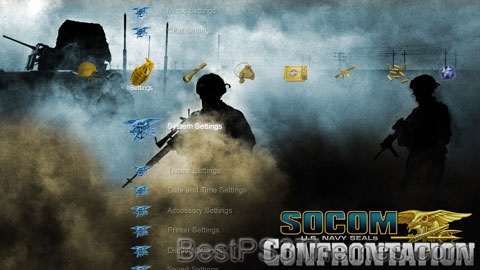
(1 background)
P3T Unpacker v0.12
Copyright (c) 2007. Anoop Menon
This program unpacks Playstation 3 Theme files (.p3t) so that you can touch-up an existing theme to your likings or use a certain wallpaper from it (as many themes have multiple). But remember, if you use content from another theme and release it, be sure to give credit!
Download for Windows: p3textractor.zip
Instructions:
Download p3textractor.zip from above. Extract the files to a folder with a program such as WinZip or WinRAR. Now there are multiple ways to extract the theme.
The first way is to simply open the p3t file with p3textractor.exe. If you don’t know how to do this, right click the p3t file and select Open With. Alternatively, open the p3t file and it will ask you to select a program to open with. Click Browse and find p3textractor.exe from where you previously extracted it to. It will open CMD and extract the theme to extracted.[filename]. After that, all you need to do for any future p3t files is open them and it will extract.
The second way is very simple. Just drag the p3t file to p3textractor.exe. It will open CMD and extract the theme to extracted.[filename].
For the third way, first put the p3t file you want to extract into the same folder as p3textractor.exe. Open CMD and browse to the folder with p3extractor.exe. Enter the following:
p3textractor filename.p3t [destination path]Replace filename with the name of the p3t file, and replace [destination path] with the name of the folder you want the files to be extracted to. A destination path is not required. By default it will extract to extracted.filename.
Sonic Unleashed theme by hulk0408
Download: SonicUnleashed.p3t
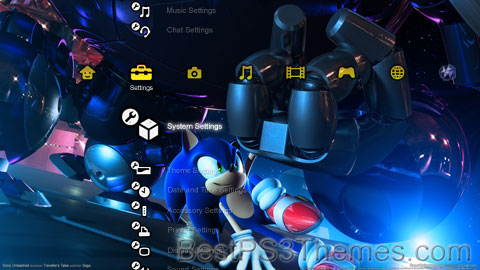
(2 backgrounds)
| Sonic Unleashed | |
|---|---|
 | |
| Developer(s) | Sonic Team[a] |
| Publisher(s) | Sega[b] |
| Director(s) | Yoshihisa Hashimoto |
| Producer(s) | Akinori Nishiyama |
| Designer(s) |
|
| Programmer(s) |
|
| Artist(s) |
|
| Writer(s) | Kiyoko Yoshimura |
| Composer(s) |
|
| Series | Sonic the Hedgehog |
| Platform(s) | |
| Release | |
| Genre(s) | Platform, action-adventure, beat 'em up |
| Mode(s) | Single-player |
Sonic Unleashed[c] is a 2008 platform game developed by Sonic Team and published by Sega as part of the Sonic the Hedgehog series. The plot follows Sonic as he attempts to restore the world after his nemesis Doctor Eggman shatters it with a powerful laser to unleash Dark Gaia, an ancient evil which periodically transforms Sonic into a werewolf form (dubbed a "Werehog"). Gameplay features two distinct styles: daytime stages incorporate Sonic's traditional platforming and trademark speed; while night-time stages see Sonic transform into the Werehog and engage in slower combat against waves of enemies using the Werehog's brute strength.
The game's development began in 2006, after the creation of its game engine, the Hedgehog Engine. It was initially conceived as a sequel to Sonic Adventure 2 (2001), but developer Sonic Team began to introduce enough new innovations that separated it from previous games, and it was renamed Sonic World Adventure in domestic markets. The Werehog gameplay was conceived to help introduce newer gamers unfamiliar with the Sonic franchise to the series and is what influenced the use of Unleashed as a subtitle for western markets. The game's existence was first brought to light when Sega trademarked the Unleashed name in March 2008, and shortly after, images and a gameplay video were leaked. Three versions of the game were developed: one by Sonic Team for high definition consoles such as the Xbox 360 and PlayStation 3, one by Sonic Team and Dimps for standard definition consoles such as the Wii and PlayStation 2, and one by Gameloft for mobile phones. The game was released worldwide in 2008.
Public anticipation for Sonic Unleashed was high, as video game journalists saw it as a possible return to Sonic's platforming roots. While it was commercially successful, selling 2.45 million units, initial critical reception was mixed. Reviewers praised certain elements, such as the sense of speed in daylight stages and the graphics and audio that make up the environments, but criticized others, such as the Werehog game mechanic, as well as several gameplay and design concepts; many felt Unleashed was not the game to reinvigorate the series. Sonic Unleashed was delisted from retailers in 2010, following Sega's decision to remove all Sonic games with below-average Metacritic scores from sale.[2] Despite this, the PlayStation 3 version was relisted in April 2014 and added to PlayStation Now in March 2017, while the Xbox 360 version was relisted and made backward compatible for Xbox One in November 2018.[3]

Sonic Unleashed is a platform game in which the player controls the titular Sonic the Hedgehog in two modes: fast-paced levels that take place during daytime, showcasing and using Sonic's trademark speed as seen in previous games in the series, and slower, night-time levels, during which Sonic transforms into the Werehog, and gameplay switches to an action-based, brawler style of play, in which Sonic battles Gaia enemies (those created by the main enemy in the game, Dark Gaia).[4][5] Each level takes place on a particular continent, each of which is based on a real-world location.[1] In sections of the Xbox 360 and PlayStation 3 versions of the game, the player may choose to advance the time of day in order to play as either Sonic or the Werehog; in the Wii and PlayStation 2 versions, time is advanced automatically.[6]
Daytime levels focus on Sonic's speed, and to this extent, sees the player control Sonic through fast-moving stages containing both 2D and 3D styles of gameplay.[7] 2D sections are reminiscent of the Mega Drive/Genesis-era Sonic games where the player controls Sonic in a side-scrolling fashion,[8] while 3D sections see the camera placed behind Sonic so the player may move in all directions. In addition to moves available in past games, such as the Homing Attack,[9] new moves are also introduced. For instance, a new sidestep feature known as the Quick Step is available, allowing Sonic to dodge left and right, and a Drift feature, which allows Sonic to make tighter turns without slowing down.[9] The game also features a gameplay mechanic previously used in the Sonic Rush series called the Sonic Boost, which greatly increases Sonic's speed, allowing him to smash through objects, destroy enemies instantly, or even access different level paths.[10] In the Xbox 360 and PlayStation 3 versions, an on-screen "Ring Energy" meter displays how much Boost is available.[10] The amount of Boost remaining may be increased by collecting more rings, and is decreased by using the Boost.[10] In contrast, the Wii and PlayStation 2 versions of the game represent available Boost using bars, which may be added by performing "Action Chains", destroying multiple enemies in quick succession through the use of homing attacks, or by collecting rings. Japanese game company Dimps helped design some of the stages.[11][12]

Night-time levels are slow-paced and action-oriented, while also featuring simple puzzle elements.[13] Gameplay focuses on Sonic's new "Werehog" form, which gives him great strength and stretchable arms. As the Werehog, the player can cling to distant objects, move items around and perform combo attacks to defeat enemies and advance through the level.[14] Collecting rings replenishes the Werehog's health,[8] while a special move, Unleashed Mode, allows him to channel his energy into increasing the power of his attacks for a short time.[15] Night-time levels are adjusted in the Wii version to allow greater use of the Wii Remote, such that players may control the arms of the Werehog by using the Wii Remote and Nunchuk in order to grab onto objects and proceed in the levels.[6] The Wii version also expands upon the ratio of night-time levels to daytime, with more than three times as many night-time levels (twenty-five in all).[16] After night-time levels are completed, Dark Gaia Points are gained, allowing access to bonus moves.
In addition to these two gameplay types, Sonic Unleashed also features hub worlds, in which the player may reveal, as well as advance, the story of the game.[14] Hubworlds operate differently depending on the version of the game being played; the PlayStation 3 and Xbox 360 versions feature fully interactive, explorable 3D hub worlds, similar to those in Sonic the Hedgehog and Sonic Adventure, in which townspeople may be interacted with and side quests may be undertaken, in order to gain experience or unlock items, such as artwork, videos and music tracks.[14][8] In contrast, the Wii and PlayStation 2 versions feature menu-based map systems, in which players simply click on areas to talk to townspeople and find information.[6] Within both day and night-time levels are medals that Sonic may collect, two types of which exist: Sun and Moon.[10] In the Xbox 360 and PlayStation 3 versions, collecting these medals allows the player to level up Sonic's Sun and Moon stats, and these must be increased to reach new stages in the game, with a certain number of Sun Medals for Hedgehog levels, and a certain number of Moon Medals for Werehog levels.[10] Because only the Xbox 360 and PlayStation 3 versions feature playable hubworlds, these are also the only versions in which Sun and Moon Medals may be found by exploring the towns, talking to the citizens, and completing side quests.[10] In the Wii and PlayStation 2 versions, Sun and Moon Medals are earned after completing stages and clearing their objectives. The medals are used to open up doors in Gaia gates, which can earn bonus content.

In a cold open, Sonic is pursuing his nemesis, Doctor Eggman, bounding around a fleet of spaceships. After the defeat of several of his robots, Sonic transforms into Super Sonic and corners Eggman on the main spaceship.[17] However, Eggman traps the hedgehog using the energy field of a powerful new ray weapon called the Chaos Energy Cannon, which forcefully reverts him to his normal state and removes the Chaos Emeralds out of him as well as their power,[1] causing them to turn grey and useless. He then uses the Emeralds' energy to fire an enormous laser and unleash a powerful beast, Dark Gaia,[18] from the center of the planet, which has devastating consequences, shattering the planet into seven pieces.[17][18] In addition, the process has the unforeseen side-effect of transforming Sonic into a "Werehog" — a beast form that loses speed but gains greater strength and abilities — at night.[19][20] Eggman ejects Sonic into space, who then lands safely onto the planet below thanks to a strange green shield.
After landing along with the Emeralds, Sonic encounters a friendly creature who appears to suffer amnesia.[21] Assuming he has caused it with his fall,[21] Sonic decides to assist him in his quest to find out who he is, and the creature becomes a guide for Sonic;[17] he then gives him the nickname "Chip".[22] Sonic's quest begins, and with the help of some old friends, such as Amy and Tails,[16] he attempts to solve the crisis by traveling the world's continents, finding Gaia Temples that will restore the Emeralds' power, in order to return the world, and himself, to normal.[1]
After six out of the seven continents are returned to normal, Chip is able to regain his memory; he is in fact Dark Gaia's opposite, Light Gaia.[23] Since the beginning of time, the two of them had been in a cycle where Dark Gaia would break the planet apart, and Light Gaia would put it back together.[24] Chip was released along with Dark Gaia, but because both of them were released prematurely, he lost his memory, and Dark Gaia was broken apart.[25] They are able to place the last Chaos Emerald in the shrine on the final continent at Eggman's new empire, "Eggmanland", but are interrupted by him;[26] Sonic then defeats Eggman who is using a robot that utilizes Dark Gaia's power, the Egg Dragoon. During the battle, the three sink into the core of the Earth and encounter Dark Gaia. Eggman orders Dark Gaia to destroy Sonic, but it turns on him, knocking him away with one of its tentacles, and absorbs the power that turned Sonic into a Werehog, curing Sonic of lycanthropy.[27]
Dark Gaia then attacks Sonic and Chip, but Chip protects Sonic and calls all of the Gaia temples together to form the Light Gaia Colossus and fight Dark Gaia.[28] The Gaia Colossus seemingly destroys Dark Gaia, but Dark Gaia is not finished with them or the Earth yet, and consumes the entire world in darkness, becoming Perfect Dark Gaia in the process. Chip then gives the restored Chaos Emeralds to Sonic, allowing him to turn into Super Sonic and continue their fight, until he finally destroys it; Dark Gaia sinks back into the planet, but the battle takes its toll on Super Sonic. Chip saves Sonic by throwing him to the surface, before returning himself to the inside of the planet; he leaves behind his necklace and some parting words. Sonic places the necklace on his hand as a bracelet to remind him of their adventure together before speeding off with Tails, flying alongside him on the coastline in the Tornado plane.[29]
Sonic Team began development of the game in 2006, after having begun work on the core technology, the Hedgehog Engine, in 2005.[30] The title Sonic Unleashed was trademarked by Sega on March 12, 2008.[31] Screenshots of cutscenes, artwork, and a video were leaked ten days later,[31] with the title confirmed by Sega on April 3, 2008[32] with a small selection of screenshots and an updated video. The game was developed internally by Sonic Team in Japan.[33] It was originally intended to be the third installment of the Sonic Adventure series[34] and subsequently, at an early development stage, had the working title Sonic World Adventure, complete with a work-in-progress logo. However, the development team began to introduce enough new innovations to separate it from the Sonic Adventure games,[35] and so a new title, Sonic Unleashed, was decided.[36] It was then later revealed that the game's name in Japan would in fact remain Sonic World Adventure for its release there.[1]
Sonic Team decided early on in the development process to reduce the number of characters present in the game, as well as to make Sonic the only playable character; this decision was taken to get more quality out of fewer characters.[37] While it felt that these ideas combined with traditional Sonic gameplay was a good beginning, it also had to consider how to introduce newer gamers unfamiliar with the Sonic franchise to the series, and so the concept of the Werehog was born, in addition to exploring its own mythology and ideas for the story.[37] Director Yoshihisa Hashimoto felt from the outset that there would be both praise and criticism, but hoped that long-term Sonic fans would understand and empathise with the ideas and direction the team had taken.[37] The game's human non-player characters were designed by Japanese artist team Gurihiru.[38][39]
In terms of technology, Hashimoto remarked that the visual style was born out of desire to see a global illumination solution used for the game's lighting — that is, light reflecting from one object in the scene onto others.[37] To this extent, development on the renderer for this process began, and the final solution allowed the developers to use distributed rendering over hundreds of computers to calculate lighting for each ten- to twenty-kilometer action stage in around two or three days.[37] Characters, enemies and objects are then lit at run-time with Sonic Team's "Light Field" technology to blend them in with the surrounding pre-calculated lighting.[37] Because the game was being developed for two levels of hardware capability depending on the target platform, two development "silos" were set up to work on two separate builds of the game: one for the Xbox 360 and PlayStation 3 version utilizing the Hedgehog Engine, and one for the Wii and PlayStation 2 version, which instead utilizes a modified version of an existing, internal Sega engine.[40] Hashimoto, who had never directed a Sonic game before,[35] incorporated new features such as a "Quick Step" mechanic allowing players to dodge obstacles with the L and R triggers.[41] Hashimoto sought to combine the best qualities of 2D and 3D Sonic gameplay[35] and address the criticisms directed at previous 3D entries in the franchise.[41] Additional code to dynamically adjust the speed of the game for different situations was used to properly balance its fast pace with traditional platforming elements.[41]
As well as the unique motion-based gameplay mechanics, the Wii version of the game also supports the GameCube controller, and also the option of using the Classic Controller.[17] The daytime levels for the Wii were altered to accommodate the motion control-based boost mechanic,[42] while night-time levels include a mostly behind-the-back view and different platforming styles and combat mechanics.[6] Developer Dimps, who had past involvement in the Sonic franchise, was involved in the design of the daytime areas for these versions.[12] In addition, overall, the Wii and PlayStation 2 versions have fewer daytime levels than the Xbox 360 and PlayStation 3 counterparts.[14]
Initially, it was stated that Unleashed was to be intended solely as a single-player experience, and would not offer any multiplayer or online modes. This was cast into doubt when references to online modes were alluded to around E3 2008,[43] but later interviews re-iterated that Unleashed would have no online modes at all.[18] However, downloadable content, including additional levels, would remain a possibility after the game's release.[18]
Sonic Unleashed was released for PlayStation 2, Wii and Xbox 360 on November 18, 2008, in North America, and on November 27 and November 28, 2008, in Australia and Europe, respectively.[44][45][46] The PlayStation 3 version was released a month later on December 9 in North America, on December 18 in Australia, and on December 19 in Europe.[47][48] In Japan the Wii version was released on December 18, 2008, with the Xbox 360 and PlayStation 3 versions releasing next year, on February 19, 2009.
A demo version was released on the Xbox Live Marketplace on December 8, 2008[49] and on the US and EU PlayStation Stores on December 18 and 24, 2008, respectively. The demo does not contain any of the Werehog stages.[49] On March 12, 2009, Sega released Sonic Unleashed's first downloadable content for the Xbox 360 and PlayStation 3, consisting of four Chun-nan daytime stages and two night stages in addition to two new missions. Since then, more downloadable levels have been added: Spagonia, Holoska, Mazuri, Apotos, Shamar, Empire City and Adabat.[50]
Speaking after the game's release, Sonic Team member and Sonic and the Black Knight producer and director Tetsu Katano remarked that although he did not feel the Werehog concept was a mistake, time and resources were a limiting factor in the game's production. He also remarked that the Werehog may reappear in future games, or possibly in a sequel to Sonic Unleashed, should one be made.[51]
Game developer Gameloft announced in May 2009 that it had secured a licensing agreement with Sega Europe Ltd. to produce Java versions of Sega properties, and that its first game would be a version of Sonic Unleashed for mobile phone platforms. It was released in June 2009 in Europe, Middle East, Australia and New Zealand.[52][53] The mobile version of Sonic Unleashed is strictly a side-scroller reminiscent of the original Genesis games, featuring new level designs and character abilities.[54]
The game's soundtrack, Planetary Pieces: Sonic World Adventure Original Soundtrack, was released as a three-disc set in Japan on January 28, 2009.[55] The vocal theme track, "Endless Possibility", written by longtime Sonic game composer Tomoya Ohtani, features Jaret Reddick of the American rock band Bowling for Soup.[56] The ending theme music for the game is a slow tempo ballad, "Dear My Friend", and features singer Brent Cash.[citation needed]
| Aggregator | Score |
|---|---|
| Metacritic | 66/100 (Wii/PS2)[57][58] 60/100 (X360)[59] 54/100 (PS3)[60] |
| Publication | Score |
|---|---|
| 1Up.com | C (X360)[61] D (Wii)[62] |
| Eurogamer | 6/10 (Wii)[6] 4/10 (X360)[63] |
| G4 |   |
| Game Informer | 6.5/10 (Wii)[64] 6/10 (X360/PS3)[65][66] |
| GameSpot | 7/10 (Wii)[68] 3.5/10 (X360/PS3)[69] |
| GamesRadar+ | [67] |
| GamesTM | 5/10 |
| GameTrailers | 7/10 (Wii/X360)[70] |
| IGN | 7.2/10 (Wii)[7] 7/10 (PS2)[71] 4.5/10 (X360/PS3)[72] |
| Nintendo Life | 6/10 (Wii)[75] |
| Nintendo Power | 8/10 (Wii) |
| Nintendo World Report | 4/10 (Wii)[74] |
| Official Nintendo Magazine | 79% (Wii)[16] |
| Official U.S. PlayStation Magazine | 4/10 |
| Official Xbox Magazine (US) | 6.5/10[73] |
| VideoGamer.com | 6/10[14] |
Initial anticipation when the first media for Unleashed was revealed was high, as the demonstration videos hinted at a possible return of Sonic to his traditional platforming roots, especially because of the series' declining quality in recent years,[76] and a number of poorly received games in the franchise that preceded it, such as the 2006 game, Sonic the Hedgehog.[76]
Sonic Unleashed received "mixed or average" reviews, with Metacritic aggregate scores of 60 and 54 out of 100 for the Xbox 360 and PlayStation 3 versions respectively, and 66 out of 100 for the Wii and PlayStation 2 versions.[58][57][59][60] The added element of motion controls for the Werehog sections, as well as text-based hub worlds and better Werehog level design and camera system, were reasons cited for the higher review scores for the Wii and PlayStation 2 versions of the game,[6][64] though a few review websites, such as 1UP, gave the Wii version a lower score than its Xbox 360 and PlayStation 3 counterparts.[61][62] Nevertheless, the game was a commercial success and sold 2.45 million units combined making it Sega's third bestselling game during their last fiscal year period of 2008.[77]
Positive elements of Sonic Unleashed remarked upon by reviews include the environments, such as the "postcard-perfect architecture",[61] and the graphics, with stages looking "absolutely gorgeous"[6
Final Fantasy VII theme by myownscars
Download: FinalFantasyVII_10.p3t
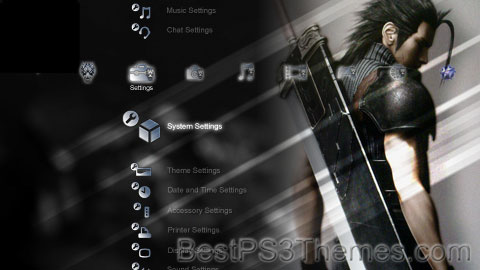
(8 backgrounds)
| Final Fantasy VII | |
|---|---|
 North American cover art, featuring the game's protagonist, Cloud Strife | |
| Developer(s) | Square |
| Publisher(s) |
|
| Director(s) | Yoshinori Kitase |
| Producer(s) | Hironobu Sakaguchi |
| Programmer(s) | Ken Narita |
| Artist(s) | |
| Writer(s) | Yoshinori Kitase Kazushige Nojima |
| Composer(s) | Nobuo Uematsu |
| Series | Final Fantasy |
| Platform(s) | |
| Release | January 31, 1997 |
| Genre(s) | Role-playing |
| Mode(s) | Single-player |
Final Fantasy VII[a] is a 1997 role-playing video game developed by Square for the PlayStation console and the seventh main installment in the Final Fantasy series. Square published the game in Japan, and it was released in other regions by Sony Computer Entertainment, becoming the first game in the main series to have a PAL release. The game's story follows Cloud Strife, a mercenary who joins an eco-terrorist organization to stop a world-controlling megacorporation from using the planet's life essence as an energy source. Ensuing events send Cloud and his allies in pursuit of Sephiroth, a superhuman who seeks to wound the planet and harness its healing power in order to be reborn as a god. Throughout their journey, Cloud bonds with his party members, including Aerith Gainsborough, who holds the secret to saving their world.
Development began in 1994, originally for the Super Nintendo Entertainment System. After delays and technical difficulties from experimenting with several platforms, most notably the Nintendo 64, Square moved production to the PlayStation, largely due to the advantages of the CD-ROM format. Veteran Final Fantasy staff returned, including series creator and producer Hironobu Sakaguchi, director Yoshinori Kitase, and composer Nobuo Uematsu. The title was the first in the series to use full motion video and 3D computer graphics, featuring 3D character models superimposed over 2D pre-rendered backgrounds. Although the gameplay remained mostly unchanged from previous entries, Final Fantasy VII introduced more widespread science fiction elements and a more realistic presentation. The combined development and marketing budget amounted to approximately US$80 million.
Final Fantasy VII received widespread commercial and critical success and remains widely regarded as a landmark title, and it is regarded as one of the greatest and most influential video games ever made. The title won numerous Game of the Year awards and was acknowledged for boosting the sales of the PlayStation and popularizing Japanese role-playing games worldwide. Critics praised its graphics, gameplay, music, and story, although some criticism was directed towards the original English localization. Its success has led to enhanced ports on various platforms, a multimedia subseries called the Compilation of Final Fantasy VII, and a high definition remake trilogy currently comprising Final Fantasy VII Remake (2020), and Final Fantasy VII Rebirth (2024).
The gameplay of Final Fantasy VII is similar to earlier Final Fantasy titles and Japanese role-playing games.[1] The game features three modes of play: the world map, the field, and the battle screen.[2][3]: 15, 20 At its grandest scale, players explore the world of Final Fantasy VII on a 3D world map.[4] The world map contains representations of areas for the player to enter, including towns, environments, and ruins.[5] Natural barriers—such as mountains, deserts, and bodies of water—block access by foot to some areas; as the game progresses, the player receives vehicles that help traverse these obstacles.[3]: 44 Chocobos can be found in certain spots on the map, and if caught, can be ridden to areas inaccessible on foot or by vehicle.[3]: 46 In field mode, the player navigates fully scaled versions of the areas represented on the world map.[4] VII marks the first time in the series that the mode is represented in a three-dimensional space. In this mode, the player can explore the environment, talk with characters, advance the story, and initiate event games.[3]: 15 Event games are short minigames that use special control functions and are often tied to the story.[3]: 18 While in field mode, the player can also find shops and inns. Shops allow the player to buy and sell items that can aid Cloud and his party, such as weapons, armor, and accessories. Inns restore the hit points and mana points of characters who rest at them and cure abnormalities contracted during battles.[3]: 17

At random intervals on the world map and in field mode, and at specific moments in the story, the game will enter the battle screen, which places the player characters on one side and the enemies on the other. It employs an "Active Time Battle" (ATB) system, in which the characters exchange moves until one side is defeated.[1][2] The damage or healing dealt by either side is quantified on screen. Characters have several statistics that determine their effectiveness in battle; for example, hit points determine how much damage they can take, and magic determines how much damage they can inflict with spells. Each character on the screen has a time gauge; when a character's gauge is full, the player can input a command for them. The commands change as the game progresses, and are dependent on the characters in the player's party and their equipment. Commands include attacking with a weapon, casting magic, using items, summoning monsters, and other actions that either damage the enemy or aid the player characters. Final Fantasy VII also features powerful, character-specific commands called Limit Breaks, which can be used only after a special gauge is charged by taking enemy attacks. After being attacked, characters can be afflicted by one or more abnormal "statuses", such as poison or paralysis. These statuses and their adverse effects can be removed by special items or abilities or by resting at an inn. Once all enemies are defeated, the battle ends and the player is rewarded with money, items, and experience points. If the player is defeated, it is game over and the game must be loaded to the last save point.[3]: 20–27
When not in battle, the player can use the menu screen, where they can review each character's status and statistics, use items and abilities, change equipment, save the game when on the world map or at a save point, and manage orbs called Materia. Materia are the main method of customizing characters in Final Fantasy VII, and can be added to equipment to provide characters with new magic spells, monsters to summon, commands, statistical upgrades, and other benefits.[6] Materia level up through their own experience point system and can be combined to create different effects.[3]: 30–42
Final Fantasy VII takes place on a world referred to in-game as the "Planet" and retroactively named "Gaia".[7][8] The planet's lifeforce, called the Lifestream, is a flow of spiritual energy that gives life to everything on the Planet; its processed form is known as "Mako".[9] On a societal and technological level, the game has been defined as an industrial or post-industrial science fiction setting.[10] During Final Fantasy VII, the Shinra Electric Power Company, a world-dominating megacorporation headquartered in the city of Midgar, is draining the Planet's Lifestream for energy, weakening the Planet and threatening its existence and all life.[11] Significant factions within the game include AVALANCHE, an eco-terrorist group seeking Shinra's downfall so the Planet can recover;[8] the Turks, a covert branch of Shinra's security forces;[12] SOLDIER, an elite Shinra fighting force created by enhancing humans with Mako;[13] and the Cetra, a near-extinct human tribe which maintains a strong connection to the Planet and the Lifestream.[14]
The main protagonist is Cloud Strife, an aloof mercenary who claims to be a former 1st Class SOLDIER. Early on, he works with two members of AVALANCHE: Barret Wallace, its brazen but fatherly leader; and Tifa Lockhart, a shy yet nurturing martial artist and his childhood friend. During their journey, they meet Aerith Gainsborough, a carefree flower merchant and one of the last surviving Cetra;[14][15] Red XIII, an intelligent quadruped from a tribe that protects the planet;[16] Cait Sith, a fortune-telling robotic cat controlled by repentant Shinra staff member Reeve;[3][17] and Cid Highwind, a pilot whose dream of being the first human in outer space was unrealized.[18] The group can also recruit Yuffie Kisaragi, a young ninja and skilled Materia thief; and Vincent Valentine, a former Turk and victim of Shinra's experiments.[19] The game's main antagonists are Rufus Shinra, the son of President Shinra and the later leader of the Shinra Corporation;[20] Sephiroth, a former SOLDIER who reappears several years after being presumed dead;[3] and Jenova, a hostile extraterrestrial life-form who the Cetra imprisoned 2,000 years ago and who Sephiroth was created from.[21][22][23] A key character in Cloud's backstory is Zack Fair, a member of SOLDIER and Aerith's first love.[24]
AVALANCHE destroys a Shinra Mako reactor in Midgar, but an attack on another reactor goes wrong and Cloud falls into the city's slums. There, he meets Aerith and protects her from Shinra.[25][26] Meanwhile, Shinra finds AVALANCHE's base of operations and intentionally collapses part of the upper city level in retaliation for the Mako reactor being destroyed, killing many AVALANCHE members and innocent bystanders as collateral damage.[27] Aerith is also captured since Shinra believes that as a Cetra, she can potentially reveal the "Promised Land", which they believe is overflowing with Lifestream energy they can exploit.[28][29] Cloud, Barret, and Tifa rescue Aerith, and during their escape from Midgar, discover that Sephiroth murdered President Shinra despite being presumed dead five years earlier.[30] The party pursues Sephiroth across the Planet, with now-President Rufus on their trail; they are soon joined by the rest of the playable characters.
At a Cetra temple, Sephiroth reveals he intends to use a powerful magical artifact known as "Black Materia" to cast the spell "Meteor", which would have a devastating impact on the Planet. Sephiroth claims he will absorb the Lifestream as it attempts to heal the wound caused by Meteor, and become a god-like being in the process.[31] The party retrieves the Black Materia, but Sephiroth manipulates Cloud into surrendering it. Aerith departs alone to stop Sephiroth and follows him to an abandoned Cetra city. While Aerith prays to the Planet for help, Sephiroth attempts to force Cloud to kill her; after this fails, he kills her himself before fleeing, leaving the White Materia behind.[32] The party then learns of Jenova, a hostile alien lifeform who landed on the Planet two thousand years prior to the game's events. Upon arrival on the Planet, Jenova began infecting the Cetra with a virus, and they were nearly wiped out. However, a small group managed to seal away Jenova in a tomb, which Shinra later unearthed. At Nibelheim, Jenova's cells were used in experiments which led to the creation of Sephiroth.[21][32] Five years before the game's events, Sephiroth and Cloud visited Nibelheim, where Sephiroth learned of his origins and was driven insane as a result. He murdered the townspeople, and then vanished after Cloud confronted him.
At the Northern Crater, the party learns that the "Sephiroths" they have encountered are Jenova clones who the insane Shinra scientist Hojo created. Cloud confronts the real Sephiroth as he is killing his clones to reunite Jenova's cells, but is again manipulated into giving him the Black Materia. Sephiroth then taunts Cloud by showing another SOLDIER in his place in his memories of Nibelheim, suggesting that Cloud is a failed clone of Sephiroth.[33] Sephiroth summons Meteor and seals the Crater as Cloud falls into the Lifestream and Rufus captures the party.
After escaping Shinra, the party discovers Cloud at an island hospital in a catatonic state from Mako poisoning, and Tifa decides to stay as his caretaker. When a planetary defense force called Weapon attacks the island, the two fall into the Lifestream,[34] where Tifa helps Cloud reconstruct his memories. Cloud was a mere infantryman who was never accepted into SOLDIER; the SOLDIER in his memories was his friend Zack. At Nibelheim, Cloud ambushed and wounded Sephiroth after the latter's mental breakdown, but Jenova preserved Sephiroth's life. Hojo experimented on Cloud and Zack for four years, injecting them with Jenova's cells and Mako. They managed to escape, but Zack was killed in the process. The trauma of these events triggered an identity crisis in Cloud, and he constructed a false persona based around Zack's stories and his own fantasies.[32][35] Cloud accepts his past and reunites with the party, who learn that Aerith's prayer to the Planet had been successful: the Planet had attempted to summon Holy to prevent Meteor's impact, but Sephiroth prevented it from having any effect.
Shinra fails to destroy Meteor, but manages to defeat a Weapon and puncture the Northern Crater, seemingly killing Rufus and several other personnel. After killing Hojo, who is revealed to be Sephiroth's biological father,[21] the party descends to the Planet's core through the opening in the Northern Crater and defeats both Jenova and Sephiroth. The party escapes and Holy is summoned once again, destroying Meteor with help from the Lifestream.[36] Five hundred years later, Red XIII is seen with two cubs looking out over the ruins of Midgar, which are now covered in greenery, showing that the planet has healed.
Initial concept talks for Final Fantasy VII began in 1994 at Square studio, following the completion of Final Fantasy VI. As with the previous installment, series creator Hironobu Sakaguchi reduced his role to producer and granted others a more active role in development: these included Yoshinori Kitase, one of the directors of FFVI. The next installment was planned as a 2D game for Nintendo's Super Nintendo Entertainment System (Super NES). After creating an early 2D prototype of it, the team postponed development to help finish Chrono Trigger.[37] Once Chrono Trigger was completed, the team resumed discussions for Final Fantasy VII in 1995.[37][38]
The team discussed continuing the 2D strategy, which would have been the safe and immediate path just prior to the imminent industry shift toward 3D gaming; such a change would require radical new development models.[37] The team decided to take the riskier option and make a 3D game on new generation hardware but had yet to choose between the cartridge-based Nintendo 64 or the CD-ROM-based PlayStation from Sony Computer Entertainment.[37] The team also considered the Sega Saturn console and Microsoft Windows.[39] Their decision was influenced by two factors: a highly successful tech demo based on Final Fantasy VI using the new Softimage 3D software, and the escalating price of cartridge-based games, which was limiting Square's audience.[37][40][41] Tests were made for a Nintendo 64 version, which would use the planned 64DD peripheral despite the lack of 64DD development kits and the prototype device's changing hardware specifications. This version was discarded during early testing, as the 2000 polygons needed to render the Behemoth monster placed excessive strain on the Nintendo 64 hardware, causing a low frame rate.[37] It would have required an estimated thirty 64DD discs to run Final Fantasy VII properly with the data compression methods of the day.[42] Faced with both technical and economic issues on Nintendo's current hardware, and impressed by the increased storage capacity of CD-ROM when compared to the Nintendo 64 cartridge, Square shifted development of Final Fantasy VII, and all other planned projects, onto the PlayStation.[37]
In contrast to the visuals and audio, the overall gameplay system remained mostly unchanged from Final Fantasy V and VI, but with an emphasis on player control.[43] The initial decision was for battles to feature shifting camera angles. Battle arenas had a lower polygon count than field areas, which made creating distinctive features more difficult.[40] The summon sequences benefited strongly from the switch to the cinematic style, as the team had struggled to portray their scale using 2D graphics.[44] In his role as producer, Sakaguchi placed much of his effort into developing the battle system.[24] He proposed the Materia system as a way to provide more character customization than previous Final Fantasy games: battles no longer revolved around characters with innate skills and roles in battle, as Materia could be reconfigured between battles.[40] Artist Tetsuya Nomura also contributed to the gameplay; he designed the Limit Break system as an evolution of the Desperation Attacks used in Final Fantasy VI. The Limit Breaks served a purpose in gameplay while also evoking each character's personality in battle.[24][40]
Square retained the passion-based game development approach from their earlier projects, but now had the resources and ambition to create the game they wanted. This was because they had extensive capital from their earlier commercial successes, which meant they could focus on quality and scale rather than obsessing over and working around their budget.[37] Final Fantasy VII was at the time one of the most expensive video game projects ever, costing an estimated US$40 million, which adjusted for inflation came to $61 million in 2017.[37][45][46] Development of the final version took a staff of between 100 and 150 people just over a year to complete. As video game development teams were usually only 20 people, the game had what was described as the largest development team of any game up to that point.[37][44] The development team was split between both Square's Japanese offices and its new American office in Los Angeles; the American team worked primarily on city backgrounds.[42]

The game's art director was Yusuke Naora, who had previously worked as a designer for Final Fantasy VI. With the switch into 3D, Naora realized that he needed to relearn drawing, as 3D visuals require a very different approach than 2D. With the massive scale and scope of the project, Naora was granted a team devoted entirely to the game's visual design. The department's duties included illustration, modeling of 3D characters, texturing, the creation of environments, visual effects, and animation.[47] The Shinra logo, which incorporated a kanji symbol, was drawn by Naora personally.[48] Promotional artwork, in addition to the logo artwork, was created by Yoshitaka Amano, an artist whose association with the series went back to its inception.[49] While he had taken a prominent role in earlier entries, Amano was unable to do so for Final Fantasy VII, due to commitments at overseas exhibitions.[8][49] His logo artwork was based on Meteor: when he saw images of Meteor, he was not sure how to turn it into suitable artwork. In the end, he created multiple variations of the image and asked staff to choose which they preferred.[50] The green coloring represents the predominant lighting in Midgar and the color of the Lifestream, while the blue reflected the ecological themes present in the story. Its coloring directly influenced the general coloring of the game's environments.[47]
Another prominent artist was Nomura. Having impressed Sakaguchi with his proposed ideas, which were handwritten and illustrated rather than simply typed on a PC, Nomura was brought on as main character designer.[24] Nomura stated that when he was brought on, the main scenario had not been completed, but he "went along like, 'I guess first off you need a hero and a heroine', and from there drew the designs while thinking up details about the characters. After [he'd] done the hero and heroine, [he] carried on drawing by thinking what kind of characters would be interesting to have. When [he] handed over the designs [he'd] tell people the character details [he'd] thought up, or write them down on a separate sheet of paper".[51] Something that could not be carried over from earlier titles was the chibi sprite art, as that would not fit with the new graphical direction. Naora, in his role as an assistant character designer and art director, helped adjust each character's appearance so the actions they performed were believable. When designing Cloud and Sephiroth, Nomura was influenced by his view of their rivalry mirroring the legendary animosity between Miyamoto Musashi and Sasaki Kojirō, with Cloud and Sephiroth being Musashi and Kojirō respectively. Sephiroth's look was defined as "kakkoii", a Japanese term combining good looks with coolness.[40] Several of Nomura's designs evolved substantially during development. Cloud's original design of slicked-back black hair with no spikes was intended to save polygons and contrast with Sephiroth's long, flowing silver hair. However, Nomura feared that such masculinity could prove unpopular with fans, so he redesigned Cloud to feature a shock of spiky, bright blond hair. Vincent's occupation changed from researcher to detective to chemist, and finally to a former Turk with a tragic past.[8][24]
Sakaguchi was responsible for writing the initial plot, which was quite different from the final version.[52] In this draft for the planned SNES version, the game's setting was envisioned as New York City in 1999. Similar to the final story, the main characters were part of an organization trying to destroy Mako reactors, but they were pursued by a hot-blooded detective named Joe. The main characters would eventually blow up the city. An early version of the Lifestream concept was present at this stage.[37][41][52] According to Sakaguchi, his mother had died while Final Fantasy III was being developed, and choosing life as a theme helped him cope with her passing in a rational and analytical manner.[44] Square eventually used the New York setting in Parasite Eve (1998).[41] While the planned concept was dropped, Final Fantasy VII still marked a drastic shift in setting from previous entries, dropping the Medieval fantasy elements in favor of a world that was "ambiguously futuristic".[53]