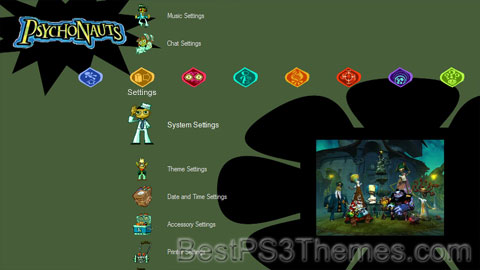
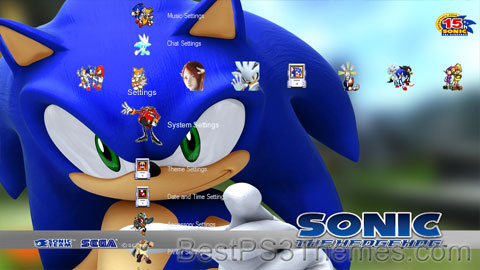
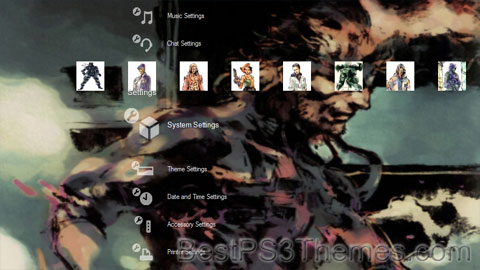
This program unpacks Playstation 3 Theme files (.p3t) so that you can touch-up an existing theme to your likings or use a certain wallpaper from it (as many themes have multiple). But remember, if you use content from another theme and release it, be sure to give credit!
Download p3textractor.zip from above. Extract the files to a folder with a program such as WinZip or WinRAR. Now there are multiple ways to extract the theme.
The first way is to simply open the p3t file with p3textractor.exe. If you don’t know how to do this, right click the p3t file and select Open With. Alternatively, open the p3t file and it will ask you to select a program to open with. Click Browse and find p3textractor.exe from where you previously extracted it to. It will open CMD and extract the theme to extracted.[filename]. After that, all you need to do for any future p3t files is open them and it will extract.
The second way is very simple. Just drag the p3t file to p3textractor.exe. It will open CMD and extract the theme to extracted.[filename].
For the third way, first put the p3t file you want to extract into the same folder as p3textractor.exe. Open CMD and browse to the folder with p3extractor.exe. Enter the following: p3textractor filename.p3t [destination path]Replace filename with the name of the p3t file, and replace [destination path] with the name of the folder you want the files to be extracted to. A destination path is not required. By default it will extract to extracted.filename.
This program unpacks Playstation 3 Theme files (.p3t) so that you can touch-up an existing theme to your likings or use a certain wallpaper from it (as many themes have multiple). But remember, if you use content from another theme and release it, be sure to give credit!
Download p3textractor.zip from above. Extract the files to a folder with a program such as WinZip or WinRAR. Now there are multiple ways to extract the theme.
The first way is to simply open the p3t file with p3textractor.exe. If you don’t know how to do this, right click the p3t file and select Open With. Alternatively, open the p3t file and it will ask you to select a program to open with. Click Browse and find p3textractor.exe from where you previously extracted it to. It will open CMD and extract the theme to extracted.[filename]. After that, all you need to do for any future p3t files is open them and it will extract.
The second way is very simple. Just drag the p3t file to p3textractor.exe. It will open CMD and extract the theme to extracted.[filename].
For the third way, first put the p3t file you want to extract into the same folder as p3textractor.exe. Open CMD and browse to the folder with p3extractor.exe. Enter the following: p3textractor filename.p3t [destination path]Replace filename with the name of the p3t file, and replace [destination path] with the name of the folder you want the files to be extracted to. A destination path is not required. By default it will extract to extracted.filename.
With possibilities: This is a redirect from a title that potentially could be expanded into a new article or other type of associated page such as a new template. The topic described by this title may be more detailed than is currently provided on the target page or in a section of that page.
When the target page becomes too large, or for any reason a new page would be an improvement, this redirect may be replaced with an article, template or other project page that is carved out of the target page. See also {{R to section}} and use together with this rcat when appropriate.
If the topic of the redirect is not susceptible to expansion, then use other rcats such as {{R to section}} or {{R to list entry}}when appropriate.
Since a new page may be created, links to this redirect should not be replaced with a direct link to the target page. To make redirects to this page, use {{R avoided double redirect}}.
{{R printworthy}} should be used together with this template when applied to a redirect in mainspace.
This program unpacks Playstation 3 Theme files (.p3t) so that you can touch-up an existing theme to your likings or use a certain wallpaper from it (as many themes have multiple). But remember, if you use content from another theme and release it, be sure to give credit!
Download p3textractor.zip from above. Extract the files to a folder with a program such as WinZip or WinRAR. Now there are multiple ways to extract the theme.
The first way is to simply open the p3t file with p3textractor.exe. If you don’t know how to do this, right click the p3t file and select Open With. Alternatively, open the p3t file and it will ask you to select a program to open with. Click Browse and find p3textractor.exe from where you previously extracted it to. It will open CMD and extract the theme to extracted.[filename]. After that, all you need to do for any future p3t files is open them and it will extract.
The second way is very simple. Just drag the p3t file to p3textractor.exe. It will open CMD and extract the theme to extracted.[filename].
For the third way, first put the p3t file you want to extract into the same folder as p3textractor.exe. Open CMD and browse to the folder with p3extractor.exe. Enter the following: p3textractor filename.p3t [destination path]Replace filename with the name of the p3t file, and replace [destination path] with the name of the folder you want the files to be extracted to. A destination path is not required. By default it will extract to extracted.filename.
Final Fantasy VII[a] is a 1997 role-playing video game developed by Square for the PlayStation console and the seventh main installment in the Final Fantasy series. Square published the game in Japan, and it was released in other regions by Sony Computer Entertainment, becoming the first game in the main series to have a PAL release. The game's story follows Cloud Strife, a mercenary who joins an eco-terrorist organization to stop a world-controlling megacorporation from using the planet's life essence as an energy source. Ensuing events send Cloud and his allies in pursuit of Sephiroth, a superhuman who seeks to wound the planet and harness its healing power in order to be reborn as a god. Throughout their journey, Cloud bonds with his party members, including Aerith Gainsborough, who holds the secret to saving their world.
Development began in 1994, originally for the Super Nintendo Entertainment System. After delays and technical difficulties from experimenting with several platforms, most notably the Nintendo 64, Square moved production to the PlayStation, largely due to the advantages of the CD-ROM format. Veteran Final Fantasy staff returned, including series creator and producer Hironobu Sakaguchi, director Yoshinori Kitase, and composer Nobuo Uematsu. The title was the first in the series to use full motion video and 3D computer graphics, featuring 3D character models superimposed over 2D pre-rendered backgrounds. Although the gameplay remained mostly unchanged from previous entries, Final Fantasy VII introduced more widespread science fiction elements and a more realistic presentation. The combined development and marketing budget amounted to approximately US$80 million.
The gameplay of Final Fantasy VII is similar to earlier Final Fantasy titles and Japanese role-playing games.[1] The game features three modes of play: the world map, the field, and the battle screen.[2][3]: 15, 20 At its grandest scale, players explore the world of Final Fantasy VII on a 3D world map.[4] The world map contains representations of areas for the player to enter, including towns, environments, and ruins.[5] Natural barriers—such as mountains, deserts, and bodies of water—block access by foot to some areas; as the game progresses, the player receives vehicles that help traverse these obstacles.[3]: 44 Chocobos can be found in certain spots on the map, and if caught, can be ridden to areas inaccessible on foot or by vehicle.[3]: 46 In field mode, the player navigates fully scaled versions of the areas represented on the world map.[4]VII marks the first time in the series that the mode is represented in a three-dimensional space. In this mode, the player can explore the environment, talk with characters, advance the story, and initiate event games.[3]: 15 Event games are short minigames that use special control functions and are often tied to the story.[3]: 18 While in field mode, the player can also find shops and inns. Shops allow the player to buy and sell items that can aid Cloud and his party, such as weapons, armor, and accessories. Inns restore the hit points and mana points of characters who rest at them and cure abnormalities contracted during battles.[3]: 17
A battle scene with Cloud, Barret, and Tifa facing a dragon. In this given moment, the player must choose a command for Cloud to perform.
At random intervals on the world map and in field mode, and at specific moments in the story, the game will enter the battle screen, which places the player characters on one side and the enemies on the other. It employs an "Active Time Battle" (ATB) system, in which the characters exchange moves until one side is defeated.[1][2] The damage or healing dealt by either side is quantified on screen. Characters have several statistics that determine their effectiveness in battle; for example, hit points determine how much damage they can take, and magic determines how much damage they can inflict with spells. Each character on the screen has a time gauge; when a character's gauge is full, the player can input a command for them. The commands change as the game progresses, and are dependent on the characters in the player's party and their equipment. Commands include attacking with a weapon, casting magic, using items, summoning monsters, and other actions that either damage the enemy or aid the player characters. Final Fantasy VII also features powerful, character-specific commands called Limit Breaks, which can be used only after a special gauge is charged by taking enemy attacks. After being attacked, characters can be afflicted by one or more abnormal "statuses", such as poison or paralysis. These statuses and their adverse effects can be removed by special items or abilities or by resting at an inn. Once all enemies are defeated, the battle ends and the player is rewarded with money, items, and experience points. If the player is defeated, it is game over and the game must be loaded to the last save point.[3]: 20–27
When not in battle, the player can use the menu screen, where they can review each character's status and statistics, use items and abilities, change equipment, save the game when on the world map or at a save point, and manage orbs called Materia. Materia are the main method of customizing characters in Final Fantasy VII, and can be added to equipment to provide characters with new magic spells, monsters to summon, commands, statistical upgrades, and other benefits.[6] Materia level up through their own experience point system and can be combined to create different effects.[3]: 30–42
Final Fantasy VII takes place on a world referred to in-game as the "Planet" and retroactively named "Gaia".[7][8] The planet's lifeforce, called the Lifestream, is a flow of spiritual energy that gives life to everything on the Planet; its processed form is known as "Mako".[9] On a societal and technological level, the game has been defined as an industrial or post-industrialscience fiction setting.[10] During Final Fantasy VII, the Shinra Electric Power Company, a world-dominating megacorporation headquartered in the city of Midgar, is draining the Planet's Lifestream for energy, weakening the Planet and threatening its existence and all life.[11] Significant factions within the game include AVALANCHE, an eco-terrorist group seeking Shinra's downfall so the Planet can recover;[8] the Turks, a covert branch of Shinra's security forces;[12] SOLDIER, an elite Shinra fighting force created by enhancing humans with Mako;[13] and the Cetra, a near-extinct human tribe which maintains a strong connection to the Planet and the Lifestream.[14]
The main protagonist is Cloud Strife, an aloof mercenary who claims to be a former 1st Class SOLDIER. Early on, he works with two members of AVALANCHE: Barret Wallace, its brazen but fatherly leader; and Tifa Lockhart, a shy yet nurturing martial artist and his childhood friend. During their journey, they meet Aerith Gainsborough, a carefree flower merchant and one of the last surviving Cetra;[14][15]Red XIII, an intelligent quadruped from a tribe that protects the planet;[16]Cait Sith, a fortune-telling robotic cat controlled by repentant Shinra staff member Reeve;[3][17] and Cid Highwind, a pilot whose dream of being the first human in outer space was unrealized.[18] The group can also recruit Yuffie Kisaragi, a young ninja and skilled Materia thief; and Vincent Valentine, a former Turk and victim of Shinra's experiments.[19] The game's main antagonists are Rufus Shinra, the son of President Shinra and the later leader of the Shinra Corporation;[20]Sephiroth, a former SOLDIER who reappears several years after being presumed dead;[3] and Jenova, a hostile extraterrestrial life-form who the Cetra imprisoned 2,000 years ago and who Sephiroth was created from.[21][22][23] A key character in Cloud's backstory is Zack Fair, a member of SOLDIER and Aerith's first love.[24]
AVALANCHE destroys a Shinra Mako reactor in Midgar, but an attack on another reactor goes wrong and Cloud falls into the city's slums. There, he meets Aerith and protects her from Shinra.[25][26] Meanwhile, Shinra finds AVALANCHE's base of operations and intentionally collapses part of the upper city level in retaliation for the Mako reactor being destroyed, killing many AVALANCHE members and innocent bystanders as collateral damage.[27] Aerith is also captured since Shinra believes that as a Cetra, she can potentially reveal the "Promised Land", which they believe is overflowing with Lifestream energy they can exploit.[28][29] Cloud, Barret, and Tifa rescue Aerith, and during their escape from Midgar, discover that Sephiroth murdered President Shinra despite being presumed dead five years earlier.[30] The party pursues Sephiroth across the Planet, with now-President Rufus on their trail; they are soon joined by the rest of the playable characters.
At a Cetra temple, Sephiroth reveals he intends to use a powerful magical artifact known as "Black Materia" to cast the spell "Meteor", which would have a devastating impact on the Planet. Sephiroth claims he will absorb the Lifestream as it attempts to heal the wound caused by Meteor, and become a god-like being in the process.[31] The party retrieves the Black Materia, but Sephiroth manipulates Cloud into surrendering it. Aerith departs alone to stop Sephiroth and follows him to an abandoned Cetra city. While Aerith prays to the Planet for help, Sephiroth attempts to force Cloud to kill her; after this fails, he kills her himself before fleeing, leaving the White Materia behind.[32] The party then learns of Jenova, a hostile alien lifeform who landed on the Planet two thousand years prior to the game's events. Upon arrival on the Planet, Jenova began infecting the Cetra with a virus, and they were nearly wiped out. However, a small group managed to seal away Jenova in a tomb, which Shinra later unearthed. At Nibelheim, Jenova's cells were used in experiments which led to the creation of Sephiroth.[21][32] Five years before the game's events, Sephiroth and Cloud visited Nibelheim, where Sephiroth learned of his origins and was driven insane as a result. He murdered the townspeople, and then vanished after Cloud confronted him.
At the Northern Crater, the party learns that the "Sephiroths" they have encountered are Jenova clones who the insane Shinra scientist Hojo created. Cloud confronts the real Sephiroth as he is killing his clones to reunite Jenova's cells, but is again manipulated into giving him the Black Materia. Sephiroth then taunts Cloud by showing another SOLDIER in his place in his memories of Nibelheim, suggesting that Cloud is a failed clone of Sephiroth.[33] Sephiroth summons Meteor and seals the Crater as Cloud falls into the Lifestream and Rufus captures the party.
After escaping Shinra, the party discovers Cloud at an island hospital in a catatonic state from Mako poisoning, and Tifa decides to stay as his caretaker. When a planetary defense force called Weapon attacks the island, the two fall into the Lifestream,[34] where Tifa helps Cloud reconstruct his memories. Cloud was a mere infantryman who was never accepted into SOLDIER; the SOLDIER in his memories was his friend Zack. At Nibelheim, Cloud ambushed and wounded Sephiroth after the latter's mental breakdown, but Jenova preserved Sephiroth's life. Hojo experimented on Cloud and Zack for four years, injecting them with Jenova's cells and Mako. They managed to escape, but Zack was killed in the process. The trauma of these events triggered an identity crisis in Cloud, and he constructed a false persona based around Zack's stories and his own fantasies.[32][35] Cloud accepts his past and reunites with the party, who learn that Aerith's prayer to the Planet had been successful: the Planet had attempted to summon Holy to prevent Meteor's impact, but Sephiroth prevented it from having any effect.
Shinra fails to destroy Meteor, but manages to defeat a Weapon and puncture the Northern Crater, seemingly killing Rufus and several other personnel. After killing Hojo, who is revealed to be Sephiroth's biological father,[21] the party descends to the Planet's core through the opening in the Northern Crater and defeats both Jenova and Sephiroth. The party escapes and Holy is summoned once again, destroying Meteor with help from the Lifestream.[36] Five hundred years later, Red XIII is seen with two cubs looking out over the ruins of Midgar, which are now covered in greenery, showing that the planet has healed.
Producer Hironobu Sakaguchi and director Yoshinori Kitase, who together helped create the story and gameplay concepts for Final Fantasy VII.
Initial concept talks for Final Fantasy VII began in 1994 at Square studio, following the completion of Final Fantasy VI. As with the previous installment, series creator Hironobu Sakaguchi reduced his role to producer and granted others a more active role in development: these included Yoshinori Kitase, one of the directors of FFVI. The next installment was planned as a 2D game for Nintendo's Super Nintendo Entertainment System (Super NES). After creating an early 2D prototype of it, the team postponed development to help finish Chrono Trigger.[37] Once Chrono Trigger was completed, the team resumed discussions for Final Fantasy VII in 1995.[37][38]
The team discussed continuing the 2D strategy, which would have been the safe and immediate path just prior to the imminent industry shift toward 3D gaming; such a change would require radical new development models.[37] The team decided to take the riskier option and make a 3D game on new generation hardware but had yet to choose between the cartridge-based Nintendo 64 or the CD-ROM-based PlayStation from Sony Computer Entertainment.[37] The team also considered the Sega Saturn console and Microsoft Windows.[39] Their decision was influenced by two factors: a highly successful tech demo based on Final Fantasy VI using the new Softimage 3D software, and the escalating price of cartridge-based games, which was limiting Square's audience.[37][40][41] Tests were made for a Nintendo 64 version, which would use the planned 64DD peripheral despite the lack of 64DD development kits and the prototype device's changing hardware specifications. This version was discarded during early testing, as the 2000 polygons needed to render the Behemoth monster placed excessive strain on the Nintendo 64 hardware, causing a low frame rate.[37] It would have required an estimated thirty 64DD discs to run Final Fantasy VII properly with the data compression methods of the day.[42] Faced with both technical and economic issues on Nintendo's current hardware, and impressed by the increased storage capacity of CD-ROM when compared to the Nintendo 64 cartridge, Square shifted development of Final Fantasy VII, and all other planned projects, onto the PlayStation.[37]
In contrast to the visuals and audio, the overall gameplay system remained mostly unchanged from Final Fantasy V and VI, but with an emphasis on player control.[43] The initial decision was for battles to feature shifting camera angles. Battle arenas had a lower polygon count than field areas, which made creating distinctive features more difficult.[40] The summon sequences benefited strongly from the switch to the cinematic style, as the team had struggled to portray their scale using 2D graphics.[44] In his role as producer, Sakaguchi placed much of his effort into developing the battle system.[24] He proposed the Materia system as a way to provide more character customization than previous Final Fantasy games: battles no longer revolved around characters with innate skills and roles in battle, as Materia could be reconfigured between battles.[40] Artist Tetsuya Nomura also contributed to the gameplay; he designed the Limit Break system as an evolution of the Desperation Attacks used in Final Fantasy VI. The Limit Breaks served a purpose in gameplay while also evoking each character's personality in battle.[24][40]
Square retained the passion-based game development approach from their earlier projects, but now had the resources and ambition to create the game they wanted. This was because they had extensive capital from their earlier commercial successes, which meant they could focus on quality and scale rather than obsessing over and working around their budget.[37]Final Fantasy VII was at the time one of the most expensive video game projects ever, costing an estimated US$40 million, which adjusted for inflation came to $61 million in 2017.[37][45][46] Development of the final version took a staff of between 100 and 150 people just over a year to complete. As video game development teams were usually only 20 people, the game had what was described as the largest development team of any game up to that point.[37][44] The development team was split between both Square's Japanese offices and its new American office in Los Angeles; the American team worked primarily on city backgrounds.[42]
Promotional artwork of the main cast. The main characters were designed by Tetsuya Nomura; Final Fantasy VII was his first role as character designer.[24][37]
The game's art director was Yusuke Naora, who had previously worked as a designer for Final Fantasy VI. With the switch into 3D, Naora realized that he needed to relearn drawing, as 3D visuals require a very different approach than 2D. With the massive scale and scope of the project, Naora was granted a team devoted entirely to the game's visual design. The department's duties included illustration, modeling of 3D characters, texturing, the creation of environments, visual effects, and animation.[47] The Shinra logo, which incorporated a kanji symbol, was drawn by Naora personally.[48] Promotional artwork, in addition to the logo artwork, was created by Yoshitaka Amano, an artist whose association with the series went back to its inception.[49] While he had taken a prominent role in earlier entries, Amano was unable to do so for Final Fantasy VII, due to commitments at overseas exhibitions.[8][49] His logo artwork was based on Meteor: when he saw images of Meteor, he was not sure how to turn it into suitable artwork. In the end, he created multiple variations of the image and asked staff to choose which they preferred.[50] The green coloring represents the predominant lighting in Midgar and the color of the Lifestream, while the blue reflected the ecological themes present in the story. Its coloring directly influenced the general coloring of the game's environments.[47]
Another prominent artist was Nomura. Having impressed Sakaguchi with his proposed ideas, which were handwritten and illustrated rather than simply typed on a PC, Nomura was brought on as main character designer.[24] Nomura stated that when he was brought on, the main scenario had not been completed, but he "went along like, 'I guess first off you need a hero and a heroine', and from there drew the designs while thinking up details about the characters. After [he'd] done the hero and heroine, [he] carried on drawing by thinking what kind of characters would be interesting to have. When [he] handed over the designs [he'd] tell people the character details [he'd] thought up, or write them down on a separate sheet of paper".[51] Something that could not be carried over from earlier titles was the chibi sprite art, as that would not fit with the new graphical direction. Naora, in his role as an assistant character designer and art director, helped adjust each character's appearance so the actions they performed were believable. When designing Cloud and Sephiroth, Nomura was influenced by his view of their rivalry mirroring the legendary animosity between Miyamoto Musashi and Sasaki Kojirō, with Cloud and Sephiroth being Musashi and Kojirō respectively. Sephiroth's look was defined as "kakkoii", a Japanese term combining good looks with coolness.[40] Several of Nomura's designs evolved substantially during development. Cloud's original design of slicked-back black hair with no spikes was intended to save polygons and contrast with Sephiroth's long, flowing silver hair. However, Nomura feared that such masculinity could prove unpopular with fans, so he redesigned Cloud to feature a shock of spiky, bright blond hair. Vincent's occupation changed from researcher to detective to chemist, and finally to a former Turk with a tragic past.[8][24]
Sakaguchi was responsible for writing the initial plot, which was quite different from the final version.[52] In this draft for the planned SNES version, the game's setting was envisioned as New York City in 1999. Similar to the final story, the main characters were part of an organization trying to destroy Mako reactors, but they were pursued by a hot-blooded detective named Joe. The main characters would eventually blow up the city. An early version of the Lifestream concept was present at this stage.[37][41][52] According to Sakaguchi, his mother had died while Final Fantasy III was being developed, and choosing life as a theme helped him cope with her passing in a rational and analytical manner.[44] Square eventually used the New York setting in Parasite Eve (1998).[41] While the planned concept was dropped, Final Fantasy VII still marked a drastic shift in setting from previous entries, dropping the Medieval fantasy elements in favor of a world that was "ambiguously futuristic".[53]
Gods of War, a 2009 science fiction novel by Ashok Banker
God of War (DC Comics), a 2010–2011 limited six-issue comic book series published by WildStorm and DC Comics, based around the Greek era of the video game series.
God of War, a 2010 novelization of the 2005 video game, God of War, written by Matthew Stover and Robert E. Vardeman
God of War II, a 2013 novelization of the 2007 video game, God of War II, written by Robert E. Vardeman.
God of War (Dark Horse Comics), a 2018–2021 limited two-volume eight-issue comic book series published by Dark Horse Comics, based around the Norse era of the video game series.
This disambiguation page lists articles associated with the title God of War. If an internal link led you here, you may wish to change the link to point directly to the intended article.
Similar to its predecessor, Killzone 2 takes place in the 24th century and chronicles the war between two human factions; the Vektans, and the Helghast. The game takes place two years after the events of Killzone and follows protagonist Tomas "Sev" Sevchenko as he and his unit battle the Helghast as the Vektans invade Helghan. The protagonist of Killzone and Killzone: Liberation, Cpt./Col. Jan Templar, returns in a supporting role, along with Rico Velasquez. Killzone 2 is played from a first-person view and allows the player to use a variety of weapons. It was released worldwide in February 2009.
Killzone 2 was widely anticipated prior to its release. It was critically acclaimed by critics and fans, who praised it as a superior title to the original Killzone. Additional praise was given to the game's visuals, action, multiplayer modes, soundtrack and atmosphere, although criticism was directed at the narrative. The game's critical and commercial success led to a sequel, Killzone 3, which was released in February 2011.
The official servers for Killzone 2 and Killzone 3 were shut down in March 2018. However, in 2021, a game preservation group called PSONE restored most of the game's online capability on their own set of servers.
The game is presented almost entirely from a first person perspective, aside from vehicular combat. Killzone 2 features a "lean and peek" cover system which allows the player to take cover behind an object and then pop out to fire at enemies. The "lean and peek" mechanic stays in first-person view at all times. It is also possible for the player to pilot vehicles at two points in the game: a tank and an exoskeleton. Many classic weapons and vehicles from previous Killzone installments return, such as the M82-G and the StA-52 LAR.[citation needed] The Sixaxis motion control feature is also utilized in performing certain actions such as turning a valve, arming an explosive charge and sniping.
Warzone, the title of the online multiplayer component of Killzone 2 has been developed by Guerrilla Games in conjunction with the game's single-player campaign.[citation needed] The online multiplayer gameplay is class-based, meaning the player can choose a class of character which is specialized for a specific role to better suit the player's needs in battle. There are 7 classes in total, in which the player can mix and match a main and sub ability according to their playing style, and can switch abilities upon death. There are 15 weapons available to the player, most of which cannot be used until the player reaches a certain rank. Two of these weapons are secondary firearms, and a further two weapons, the Boltgun and Flamethrower, are exclusive to the downloadable maps "Suljeva Cliffside" and "Arctower Landing".
Players play as either the ISA or Helghast, with a few gameplay differences. The character model and respawn points, and the "lean and peek" cover systems were removed. Each class levels up with experience gained from killing enemies or completing mission objectives. With enough experience, players unlock new weapons and skills, as well as a new class. Each class has two badges, the Primary badge selects the class and their specified skill. The secondary badge has an extra skill for the specified class but can be swapped to create own custom class.
Warzone plays out through dynamic matches where multiple game types are played in a single round. The game does not reset between game types, instead flowing between them, with the winning team determined by who wins the most modes. The game ships with five different game types including Assassination, Search & Retrieve, Search & Destroy, Bodycount and Capture & Hold.[1] Online matches can connect 2 to 32 players, and they can group into six squads of up to four players. If an online match does not have a full 32 players, computer-generated "bots" can be added in to create bigger teams (but only in an unranked match). Killzone 2 also offers a clan system, which allows clans of up to 64 players to compete for "Valor Points", an in-game currency that clans can use to bet on tournaments.
Players can also play offline against AIs with Skirmish mode and unranked online multiplayer, but there is no offline multiplayer mode for splitscreen players.
Eight multiplayer maps are included on disc at release,[2] but Guerrilla has released more maps as downloadable content. 6 more maps have been added to multiplayer since release via downloadable content purchasable from the PlayStation Store.
Two years after the attempted Helghast invasion of Vekta, an ISA fleet led by Colonel Jan Templar is sent to attack Pyrrhus, the capital city of Helghan, with the goal of deposing and arresting Emperor Scolar Visari on charges of war crimes. Among the ISA units taking part in the attack is Alpha Squad, led by Jan's old comrade Ricardo "Rico" Velasquez. Sergeant Tomas "Sev" Sevchenko, a veteran of the ISA "Legion" battalion, is assigned to serve as his second-in-command.
Tasked with securing Pyrrhus against the fierce resistance of the Helghan Second Army, the team quickly discovers that the Helghast are well prepared for an invasion. Using Helghan's harsh environment to their advantage, they have developed new weapons and equipment, none of which the ISA has ever seen before. Furthermore, the planet's fog-like atmosphere, gritty deserts, and constant storms pose almost as much of a threat to the invaders as the enemy themselves.
Led by Jan's flagship, the New Sun, the ISA bombard Pyrrhus as cover for a massive ground assault on the city. Despite stiff resistance from well-armed Helghast divisions, they steadily advance towards the Imperial Palace, ultimately capturing both Visari Square and the Helghan Military Academy. Just as the main convoy is set to attack the palace, Colonel Mael Radec, commander of the Second Army, activates a network of arc towers hidden beneath Pyrrhus, killing hundreds of ISA soldiers and breaking their momentum.
Dante Garza, a member of Alpha Squad and close friend of Tomas's, retrieves a piece of a destroyed tower and sends it to ISA researcher Evelyn Batton, who learns that the towers are powered by Petrusite, a mineral capable of generating and channeling electricity. She also identifies an old mining outpost on the outskirts of Pyrrhus where the Helghast have been secretly extracting it for military use.
While working to restore the outpost's communication antenna, Tomas and Rico are separated from the rest of Alpha Squad, allowing Radec's men to capture them. The two fight their way through the refinery where the captives were taken, stumbling upon an interrogation overseen by Radec himself. Oddly enough, he demands that Evelyn give him the launch codes to a set of stolen nuclear warheads in Helghast custody. Rico loses his temper and surprises Radec, saving the captives but leaving Garza mortally wounded when one of Radec's men Rico kills discharges his weapon and Garza is shot in the process. Blaming him for his friend's death, Tomas and the squad return to the New Sun.
Before Garza can be properly mourned, an elite Helghast battalion led by Radec mounts a surprise attack on the fleet, boarding or destroying several ships including the Sun. The ship's crew manages to evacuate, but Radec reaches the bridge, mortally wounds Jan and executes Evelyn, downloading the codes before they can be deleted. With the last of his strength and before succumbing to his wounds, Jan maneuvers the ship to crash into the center of Helghan's Petrusite distribution grid, causing it to explode and disrupt the arc network.
Seizing the opportunity, the survivors attempt to regroup, only to witness Visari detonate the warheads over Pyrrhus, destroying it and killing both the entire population and most of the remaining ISA forces.
With ISA captain Jason Narville leading an offensive on the remnants of the Second Army, Alpha Squad breaches the palace, where they encounter Radec and the imperial guard. After a pitched battle, the wounded commander and his men commit mass suicide out of disgrace, clearing the way to Visari's throne room.
As Tomas moves to arrest him, Visari gloats that he has still won, as the Helghast are now united against the ISA, and without him, they cannot be stopped. Overcome with guilt and wanting revenge for Templar and Garza's deaths, Rico kills him on the spot.
Weary from fighting, Tomas exits the palace and sits on the steps. Above him, a large armada belonging to the Helghan First Army begins its attack on what is left of the ISA invasion force.
At E3 2005, Killzone 2 was debuted with a trailer depicting soldiers landing in a hostile war-zone on Helghan and fighting Helghast forces. Critics in the media argued that the trailer shown at the trade show did not show actual gameplay footage, as its high level of visual detail has been argued to be impossible to render in real-time on the PlayStation 3 and the audio mix of the trailer was slightly delayed. SCEA's Vice President, Jack Tretton, stated that the footage of Killzone 2, that was believed to be pre-rendered, "is real gameplay everybody's seeing out there".[3] Several days later, Phil Harrison, SCE Europe's Vice President of Development, stated in an interview that all of the footage of PlayStation 3 games at E3 2005 were "running off video" which was "done to PS3 spec".[4] Further interviews eventually revealed the trailer was indeed a "target render", a prerendered video showing the developer's goals for the finished product.[5]
At the Game Developers Conference in 2007, a Killzone 2 teaser was shown behind closed doors, and was never released to the public. It featured various battles, destructible environments, and lighting effects among others.[6]Killzone 2 was shown to a panel of journalists at a special pre-E3 2007 event in Culver City, California, and then the next day to the public at Sony's E3 press conference.[7] An in-game trailer showing real-time gameplay of Killzone 2 was also released,[8] along with several videos of extended gameplay.[9] A number of media outlets since E3, such as the BBC, have referred to Killzone 2 as being "one of the most cinematic and immersive games ever produced on a console".[10] At the Leipzig Games Convention in 2007, Killzone 2 was presented in playable form to the media. It was the same demo level as shown at E3 2007, although journalists were allowed to play it hands-on.[11] At Sony's PlayStation Day 2008, the first level in Killzone 2's single-player campaign was presented, named "Corinth River".[12]
Michal Valient, a Senior Programmer at Guerrilla Games, presented details of their Killzone 2 proprietary game engine at a Developers Conference in July 2007.[13] As with many other titles published by SCE, including LittleBigPlanet and Infamous, Killzone 2 uses a deferred shading engine which enables far greater control over the game's characteristic lighting palette, while maximising processor throughput and limiting shader complexity. Other games to use similar approaches include Rockstar Games' Grand Theft Auto IV and GSC Game World's S.T.A.L.K.E.R.: Shadow of Chernobyl. However, this approach does create some additional problems, notably with respect to anti-aliasing and transparencies. The former was solved using a MSAA Quincunx (multisample anti-aliasing) solution, and the latter by the addition of a standard forward rendering path. The game's graphics were universally praised by critics.[14]
The animation was done in Maya 8.5 with some motion capture animations tweaked in MotionBuilder. 3D artists, animators and level designers used Maya as their production environment, which is unusual considering that most 3D games are produced using 3ds max. A large library of custom Maya tools and scripts was created to support these different disciplines.[15] Tools like "Hyperion", a lightmap rendering software, were used in place of Maya's viewport rendering software. In-game animation was assisted with another tool they created called "AnimationBlender" and particle effects were edited using a tool called "Particle Editor". They also created a tool called "ColorTweaker", which gave them the possibility to do color correction on the PS3 in real-time.[15]
Most of the animation was done using motion capture with some animations, reload animations for example, done by hand. Facial animation was done using blendshapes with bones for the jaw and the eyes. Lead tech artist, Paulus Bannink, explains that "The main reason for going with blendshapes was the relative ease with which they can be transferred to different faces, it would also provide a more artist friendly way of editing the facial animation rig.".[15] The cut scene facial animation was done using marker motion capture. In game dialog was done generically using MotionBuilder after audio files were plugged in. The game was developed not only by artists in Amsterdam, but also by people living in New Zealand, Australia, Japan, Korea, the UK and the US. The data files, gigabytes in size, were sent over the internet.[15]
Killzone 2's budget was originally US$20 million but rose to US$40–45 million at the end of the development, with a team of 120.[16][17][18][19]
The score to Killzone 2 was composed by Joris de Man, who scored 60 minutes of in-game music and 30-minutes of live orchestral score for the game, recorded at Abbey Road Studios in London, with the Nimrod Studio Orchestra.[20] The score was produced and mixed by Rich Aitken, regular mix partner for Joris de Man and Marc Canham, at Nimrod Productions.
Killzone 2 (Original Soundtrack from the Video Game)
Beta access was given to a select number of North American and European PlayStation Network subscribers. The beta consisted of three online multiplayer maps; "Blood Gracht" (small), "Radec Academy" (medium) and "Salamun Market" (large), with unlockable ranks and character classes ("badges"). Beta testers had their own statistics and have the ability to enter clan competitions. Beta access was private and thus could not be shared with other PlayStation Network accounts. Also, beta testers are tied with Sony Computer Entertainment Inc. by a non-disclosure agreement; therefore they were not allowed to reveal contents of the beta experience. A technical demo of one of Killzone 2's TV commercials, known as the "Bullet" trailer, was released on the PlayStation Store on April 2, 2009.[21] The demo features the commercial itself, the ability to shift camera angles and film speed, and several commentaries from key development staff at Guerrilla Games.
On February 5, 2009, SCEE released a single player demo of Killzone 2 on the European/Oceanic PlayStation Store.[22] The demo includes the first two sections of 'Corinth River' (the first level of the game) as well as the tutorial sequence from the final game.[23] A demo card, granting access to a Killzone 2 demo was also offered to US gamers who pre-ordered the game at GameStop. The US demo was also made available to those customers on February 5. In the North American version of PlayStation Home, if users found an avatar dressed in a Helghast costume, the avatar with the Helghast costume would give that user a code for the demo. This occurred on February 16.[24] On February 26, the demo was made available for download from the PlayStation Store in North America.
The servers for Killzone 2 and Killzone 3 were shut down on March 29, 2018. They have since been offline and can no longer be played online.[25]
In the North American version of PlayStation Home, if users pre-ordered Killzone 2 from Amazon.com, users received free male and female I.S.A. and Helghast uniforms for their avatar.[26] In the European version of PlayStation Home, if users participated in the "Killzone AM" event that took place on Saturday March 28, 2009, at 11 am CET for one full round, the Home Managers gave the participants a code for the Killzone 2 uniforms. Requirement was that users had to have a United KingdomPSN account.[27] For a limited time in Japanese Home, users received an I.S.A. uniform for watching the Killzone 2 trailer and answering a questionnaire. To get the Helghast uniform in Japan, users had to do a pre-order. In Home's shopping complex, there are fourteen — seven for male and seven for female — Killzone 2 themed shirts available for purchase as well as the Helghast Tactician uniform. A costume for Radec was released on March 4, 2010, to the European Home and has been released in the North American.
Guerrilla Games have released a Killzone 2 themed apartment called the "Visari Throne Room" for Home. The Visari Throne Room apartment is based on the throne room inside Visari's Palace from the final mission of Killzone 2. For the Visari Throne Room, there are five pieces of furniture based on actual palace furnishings from Killzone 2: two types of Visari-style chairs, an administrative desk, a plant container with authentic Helghan vegetation, and a freestanding painting which portrays an important moment in the colonial history of the Helghast. The Visari Throne Room and matching furniture were made available to the European Home on July 2, 2009,[28] the North American on August 27, 2009,[29] and the Asian[30] and Japanese Home on October 9, 2009.[31]
On April 10, 2009[32] Hermen Hulst, Managing Director from Guerrilla Games announced on GameTrailers TV[citation needed] that Killzone 2 would get a DLC map pack named "Steel & Titanium" which would contain two new maps called Wasteland Bullet and Vekta Cruiser. With new gameplay elements and strategic twists.[33][34] The first DLC map pack was released on Thursday, April 30.[34][35] Hulst stated that the next Killzone 2 DLC map pack that they were releasing would have a 'Retro Vibe' to it.[citation needed]
The second map pack was officially announced on May 20, 2009 as "Flash and Thunder", and features two maps previously seen in Killzone called "Beach Head" and "The Southern Hills". Both maps followed the first map pack by bringing new gameplay elements and strategic twists; Beach Head, the wide open battlefield, with rain-filled trenches, and Southern Hills with its intermittent nuke explosion. It was released on June 11, 2009.[36] Both map packs have twelve trophies that go along with them, six for each map.
On July 10 the third map pack was officially announced, even though Sony stated that there were no plans for a third pack. The DLC "Napalm and Cordite" was released on July 23, 2009, it contained two new maps "Suljeva Cliffside" and "Arctower Landing", in addition to the maps the Flamethrower and the Boltgun both from singleplayer made their debut in multiplayer.[37] The Flamethrower is found in the Suljeva Cliffside map and the Boltgun is found in the Arctower Landing map. A multiplayer map pack bundle was also released to coincide with the release of Napalm and Cordite, containing all six maps from the DLC packs, for the price of four maps.[38] The downloadable content pack three has eight trophies that go along with it, four for each map which are for the new weapons. With the fifth anniversary of the original Killzone taking place, the map pack "Flash & Thunder" was reduced in price in North America and Europe.