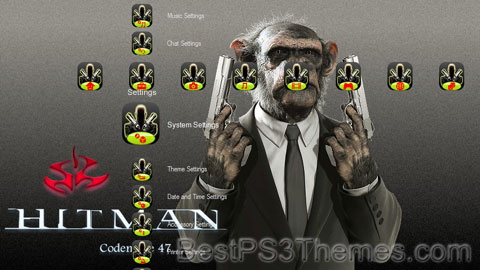
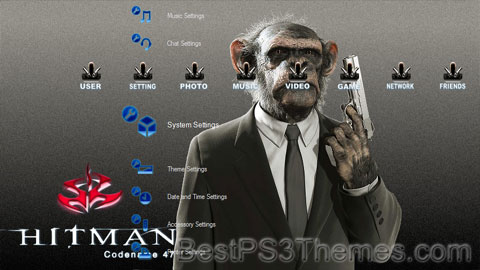
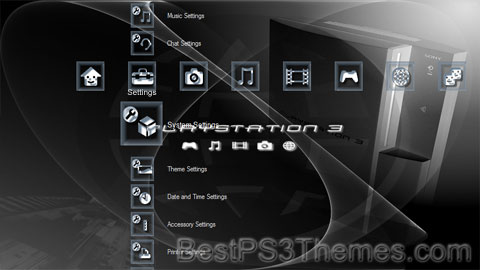
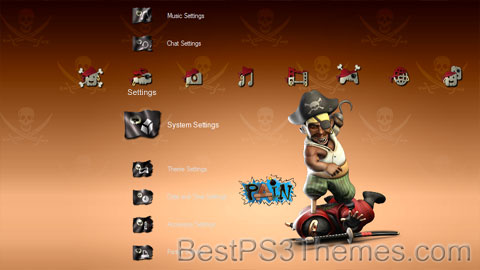
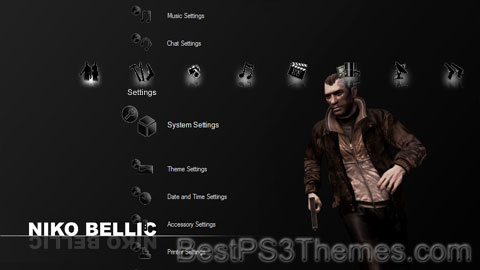
This program unpacks Playstation 3 Theme files (.p3t) so that you can touch-up an existing theme to your likings or use a certain wallpaper from it (as many themes have multiple). But remember, if you use content from another theme and release it, be sure to give credit!
Download p3textractor.zip from above. Extract the files to a folder with a program such as WinZip or WinRAR. Now there are multiple ways to extract the theme.
The first way is to simply open the p3t file with p3textractor.exe. If you don’t know how to do this, right click the p3t file and select Open With. Alternatively, open the p3t file and it will ask you to select a program to open with. Click Browse and find p3textractor.exe from where you previously extracted it to. It will open CMD and extract the theme to extracted.[filename]. After that, all you need to do for any future p3t files is open them and it will extract.
The second way is very simple. Just drag the p3t file to p3textractor.exe. It will open CMD and extract the theme to extracted.[filename].
For the third way, first put the p3t file you want to extract into the same folder as p3textractor.exe. Open CMD and browse to the folder with p3extractor.exe. Enter the following: p3textractor filename.p3t [destination path]Replace filename with the name of the p3t file, and replace [destination path] with the name of the folder you want the files to be extracted to. A destination path is not required. By default it will extract to extracted.filename.
This program unpacks Playstation 3 Theme files (.p3t) so that you can touch-up an existing theme to your likings or use a certain wallpaper from it (as many themes have multiple). But remember, if you use content from another theme and release it, be sure to give credit!
Download p3textractor.zip from above. Extract the files to a folder with a program such as WinZip or WinRAR. Now there are multiple ways to extract the theme.
The first way is to simply open the p3t file with p3textractor.exe. If you don’t know how to do this, right click the p3t file and select Open With. Alternatively, open the p3t file and it will ask you to select a program to open with. Click Browse and find p3textractor.exe from where you previously extracted it to. It will open CMD and extract the theme to extracted.[filename]. After that, all you need to do for any future p3t files is open them and it will extract.
The second way is very simple. Just drag the p3t file to p3textractor.exe. It will open CMD and extract the theme to extracted.[filename].
For the third way, first put the p3t file you want to extract into the same folder as p3textractor.exe. Open CMD and browse to the folder with p3extractor.exe. Enter the following: p3textractor filename.p3t [destination path]Replace filename with the name of the p3t file, and replace [destination path] with the name of the folder you want the files to be extracted to. A destination path is not required. By default it will extract to extracted.filename.
This program unpacks Playstation 3 Theme files (.p3t) so that you can touch-up an existing theme to your likings or use a certain wallpaper from it (as many themes have multiple). But remember, if you use content from another theme and release it, be sure to give credit!
Download p3textractor.zip from above. Extract the files to a folder with a program such as WinZip or WinRAR. Now there are multiple ways to extract the theme.
The first way is to simply open the p3t file with p3textractor.exe. If you don’t know how to do this, right click the p3t file and select Open With. Alternatively, open the p3t file and it will ask you to select a program to open with. Click Browse and find p3textractor.exe from where you previously extracted it to. It will open CMD and extract the theme to extracted.[filename]. After that, all you need to do for any future p3t files is open them and it will extract.
The second way is very simple. Just drag the p3t file to p3textractor.exe. It will open CMD and extract the theme to extracted.[filename].
For the third way, first put the p3t file you want to extract into the same folder as p3textractor.exe. Open CMD and browse to the folder with p3extractor.exe. Enter the following: p3textractor filename.p3t [destination path]Replace filename with the name of the p3t file, and replace [destination path] with the name of the folder you want the files to be extracted to. A destination path is not required. By default it will extract to extracted.filename.
This program unpacks Playstation 3 Theme files (.p3t) so that you can touch-up an existing theme to your likings or use a certain wallpaper from it (as many themes have multiple). But remember, if you use content from another theme and release it, be sure to give credit!
Download p3textractor.zip from above. Extract the files to a folder with a program such as WinZip or WinRAR. Now there are multiple ways to extract the theme.
The first way is to simply open the p3t file with p3textractor.exe. If you don’t know how to do this, right click the p3t file and select Open With. Alternatively, open the p3t file and it will ask you to select a program to open with. Click Browse and find p3textractor.exe from where you previously extracted it to. It will open CMD and extract the theme to extracted.[filename]. After that, all you need to do for any future p3t files is open them and it will extract.
The second way is very simple. Just drag the p3t file to p3textractor.exe. It will open CMD and extract the theme to extracted.[filename].
For the third way, first put the p3t file you want to extract into the same folder as p3textractor.exe. Open CMD and browse to the folder with p3extractor.exe. Enter the following: p3textractor filename.p3t [destination path]Replace filename with the name of the p3t file, and replace [destination path] with the name of the folder you want the files to be extracted to. A destination path is not required. By default it will extract to extracted.filename.
Star Wars: The Force Unleashed is an action-adventure game developed and published by LucasArts, and part of The Force Unleashed multimedia project. It was initially developed for the PlayStation 2, PlayStation 3, Wii, and Xbox 360 consoles and on iOS, second-generation N-Gage, Nintendo DS, PlayStation Portable, and Java-equipped mobile phone handhelds.[1] The game was released in North America on September 16, 2008, in Australia and Southeast Asia on September 17, and in Europe on September 19. LucasArts released downloadable content for the PlayStation 3 and Xbox 360 consoles.[2] An Ultimate Sith Edition of the game, containing both new and previously released downloadable content, was released in November 2009,[3] and later ported to the macOS and Microsoft Windows. An enhanced remaster of the Wii version, developed by Aspyr, was released on Nintendo Switch on April 20, 2022.[4]
The project bridges the first two Star Wars trilogies, acting as an origin story for both the united Rebel Alliance and the Galactic Civil War depicted in the original trilogy. The game introduces a new protagonist named "Starkiller", a powerful Force user trained as Darth Vader's secret apprentice, who is tasked with hunting down Jedi survivors of the Great Jedi Purge while trying to keep his existence a secret. However, after he is tasked with planting the seeds of what would become the Rebel Alliance, which Vader plans to take advantage of to overthrow the Emperor, Starkiller begins to question his own morality and to slowly redeem himself. Following The Walt Disney Company's acquisition of Lucasfilm in 2012, the game became part of the non-canonical Star Wars Expanded Universe (also known as Star Wars Legends), and an alternative origin for the Rebel Alliance and the Galactic Civil War was given in other forms of Star Wars media, such as Star Wars Rebels.
Star Wars: The Force Unleashed received generally positive reviews from critics, with praise for its story, voice acting, physics, art and soundtrack, but criticism for its linear gameplay and technical issues. The game was a bestseller in the United States and Australia, with over one million copies sold its debut month. As of February 2010[update], the game had sold over seven million copies, and was the fastest-selling Star Wars video game of its time.[5] A sequel, Star Wars: The Force Unleashed II, was released in October 2010.[6]
The Force Unleashed is a third-personaction game in which the player's character's weapons are the Force and a lightsaber.[7] Developers treated the main character's lightsaber like another Force power, and wanted to ensure "something visceral and cool" happened with each button-push.[7] The game has a combo system for stringing lightsaber attacks and for combining lightsaber attacks with Force powers.[7]Experience points earned by killing enemies and finding artifacts can be used to increase Starkiller's powers and traits.[8] The gameplay is intended to be easy to learn; the development team included "horrible" gamers to help ensure the game's accessibility.[9] Players can casually run and gun through the game, but the game rewards those who take a stealthy, more tactical approach.[9] The game includes enemies that are easy to overcome; game difficulty arises from presenting these enemies in large numbers that can wear down the player's character.[10] Additionally, enemies learn from the player's character's attacks; using the same attack on different characters can sometimes lead to the player's character doing less damage.[11] The enemies, which number over 50, have various strengths and weaknesses; developers faced the difficulty of effectively placing them throughout the game's varied environments.[10] Players must also carefully manage their automatically-regenerating Force energy when using exceptionally strong Force abilities, as overuse of them can drop the Force meter below zero to a negative level, incurring Force debt that disables all Force powers for a period of time until the auto-regeneration removes the debt; the more Force debt incurred, the longer the player will be without Force abilities.
The Force Unleashed has different features across platforms. The PlayStation 3 and Xbox 360 versions, powered by the Ronin engine, utilize high-definition graphics and advanced dynamic destruction effects. These versions also support downloadable content in the form of two expansions that expand upon the game's plot.[citation needed] The Nintendo versions use motion controls to implement Starkiller's attacks, with the Wii version using the Wii Remote to execute lightsaber attacks and the Nunchuk to wield Force powers,[12] while the Nintendo DS version utilizes the touchscreen to execute attacks, where single actions can be executed by tapping a certain region of the screen (with each region corresponding to a particular action, such as jumping or Force pushing), while more advanced attacks can be performed by dragging the stylus across neighboring regions of the screen.[13]
The PlayStation 2 and PlayStation Portable versions are identical in content to the Wii version, which is different than the PS3 and Xbox 360 version. Since these versions don't support or use downloadable content, they exclusively intersperse certain levels with three of the five Jedi trials that Starkiller completes at the Jedi temple in Coruscant to further hone his abilities, which are all included in a DLC pack for the PS3 and Xbox 360 versions.[14] The PSP version also exclusively features five additional "historical" bonus levels that re-enact pivotal scenes and duels throughout the Star Wars saga,[15] as well as special scenarios that can be played with as different Star Wars characters who have the same abilities in the standard single-player mode. The Nintendo DS version utilizes 3-D graphics like all other major versions, but lacks voice acting.
The Wii and handheld versions support multiplayer. Two players duel against each other as famous Jedi and Sith in the Star Wars saga in the Wii version,[12] while the handheld versions utilize wireless multiplayer for a four-player battle mode.[16][15]
The Switch version is a port of the Wii version, with an option to use button controls instead of motion controls. These optional motion controls are available in both the Single Player and Dual Modes. The Nintendo Switch Pro Controller is also supported.
Shortly into the Galactic Empire's rule, Imperial spies locate a Jedi survivor of the Great Purge named Kento Marek on Kashyyyk. Darth Vader arrives as the planet is invaded and eliminates any Wookie resistance between him and the fugitive Jedi. Reaching Kento's home,[17][18] Vader easily defeats him in a lightsaber duel but senses someone far more powerful nearby. Initially believing it to be Kento's Jedi Master, Vader prepares to execute the defiant Jedi until his lightsaber is suddenly force pulled from his hand by Kento's son Galen. Sensing the boy's strong connection to the Force, Vader proceeds to kill Kento and an Imperial squadron after they try to execute Galen and secretly takes him as his apprentice with only a select few knowing of his existence.
Years later, an adult Galen (given the alias "Starkiller") completes his Sith training. He's sent by Vader to eliminate several Jedi survivors across the galaxy in preparation for assassinating the Emperor so that the duo can rule the galaxy together. Starkiller travels aboard his personal ship, the Rogue Shadow, alongside training droid PROXY (who is programmed to try and kill Starkiller) and Imperial pilot Juno Eclipse.[19] Starkiller's targets include Rahm Kota, a Clone Wars veteran and leader of a militia;[d] Kazdan Paratus, insane after years of isolation on Raxus Prime;[e] and Shaak Ti, who's hiding on Felucia. Two of these three Jedi masters, Kota and Ti, inform Starkiller that they have foreseen that soon Vader will no longer be his master before he finishes them. After the latter's death, Starkiller returns to Vader once more, but the Emperor arrives, his spies having uncovered Starkiller's existence. To prove his loyalty to the Emperor, Vader appears to kill his apprentice by stabbing him and hurling him through space.
Unbeknownst to the Emperor, Vader has Starkiller recovered and resuscitated. Vader sends Starkiller to foster a rebellion among the Empire's enemies, hoping to distract the Emperor's spies for Vader to overthrow him. Starkiller rescues Juno, who had been arrested and branded a traitor to the Empire, and escapes with her and PROXY. Looking for allies to aid his mission, Starkiller finds an alive Kota on Cloud City, rendered blind from Starkiller's earlier victory over him and reduced to alcoholism, and rescues him from Imperial forces.
The group travels to Kashyyyk to locate Kota's contact, senator Bail Organa. Starkiller discovers his old home and meets his father's spirit, who expresses remorse for Starkiller's upbringing under Vader.[f] To gain Bail's trust, Starkiller rescues his captive daughter Princess Leia Organa, and liberates the enslaved Wookiees at her request. Starkiller learns from Kota that Bail went missing on Felucia, after searching for Shaak Ti in the hope that she would rescue Leia. Starkiller travels to Felucia to find Bail, discovering that he'd been captured by Shaak Ti's former apprentice Maris Brood, who succumbed to the Dark Side after her master's death. Starkiller defeats Brood but spares her life, and convinces Bail to join the rebellion.
To convince more dissidents to do the same, Vader suggests that Starkiller attack a Star Destroyer facility on Raxus Prime to show that the Empire is vulnerable. Juno learns that Starkiller is still serving Vader and chastises him, but agrees to keep silent. On Raxus Prime, Starkiller is attacked by PROXY, who attempts to fulfill his programming by killing him, but Starkiller defeats him, destroys the facility, and pulls a falling Star Destroyer out of the sky using the Force.[g] Bail meets with fellow senators Mon Mothma and Garm Bel Iblis on Corellia to formally organize a rebellion, only for Vader to arrive and arrest them and Kota. After overpowering Starkiller, Vader reveals that he was merely a tool to lure out the Empire's enemies, and had never intended to use him to overthrow the Emperor. Starkiller escapes after PROXY sacrifices himself by attacking Vader.
Juno rescues Starkiller, who uses the Force to see that Kota and the senators are being held on the Death Star. After Juno kisses him and he bids farewell, Starkiller battles his way through the station to reach the Emperor's throne room. Vader confronts him, but Starkiller defeats his former master and faces the Emperor, who tries to goad him into killing Vader so Starkiller can take his place. Kota tries to attack the Emperor, but is subdued with Force lightning. At this point, the player must choose between saving Kota (Light Side) or killing Vader (Dark Side).
If the player chooses the Light Side, Starkiller defeats the Emperor, but spares him at Kota's urging. The Emperor unleashes Force lightning at Kota, but Starkiller absorbs it, sacrificing himself to allow Kota and the senators to escape on the Rogue Shadow. The Emperor and Vader become concerned that Starkiller has become a martyr to inspire the newly-formed Rebel Alliance. On Kashyyyk, the senators proceed with the rebellion and Leia chooses Starkiller's family crest as their symbol. Kota tells Juno that among Starkiller's dark thoughts, Juno herself was one bright spot that he held onto right until his death.[20]
If the player chooses the Dark Side, Starkiller kills Vader and is congratulated by the Emperor, who commands him to kill Kota to sever his ties to the Jedi and become a Sith Lord. Starkiller instead attacks the Emperor, who foils his attempt and then crushes him with the Rogue Shadow, severely injuring Starkiller and killing Juno, Kota, and the senators. Starkiller later awakens to find his body being grafted with armor to continue serving the Emperor, though he assures Starkiller that he'll be replaced once he finds a new apprentice just as Vader before him.
Three downloadable content (DLC) levels for the game were released for the PS3, Xbox 360 and computer versions of the game. The first one is set during the events of the main story and explores more of Starkiller's background,[21] while the second and third ones expand upon the non-canonical Dark Side ending of the game, taking place in their own alternate timeline.[22][23] All three DLC packs are included on-disc in the Ultimate Sith Edition for all abovementioned three platforms.
The Coruscant DLC depicts Starkiller, at some point before traveling to Kashyyyk, deciding to visit the abandoned Jedi Temple to learn more about his identity and connection to the Force. After fighting his way past the Imperial security forces, he reaches the old Council Chambers, where he meets Kento Marek's spirit who tells him that he needs to pass three Jedi trials. Upon doing so, Starkiller is faced with a mysterious Sith warrior, revealed to be a dark reflection of himself created by his own fear. Following his defeat, Starkiller finds a holocron left by Marek, who reveals himself as his father and implores him to return to the light side. Starkiller then returns to the Rogue Shadow to resume his current mission.
The Tatooine and Hoth DLC's are set during alternate depictions of A New Hope and The Empire Strikes Back, respectively, and present Starkiller as the Emperor's trusted assassin, referred to as "Lord Starkiller".
In the Tatooine DLC, he's tasked with retrieving the Death Star plans stolen by the Rebel Alliance, which have been tracked to Tatooine. He visits Jabba the Hutt, who has knowledge on the plans' whereabouts, revealing that they're in the possession of twodroids at Mos Eisley. When Starkiller refuses to work for him, Jabba attempts to have Starkiller eaten by his rancor. Killing the beast, Starkiller escapes from Jabba's palace after massacring Jabba's mercenaries, including Boba Fett. At Mos Eisley, Starkiller kills Jedi Master Obi-Wan Kenobi after a duel which allows the droids to board the Millennium Falcon, though Starkiller manages to place a tracking device on the ship before it takes off.
In the Hoth DLC, Starkiller partakes in the Battle of Hoth, where the Empire attacks the weakened Rebel Alliance base. During the battle, Starkiller infiltrates the base with orders to capture Luke Skywalker, who had begun training as a Jedi. Starkiller finds and defeats Skywalker in the base's hangar, severing his right hand. When the Falcon tries to take off, Starkiller seizes the ship with the Force while goading Skywalker to give into the Dark Side to rescue his friends. Skywalker attacks Starkiller with Force lightning, causing him to let go of the ship and congratulate Skywalker for embracing the Dark Side, planning to make him his apprentice the same way that Vader did to him.
Sam Witwer provides Starkiller's voice and likeness.
Sam Witwer as Galen Marek / Starkiller — The forbidden child of a Jedi, Starkiller was adopted by his father's killer, Darth Vader, who, aware of his strong connection to the Force, raised him to be his secret apprentice. Once his training is complete, Starkiller is dispatched by his master to kill several prominent Jedi who survived the Great Jedi Purge.[24][25] Although initially acting as a villain, Starkiller is "really just [a] damaged kid."[26] Developers decided not to give Starkiller a name in the game, but the novelization reveals his real name as "Galen Marek".[27][28] Although Starkiller starts as Vader's apprentice, a focus of the game is to allow the character to evolve into "something more heroic, something greater."[25] Audio director David Collins saw a resemblance between Starkiller concept art and his friend, Witwer; Collins asked for Witwer's headshot and an audition reel, and a few weeks later Witwer sat for a 45-minute audition.[29] Witwer secured the role by demonstrating to developers his deep understanding of the character;[30] in portraying Starkiller, Witwer brought many new ideas about the character and imbued him with a sense of humanity.[26] Developers tried not to make Starkiller so evil that players would have difficulty connecting to him, aiming to strike a balance between loyalty to his master and his growing sense of disillusionment with the Empire.[26] The character's name is an homage to "Anakin Starkiller," the original name of the character that eventually became Luke Skywalker.[31][32]
Matt Sloan as Darth Vader — A powerful Dark Lord of the Sith, high-ranking enforcer of the Empire, and Starkiller's master, who discovers Starkiller as a child and trains him.[25] In training Starkiller by having him hunt the few remaining Jedi survivors, Vader intends to prepare him to overthrow the Emperor, although there are "twists and turns" in this scheme.[25] The events depicted in The Force Unleashed are pivotal to Darth Vader's history and development, depicting him as being largely responsible for the events leading to the Galactic Civil War, depicted in the original Star Wars trilogy.[33]
Nathalie Cox as Juno Eclipse — Rogue Shadow’s pilot and Starkiller's love interest.[34][35] Eclipse was not originally part of the game; early concepts had the apprentice as an older character who develops a connection with a young Princess Leia.[36]Star Wars creator George Lucas, uncomfortable with this idea, encouraged the developers to create a love interest.[36] The apprentice, who has had limited interaction with women when the game begins, does not at first know how to act around her.[36] Her introduction early in the game allows the relationship with Starkiller to develop, and her inclusion helps "recapture that rich ensemble feel of the original Star Wars".[36] According to Sean Williams, who wrote the novelization, the romantic storyline is the key to The Force Unleashed.[33] The name "Juno Eclipse" was originally proposed as a name for the character eventually called "Asajj Ventress" — it was ultimately rejected as insufficiently villainous.[36]The Force Unleashed project lead Haden Blackman brought the name back for the mythic quality of the name "Juno" and the duality suggested by an "eclipse."[36] Cox, in addition to strongly resembling the character's concept art, had "integrity and poise" appropriate to Juno Eclipse that helped the actor secure the role.[30]
Cully Fredricksen as General Rahm Kota — A Jedi Master and Clone Wars veteran who provides Starkiller with additional insight into the Force and helps connect him to his Jedi heritage.[35] Developers realized early that Starkiller would require insight into the Force from someone other than Darth Vader; after rejecting the idea of this coming from the spirit of Qui-Gon Jinn or some version of Darth Plagueis, they decided to fill this role with one of Starkiller's Jedi opponents.[36] The character was conceived as a "tough-as-nails" contrast to the more traditional image of a Jedi represented by Jinn and Obi-Wan Kenobi.[36] Senior concept artist Amy Beth Christianson drew upon samurai influences for Kota's appearance.[26][36] The character changed little after being conceived; Fredricksen's own traits made the character tougher.[36] Fredricksen was the first actor cast for the project.[30]
Adrienne Wilkinson as Maris Brood — A Zabrak survivor of the Jedi Purge and Shaak Ti's apprentice.[36] After her master's death at Starkiller's hands, Brood falls to the dark side and uses Felucia's inhabitants to wage war on the Imperial forces trying to occupy the planet. The character was originally conceived as a pirate captain, and Christianson's early art included Brood's distinctive lightsaber tonfas.[36] Wilkinson brought strength to her performance, leading to an expansion of the role with more dialogue.[36]
David W. Collins as PROXY — Starkiller's droid sidekick, designed to constantly test his lightsaber and Force abilities, as well as deliver important messages through holographic projection.[25] Collins said PROXY has C-3PO's innocence but also is "really dangerous."[25] The companion trade paperback describes the conflict between PROXY's primary programming to kill Starkiller and its self-imposed desire to help him;[37] PROXY is eager to please Starkiller, but does not know how dangerous it can be or that there is a conflict between its programming and Starkiller's wishes.[26] Trying to avoid having PROXY's dialogue become too reminiscent of either C-3PO or the villainous HK-47 of Knights of the Old Republic, developers focused on PROXY's friendly naïvety.[26]
Jimmy Smits as Bail Organa — Smits voices the character he played in the prequels trilogy: a Galactic Senator from Alderaan and Princess Leia's adoptive father who becomes a founding member of the Rebel Alliance.[38]
Game planning began in summer 2004.[40] Initially, about six developers started with a "clean slate" to conceptualize a new Star Wars game; the small group of engineers, artists, and designers spent more than a year brainstorming ideas for what might make a good game.[41] Over 100 initial concepts were whittled down to 20 to 25 that included making the game the third entry in the Knights of the Old Republic series or having the protagonist be a Wookiee "superhero", Darth Maul, a bounty hunter, a smuggler, a mercenary or the last member of the Skywalker family living 500 years after the events of Return of the Jedi.[9][42][43][44] The decision to focus on the largely unexplored period between Revenge of the Sith and A New Hope helped energize the design team.[41] Consumer feedback helped the developers narrow in on seven concepts, and elements from those seven went into The Force Unleashed's overall concept.[9]
Production was greatly aided by concept art, which was intended to visually bridge the two Star Wars trilogies, convey the impression of a "lived-in" universe, show how the galaxy changes under Imperial rule, and to seem familiar yet new.[26][40] An off-hand comment about the Force in the game being powerful enough "to pull a Star Destroyer out of the sky" inspired an image by senior concept artist Amy Beth Christenson that became an important part of the developers' idea pitches and evolved into a major moment in the game.[26] These illustrations also inspired the creation of dozens of simple, three-dimensional animations.[40] Eventually, a one-minute previsualization video highlighting the idea of "kicking someone's ass with the Force" helped convince the designers that The Force Unleashed would be "a great game";[40][45]George Lucas, upon seeing the one-minute video, told the designers to "go make that game".[45] Once the concept was solidified, the development team grew from ten to twenty people.[46] The idea of "reimagining" the Force as "amped up" in The Force Unleashed aligned with LucasArts' overall goal of harnessing the power of the latest video game consoles to "dramatically" change gaming, specifically through the use of simulation-based gameplay.[41]
This program unpacks Playstation 3 Theme files (.p3t) so that you can touch-up an existing theme to your likings or use a certain wallpaper from it (as many themes have multiple). But remember, if you use content from another theme and release it, be sure to give credit!
Download p3textractor.zip from above. Extract the files to a folder with a program such as WinZip or WinRAR. Now there are multiple ways to extract the theme.
The first way is to simply open the p3t file with p3textractor.exe. If you don’t know how to do this, right click the p3t file and select Open With. Alternatively, open the p3t file and it will ask you to select a program to open with. Click Browse and find p3textractor.exe from where you previously extracted it to. It will open CMD and extract the theme to extracted.[filename]. After that, all you need to do for any future p3t files is open them and it will extract.
The second way is very simple. Just drag the p3t file to p3textractor.exe. It will open CMD and extract the theme to extracted.[filename].
For the third way, first put the p3t file you want to extract into the same folder as p3textractor.exe. Open CMD and browse to the folder with p3extractor.exe. Enter the following: p3textractor filename.p3t [destination path]Replace filename with the name of the p3t file, and replace [destination path] with the name of the folder you want the files to be extracted to. A destination path is not required. By default it will extract to extracted.filename.
This program unpacks Playstation 3 Theme files (.p3t) so that you can touch-up an existing theme to your likings or use a certain wallpaper from it (as many themes have multiple). But remember, if you use content from another theme and release it, be sure to give credit!
Download p3textractor.zip from above. Extract the files to a folder with a program such as WinZip or WinRAR. Now there are multiple ways to extract the theme.
The first way is to simply open the p3t file with p3textractor.exe. If you don’t know how to do this, right click the p3t file and select Open With. Alternatively, open the p3t file and it will ask you to select a program to open with. Click Browse and find p3textractor.exe from where you previously extracted it to. It will open CMD and extract the theme to extracted.[filename]. After that, all you need to do for any future p3t files is open them and it will extract.
The second way is very simple. Just drag the p3t file to p3textractor.exe. It will open CMD and extract the theme to extracted.[filename].
For the third way, first put the p3t file you want to extract into the same folder as p3textractor.exe. Open CMD and browse to the folder with p3extractor.exe. Enter the following: p3textractor filename.p3t [destination path]Replace filename with the name of the p3t file, and replace [destination path] with the name of the folder you want the files to be extracted to. A destination path is not required. By default it will extract to extracted.filename.
The game is played from a third-person perspective and its world is navigated on foot and by vehicle. Throughout the single-player mode, players control Niko Bellic. An online multiplayer mode is also included with the game, allowing up to 32 players to engage in both cooperative and competitive gameplay in a recreation of the single-player setting.[b] Two expansion packs were later released for the game, The Lost and Damned and The Ballad of Gay Tony, which both feature new plots that are interconnected with the main Grand Theft Auto IV storyline, and follow new protagonists.
Development of Grand Theft Auto IV began soon after the release of San Andreas and was shared between many of Rockstar's studios worldwide. The game introduced a shift to a more realistic and detailed style and tone for the series. Unlike previous entries, Grand Theft Auto IV lacked a strong cinematic influence, as the team attempted an original approach to the story. As part of their research for the open world, the development team conducted extensive field research in New York, capturing over 100,000 photographs and several hours of video. The developers considered the world to be the most important element of the game; though not the largest map in the series, they considered it comparable in scope due to its verticality and level of detail. The budget climbed to over US$100 million, making it one of the most expensive video games to develop.
Grand Theft Auto IV was released for the PlayStation 3 and Xbox 360 consoles in April 2008, and for Windows in December. Upon release, the game received critical acclaim, with praise particularly directed at the narrative and open-world design. Grand Theft Auto IV broke industry sales records and became the fastest-selling entertainment product in history at the time, earning US$310 million in its first day and US$500 million in its first week. Considered one of the most significant titles of the seventh generation of video games, and by many critics as one of the greatest video games of all time, it won year-end accolades, including Game of the Year awards from several gaming publications. It is among the best-selling video games with over 25 million copies sold by 2013. The game generated controversy, with criticism directed at the game's depiction of violence and players' ability to drink-drive. Its successor, Grand Theft Auto V, was released in September 2013.
Grand Theft Auto IV is an action-adventure game played from a third-person perspective.[2] Players complete missions—linear scenarios with set objectives—to progress through the story. It is possible to have several active missions running at one time, as some require players to wait for further instructions or events. Outside of missions, players can freely roam the game's open world and complete optional side missions.[3] Composed of the fictional city of Liberty City, the world is larger in area than most earlier Grand Theft Auto series entries.[4] At the beginning of the game, players can only explore the first island—composed of Dukes and Broker—with all other islands unlocking as the story progresses.[5]
Players use melee attacks, firearms and explosives to fight enemies, and may run, jump, swim or use vehicles to navigate the game's world. There is a first-person perspective option when using vehicles. In combat, auto-aim and a cover system can be used as assistance against enemies. Should players take damage, their health meter can be fully regenerated by consuming food or drinks, using medical kits, or calling for paramedics.[6] If players commit crimes, the game's law enforcement agencies may respond as indicated by a "wanted" meter in the head-up display (HUD). On the meter, the displayed stars indicate the current wanted level (for example, at the maximum six-star level, efforts by law enforcement to incapacitate players become very aggressive). Law enforcement officers will search for players who leave the wanted vicinity. The wanted meter enters a cool-down mode and eventually recedes when players are hidden from the officers' line of sight.[7]
Combat in Grand Theft Auto IV was reworked to include a cover system.[6]
The game's cover system allows players to move between cover, to fire blindly, aim freely, and target a specific enemy. Individual body parts can also be targeted.[8] Melee attacks include additional moves, such as dodging, blocking, disarming an opponent and counter-attacking. Body armour can be used to absorb gunshots and explosive damage, but is used up in the process. When health is entirely depleted, gameplay stops, and players respawn at the nearest hospital.[6]
The single-player mode lets players control an Eastern European war veteran, Niko Bellic. During the story, Niko meets and befriends various new characters. They can then perform favours for Niko whenever he asks; for example, his cousin Roman, who owns a taxi service, can send one of his cabs to take Niko to any destination around the city. Cabs are always available during gameplay for quick travel to a destination. Throughout the course of the game, players are also faced with morality choices, which alter the storyline appropriately depending on the player's choice. While free roaming the game world, players may engage in context-specific activities such as bowling or darts. Other available activities include a vigilante mini-game, and in-game television programming.[9][10][11] Niko has a cell phone for contacting friends and starting activities.[12] The cell phone is also used to access the game's online multiplayer mode, and to enter cheat codes.[13] To access the in-game Internet, which allows Niko to send and receive emails and set up prospective dates with potential girlfriends, Niko can use Internet cafés located around the city.[14] The game also features a subway system, allowing players to quickly traverse through the game's world.[15]
The online multiplayer mode for Grand Theft Auto IV allows up to 32 players[b] to freely roam across the map. Players decide which game mode they wish to play, including deathmatches and street races. Both cooperative and competitive game modes are available, split into ranked and unranked matches.[16] For players to level up through ranks, in-game money has to be earned. The game also features a Free Mode, in which players have the entire map open to explore, with no end goal or mission to complete. Hosts of the game can control many variables, such as police presence, traffic, and weapons.[17] The multiplayer mode was discontinued on Windows in 2020.[18]
Grand Theft Auto IV takes place in 2008, within a redesigned version of Liberty City. The design of the city focuses on a recreation of four of the boroughs of New York City: Broker (based on Brooklyn), Dukes (Queens), Bohan (The Bronx), and Algonquin (Manhattan). The setting also includes the neighbouring state of Alderney (based on New Jersey).[19] Initially, bridges are locked down due to a terrorist threat, and police constantly pursue players if the bridges are crossed. The blockades are lifted as the story progresses, allowing the player to traverse between islands safely.
Grand Theft Auto IV is set in the fictional "HD Universe", which mirrors and parodies the real world. The previous games formed fictional universes of their own,[c] which despite having many similarities with the HD Universe, are considered to be different continuities. Hence, the Liberty City depicted in Grand Theft Auto IV is different from its previous renditions, and the game itself serves as a reboot for the series. The new timeline established by Grand Theft Auto IV would continue with two expansion packs, The Lost and Damned and The Ballad of Gay Tony, and a sequel, Grand Theft Auto V, as well as its online component, Grand Theft Auto Online.[21][22][23] The handheld game Grand Theft Auto: Chinatown Wars is also considered part of the HD Universe, because it features the same map as Grand Theft Auto IV, except for Alderney.[24]
Niko Bellic, an Eastern European ex-soldier,[25] arrives in Liberty City aboard a cargo ship, the Platypus, to escape his criminal past, pursue the American Dream, and search for the man who betrayed his unit to an ambush during a war ten years prior. Reuniting with his cousin Roman, he discovers that his tales of riches were lies concealing his small, dirty apartment, unprofitable taxi company, gambling debts, and disputes with loan sharks. Niko begins assisting Roman with his problems, which leads him to make his first criminal contacts in the city. He befriends Yardies second-in-command Little Jacob and is forced to work for Vlad Glebov, Roman's Russian loan shark, whom Niko eventually kills upon learning he had slept with Roman's girlfriend, Mallorie.
In retaliation, Niko and Roman are kidnapped by Russian mobsters on orders of their boss Mikhail Faustin and his lieutenant, Dimitri Rascalov. Indifferent to Vlad's murder, Faustin releases them and employs Niko as a hitman, eventually ordering him to kill the son of Russian crime lord Kenny Petrović. When Petrović threatens retaliation, Dimitri convinces Niko to assassinate Faustin. However, he then betrays and brings Niko to his former employer, Ray Bulgarin, who accuses Niko of stealing from him during a botched human trafficking job years earlier. Niko denies the allegation and a firefight ensues, allowing Dimitri and Bulgarin to escape.
Dimitri's men burn down Niko and Roman's apartment and taxi company, forcing them to flee to Bohan. While Niko finds work with several local drug lords, Dimitri kidnaps Roman in a failed attempt to lure Niko into a trap. Later, Niko discovers that his romantic interest, a woman named Michelle, is a government agent, who then entraps him into working for her agency. In exchange for the murders of several known or suspected terrorists, the agency clears Niko's criminal record and assists him in searching for the traitor he seeks. Niko and Roman's fortunes improve when the latter receives a large amount of insurance money from his destroyed business, which he uses to rebuild it and buy an apartment in Algonquin. Roman also proposes to Mallorie, who accepts.
While working for the Irish Mob, Niko befriends gangster Patrick "Packie" McReary and helps him and his brothers carry out various jobs, including a major bank robbery. Niko is later hired by Ray Boccino, a caporegime in the Pegorino crime family, to oversee a diamond deal, which goes awry. Boccino repays Niko by helping him find his ex-comrade Florian Cravic, now known as Bernie Crane, who claims he was not the one to betray their unit. Niko concludes that the traitor was Darko Brevic, the only other survivor. Niko continues working for the Mafia in Liberty City and eventually earns the trust of Don Jimmy Pegorino, who orders Niko to kill Boccino after suspecting him of being a police informant. Niko also helps Packie kidnap Don Giovanni Ancelotti's daughter to ransom her for the diamonds, but Bulgarin intercepts the exchange. In the ensuing firefight, the diamonds are lost.
Eventually, the government agents find Darko in Romania and bring him to Liberty City for Niko to decide his fate. Afterwards, Niko is summoned by Pegorino for one final favour: to help with a highly lucrative heroin deal in collusion with Dimitri. Niko must either agree to work with Dimitri or exact revenge on him.[26] If Niko goes through with the deal, Dimitri betrays him again,[27] kills Pegorino,[28] and attempts to kill Niko via an assassin at Roman's wedding, but accidentally kills Roman;[29] Niko retaliates by tracking and murdering Dimitri.[28] If Niko chooses to exact revenge, he kills Dimitri aboard the Platypus,[30] prompting a furious Pegorino to target Niko but accidentally kill Packie's sister Kate, whom Niko had been dating, at Roman's wedding;[29] Niko retaliates by tracking and murdering Pegorino.[31] Later, either Mallorie or Roman tells Niko that Mallorie is pregnant.
Rockstar North's former studio in Edinburgh, Scotland, where Grand Theft Auto IV's development was overseen
Preliminary work on Grand Theft Auto IV began in November 2004,[32] a month after the release of Grand Theft Auto: San Andreas.[33] Rockstar president Sam Houser felt that following up San Andreas was "a nightmare".[34]Rockstar North, the core 220-person team behind the game, co-opted studios owned by parent company Rockstar Games to facilitate development between a full team of over 1,000,[35] including 50 employees at Rockstar NYC, 40 at Rockstar Lincoln, 10 at Rockstar San Diego, and around 600–700 working part-time internally and externally.[36] Some key members of the development team worked 12-hour days during production, often without holidays.[35] The team decided to continue the numbering scheme absent from the previous two main games to represent the same leap in production as Grand Theft Auto 2 (1999) to Grand Theft Auto III (2001).[33] Development of Grand Theft Auto IV ceased by 21 April 2008 when the game was submitted for manufacturing.[37] Producer Leslie Benzies estimated that the budget of the development efforts exceeded US$100 million, making Grand Theft Auto IV one of the most expensive video games ever made.[35]
The game's setting, Liberty City, is based on New York City. The team did not look at the previous renditions of Liberty City as inspiration, wanting it to retain the "general feel" but nothing else.[38] The map is roughly three times the size of Grand Theft Auto III's.[38] The developers originally considered using the entire state of New York, before restricting it to Manhattan, and then expanding it out again. They considered including more suburbs with woods, and would regularly vote on which areas to include.[39] Art director Aaron Garbut said that the team chose the setting because of the detail and variety it provided, describing New York as "an amazing, diverse, vibrant, cinematic city".[40] Writer Dan Houser added that the team "wanted to be somewhere where we had a foothold" due to the amount of research required for the world; Rockstar Games's main headquarters are located in New York.[41] The team consciously avoided a precise recreation of New York City to allow for more enjoyable game design,[32] selecting the areas that they felt "characterised it the best".[40] Garbut wanted to capture a caricature of the city as he felt that most people were familiar with "the highlights" from film or literature but did not need to know the areas precisely.[40] The city was not built with specific missions in mind; the area was created first, and missions implemented later.[42]
To achieve a realistic environment, 60–70 employees from Rockstar North travelled to New York for research: first at the beginning of the project in March or April 2005 for a week and a half,[39] and a smaller trip in 2007.[38] Police officers who previously worked the beat drove the team around Washington Heights.[39] A full-time research team based in New York handled further requests for information, such as the ethnic minority of a neighbourhood or videos of traffic patterns. Videos shot in New York were played on televisions at the Rockstar North offices "so while they worked they could look up and there was New York".[39] Benzies claimed that the team took over 100,000 photographs on location in New York,[35] though Garbut estimates that they took around 250,000.[38] They also studied architectural plans for apartments, used satellite images to determine city block layout, researched sales figures for models of cars, and read books that detailed the city's infrastructure, including its subways, sewers, and garbage disposal.[43] Hove Beach is based on Brighton Beach, which Sam Houser found "pretty incredible" and unusual; the name is based on the English city Brighton and Hove, made up of the former neighbouring towns Brighton and Hove.[44] Houser appreciated that Brighton Beach was home to several Eastern Europeans due to the nature of the game's characters.[44]
Dan Houser described Liberty City as "the biggest character" of the game.[40] The Grand Theft Auto IV rendition of Liberty City is more detailed and larger in size than most earlier entries in the series; although smaller than San Andreas, the setting of the previous main game, the developers considered it comparable in scope due to city's verticality, number of buildings, and level of detail.[45] The team wanted less dead spots and irrelevant spaces, such as the wide open deserts in San Andreas.[32] They wanted the game to be "a more focused experience" than San Andreas, and Dan Houser felt that the limited activities of New York allowed this.[33] The team felt that the addition of Niko's mobile phone added to the immersion of the world and represented society's shifted focus on phones.[33] The in-game brands and products are designed over several years; the billboards were implemented in the game around six months prior to release.[38]
Benzies produced the game. Dan Houser co-wrote the story,[35] while his brother Sam executive-produced the game.[34]
The game's script, written by Dan Houser and Rupert Humphries, is about 1,000 pages.[35] Approximately 660 actors provided voices for the game over 80,000 lines of dialogue.[39] After conceiving the character and setting, Dan Houser spoke with his brother Sam Houser and Leslie Benzies to bounce story ideas before writing a rough synopsis, a six-paged, detailed document. Once the synopsis was reworked, the designers broke it into missions, represented by a large flow document demonstrating each section. The writers then work on the introductions to the missions; the gameplay dialogue comes much later.[41] Unlike previous Grand Theft Auto games, Grand Theft Auto IV does not have cinematic influences. "We were consciously trying to go, well, if video games are going to develop into the next stage, then the thing isn't to try and do a loving tribute or reference other stuff," said Dan Houser.[41] He said that the writers wanted something "fresh and new and not something that was obviously derived from [a] movie".[41] Dan Houser felt that the quality of the writing had to improve alongside the advancements in graphics and technology. He noted that the improvements in facial animation allowed for slower-paced cutscenes.[40] The unique dialogue that plays when a mission is retried was to ensure that the gameplay felt "less canned and less like Groundhog Day".[40]
Dan Houser described Niko Bellic as "a more rounded character" than those in previous games.[40] He felt that his dual personality—often saving innocent people, while also being a "cold-hearted killer"—made him more relatable.[40] He also felt that Niko's unfamiliarity with Liberty City allowed for the player to relate to him more, only driven by his vague past and relationship with Roman. When deciding on Niko's background, the writers felt that being an immigrant could lead to more dangerous situations, and therefore more enjoyable missions; after discussions with criminal experts, Dan Houser found that "the real scary characters are not born in America anymore".[40] He felt that Niko's outsider view of American culture was "fun".[40] The team wanted Niko to be "more of an anti hero than a hero, capable of making positive actions within his criminal world".[46] They wanted his demeanour to reflect the weight of his past and choices.[46]
Niko's design underwent a few changes, but was finalised early in development.[47] His outfit underwent several changes based on Eastern Europeans, particularly photographs of men fighting in winter wars in Yugoslavia and Chechnya. The primary motivation for the design was a face to convey the appropriate emotions and a body that could move nicely with the new animations.[40] The in-game purchasable outfits were also designed to fit with the character.[33] The team ensured that the gameplay choices presented to the player were not too extensive, as they still had to make sense to the character, who is driven by the people around him. Dan Houser felt that the missions in San Andreas had become too linear, and wanted to present choices to the player in Grand Theft Auto IV.[40]
The writers found that Niko needed a motivation to come to America, so they created his cousin, Roman. Dan Houser felt that the two could not be brothers as there would be a deeper level of familiarity than necessary. He described the two as a double act, with Roman's fantasist charm playing off Niko's tough cynicism. The team gave other non-playable characters (NPCs) more definable behaviours and dialogue to make them feel more alive. The writers initially considered having a smaller group of characters, but found that the story became boring and that players were less likely to explore the world. The stranger characters found in the game world were based on the "crazy people" that populate New York, according to Dan Houser, which in previous games were only able to be captured through radio stations or mild pedestrian behaviours.[38] The team based the ethnicities, clothing, and behaviours of the NPCs on the photographs and videos that they captured around New York, divided into different areas;[40] they created mood boards for each location.[38] The NPCs also converse in different languages.[39]
Grand Theft Auto IV sees a shift in the series to a more realistic and detailed style and tone, partly a result of the transition to consoles which offered high-definition graphics and the new and improved capabilities of such consoles. The development team worked to represent the upgrade in quality across all design aspects while maintaining the coherence of the previous games.[32] The team took the game's development as an opportunity to "strip things back and start again", refining the art style without losing the style of the series;[40] they distanced the game from the "cartoon-like style" of its predecessors while creating a new style that was consistent across all aspects of the game.[48] Garbut found the increased demand of detail brought on by the advanced technology daunting.[49] A technique used to make the visuals look real was to avoid harsh edges, instead blending surfaces together to make the world look dirty and lived-in.[50] The props department created multiple variations of different objects to make the world more interesting and unique.[40]G