Heavenly Sword theme by Tarot P. Turcato (PulseDragon)
Download: HeavenlySword_4.p3t
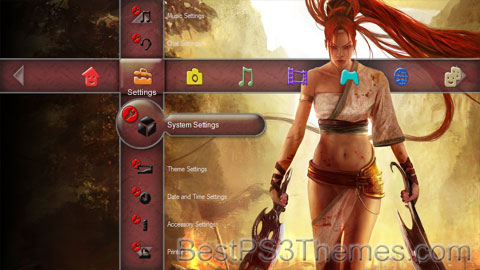
(1 background)
| Heavenly Sword | |
|---|---|
 European box art showing protagonist Nariko | |
| Developer(s) | Ninja Theory |
| Publisher(s) | Sony Computer Entertainment |
| Director(s) | Nina Kristensen Tameem Antoniades |
| Producer(s) | Mat Hart |
| Artist(s) | Hugues Giboire |
| Writer(s) | Tameem Antoniades Rhianna Pratchett Andy Serkis |
| Composer(s) | Nitin Sawhney |
| Platform(s) | PlayStation 3 |
| Release | |
| Genre(s) | Action-adventure, hack and slash |
| Mode(s) | Single-player |
Heavenly Sword is a 2007 action-adventure hack and slash video game developed by Ninja Theory and published by Sony Computer Entertainment for the PlayStation 3.
Gameplay[edit]
The game is an action-adventure title with heavy elements of hack and slash gameplay. The gameplay of the game resembles a martial arts title focused on melee combat while featuring opportunities for ranged attacks. The main character, Nariko, uses a weapon called the "Heavenly Sword" which changes into one of three forms depending on what attack stance the player uses as part of a unique fighting style. Speed Stance provides an even balance between damage and speed, where the sword takes the form of two separate blades.[1] Range Stance allows fast, long-range, but weaker attacks, with the sword being two blades chained together. Power Stance is the most powerful, but slowest style, where attacks are made with the sword in the shape of one large, two-handed blade.
For exploration and certain battles, the game also makes use of quick time events (QTE). During a QTE, a symbol for a certain button or for an action such as moving the analog stick to the right or left appears on-screen and the player must match what is shown to successfully complete the scene.[1]
In addition to Nariko, a secondary character, Kai, is controlled for some portions of the game.[1] Many of Kai's stages take the form of sniping missions, using her crossbow to pick off enemies, in some cases to protect characters. While Kai cannot perform hand-to-hand combat,[1] in stages that call for her to explore the level she is able to hop over objects and to free herself from an enemy's grasp by temporarily stunning them.
Projectiles can be maneuvered to their targets using the motion-sensing capabilities of the Sixaxis controller through a feature known as Aftertouch. Such projectiles include guiding Kai's arrows after she has launched them, and for Nariko, guiding a cannon or rocket launcher, or picking up and throwing objects.
Plot[edit]
Setting[edit]
The game's story and mythos revolves around the titular Heavenly Sword, a blade said to have been wielded by an unnamed Heavenly deity against a demonic warlord called the Raven Lord.[2] After the battle was won and the Raven Lord defeated, the sword was left in the mortal world, becoming the center of wars over its power.[3] The fighting made the sword lust after the life of its users, eventually killing them after a short time.[4][5] A warrior tribe finally took charge of the sword, ending the wars and pledging to keep it safe and unused for the world's own good.[6] Among the tribe, a legend said that the sword's original wielder would be reborn in the year of the "fire-horse", and that this figure would unite the world's scattered tribes and lead the world to peace.[7]
Characters[edit]
The game's narrator and main protagonist is Nariko (Anna Torv), a headstrong red-headed woman who was born in the year of the prophesied divine warrior: because she was a woman, her clan saw her as a mockery of the prophecy and a portent of doom.[8] The game's main antagonist is King Bohan (Andy Serkis), a tyrannical ruler who is determined to bring the world's tribes to heel and pave the way for a new golden age.[9] Nariko is trained as a warrior by her father, Master Shen (Ewan Stewart), who both cares for her as a child and has difficulty coping with her role in the clan's seeming undoing and the death of his wife.[10] Nariko's only friend is Kai (Lydia Baksh), a wild and erratic young girl who is the last member of a clan destroyed by the armies of Bohan.[11] Among Bohan's servants are his general, Flying Fox (Steven Berkoff): his serpentine mistress Whiptail (Race Davies): and Roach (Richard Ridings), Bohan's son, of whom the king is so ashamed because of Roach's obese appearance that he will not even acknowledge Roach as his own.[12]
Story[edit]
The game begins in medias res, with Nariko fighting the forces of Bohan. As she is fighting the sword finishes draining her life and she seemingly dies, waking in a field and speaking to the power within the sword about what has happened. Five days before, Nariko's clan is assaulted by King Bohan's forces. Before she joins the fight, Shen thrusts the sword into the ground next to her demanding that she take care of it. Nariko fights alongside her father and her clansmen as their defenses are weakened and stretched by scores of Bohan's warriors scaling the city walls accompanied by catapults. As the warriors and Shen escape from Bohan's Army, Nariko protects them until spotting a catapult moving toward the fort. As Shen had earlier instructed her, she flees, as the fortress is apparently destroyed behind her. She passes a large black bird with a golden head, the animal form of the Raven Lord. When Bohan's army captures her father and corners her Nariko has no choice but to wield the sword to defend herself in order to escape. She takes a flying leap off a cliff edge as Bohan's archers begin firing at her. Kai finds Nariko after disobeying Shen's orders to hide and informs her of the temple where her father and clansmen are held captive. Nariko infiltrates the temple and is ambushed by Flying Fox. She defeats the general and continues on to rescue her father. Meanwhile, King Bohan plots to set up a trap for Nariko with Whiptail. Nariko falls into the trap, and Whiptail, after watching most of her personal guards defeated, tells Nariko the truth behind her father's original feelings about her birth - Shen wanted to kill Nariko shortly after her birth, but was unable to bring himself to do so.[13] Nariko tells her father to leave her and fights with Whiptail. After Nariko impales Whiptail with the sword, King Bohan turns up and snaps Whiptail's neck in her dying moments, then captures the sword and an incapacitated Nariko.
As Shen escapes, Kai makes her way to Nariko's cell. Kai is able to find where Nariko is imprisoned and begs that she comes home with her. Nariko explains to Kai that she needs to reacquire the Heavenly Sword to kill King Bohan. She asks Kai to retrieve the sword and Kai accepts the task. Kai succeeds in finding the Heavenly Sword, only to also discover her mother's skeleton. In a flashback, it is revealed that, some years ago, Kai's mother was murdered in front of her eyes by Flying Fox. Returning to the present, Kai is confronted by Flying Fox and barely manages to escape from him with the sword. Meanwhile, Nariko is forced by Bohan to fight before his army against Orangumen, pets of Roach's. During the battle, Kai arrives and throws Nariko the sword. When Nariko defeats all the Orangumen, Bohan orders Roach to murder Nariko. After defeating Roach, both Nariko and Kai flee from the pit. Bohan then commands Flying Fox to kill Kai while his soldiers take on Nariko. As the two try to escape, Flying Fox cuts Kai off from Nariko and they are separated. Nariko desperately tails Flying Fox, but when she finally catches up, he seemingly hangs Kai in front of her. Believing Kai dead, Nariko flies into a rage and battles with Flying Fox. As Nariko and Flying Fox duel, Kai, who survived the drop, uses her crossbow to shoot an arrow into Flying Fox's head, killing him. Nariko releases the injured Kai from the noose and returns her to the care of the clan.
King Bohan rallies his men to launch a final attack to regain the Heavenly Sword. Nariko fights alongside her father and clansmen once more. Nariko kills countless numbers of Bohan's troops with ease and destroys his catapults. Despite her efforts, the sword kills her, bringing the events of the game full circle. But this time, Nariko reverses her death by making a pact with the sword to protect it from becoming a useless and dusty relic, since it needs her more than her clan needs it.[14] Nariko returns as a goddess-like figure, and proceeds to slaughter Bohan's troops. Desperate, Bohan begs the Raven Lord (who has been seen repeatedly throughout the game watching Nariko or being with Bohan) to give him the power to destroy Nariko. Bohan gets his wish and the Raven Lord merges with him.[15] An epic battle ensues similar to the one foretold in the prophecy. After Nariko manages to defeat Bohan, the raven leaves his body, and, despite Bohan begging for mercy, pecks his eyes out and flies away.
As Nariko raises the sword to strike the final blow, Roach comes to his father's side and begs Nariko to let him take Bohan. Nariko relents, then Roach and Bohan leave, with Bohan calling Roach his son for the first time.[16] Though successful in protecting the sword from coming into the hands of Bohan, Nariko still must give her life for wielding it, for that is the price for using the almighty sword, and the story comes to its end. Nariko reflects that she believes they have fought in vain for the prophecy, that the sword was not from Heaven, but feels gratified that she chose to be the one who was going to save her people from evil: she took the sword, paid the price and ultimately defeated Bohan's army, but nevertheless she was still a normal woman.[17] Nariko heals Kai, and gives her the sword for safekeeping, before passing away. At the funeral, Nariko's body is placed into a boat filled with blossoms, and Kai and Shen cast her out to sea.
Development[edit]
Heavenly Sword began development in 2002.[18] After establishing early concept, a CGI trailer was produced which helped guide future development, described by the team as an iterative process where many other things changed around the central concept. The team began production without a specific console in mind, tailoring gameplay elements to the PlayStation 3 when the game was picked up by Sony as an exclusive for their upcoming platform.[19] The game was developed using Havok Complete, a combination of Havok Physics and Havok Animation.[20] Production began with the aim of telling a cinematic action adventure inspired by recent films including Crouching Tiger, Hidden Dragon and Hero, with a later fantasy influence inspired by the themes of The Lord of the Rings.[21] Other influences included the game Ico (2001), the graphic novel La Tour, and the South Korean movie Musa.[19] The game eventually developed a distinct visual and narrative identity while maintaining elements from these early inspirations.[21] Nariko's three combat styles drew direct inspiration from the dragon forms in Panzer Dragoon Orta (2002).[19]
The character designs were intended to stand out from each other, with distinct elements ranging from color coding to how a character moved. Nariko was made recognisable both with her unique red hair and the simplicity of her outfit compared to other characters.[21] The early concept designs were heavily influenced by Japanese art, and while it retained a strong Far Eastern theme with influences from Japan and China, the team also incorporated references to Mongolian and South American environments and architecture.[19]
Character movement was an important element for the team. Kai's movements were based on several elements, including cats and Princess Mononoke protagonist San.[19] While they were still faced with technical restrictions, the team had access to hardware which better enabled them to realise their world and character design. Ninja Theory collaborated with Peter Jackson's company Wētā FX to create realistic facial expressions both during cutscenes and in gameplay.[21] All of the actors involved in the project had previously been involved in film or television.[19] Actor Andy Serkis performs as the voice and motion capture actor for King Bohan, one of the major characters in Heavenly Sword; he also acts as dramatic director for the game and is one of the writers of the story of the game. Nariko is voiced by Australian actress Anna Torv.[22]
A demo was released to the PlayStation Store on July 26, 2007, featuring a short, cinematic clip at the beginning and two brief enemy battles, lasting approximately five to ten minutes. An eight-second clip of the game was seen in an episode of the TV series Heroes entitled "Parasite", ostensibly being played by Jessica Sanders and her son, Micah. It featured Nariko running across ropes as they were cut by Bohan's soldiers, before landing on the platform to face them.[23] While the episode was broadcast over four months before the actual release of the game, the level displayed remained in the released build, including the rope sequence shown; the icons in the final game used to inform the player which buttons to press were changed from large, central icons as seen in the clip, to be smaller and positioned at the bottom of the screen. Sony and Ninja Theory have made five 'making-of' videos about the production of Heavenly Sword, with each one detailing a certain aspect of the game's production, from music to motion capture. The videos can either be unlocked while playing the game or downloaded from the PlayStation Store.
Soundtrack[edit]
Nitin Sawhney composed the music for the soundtrack. It was performed by the City of Prague Philharmonic Orchestra conducted by Stephen Hussey. Tameem Antoniades of Ninja Theory said "we have our big orchestral soundtrack but we wanted to add a more ethnic element and marry those two together. There are actually very few musicians in the world who are experts in both areas. Nitin Sawhney is one of them."[24] Sawhney stated that his creation of "musical textures take in everything from Hollywood, European and Chinese cinema to Indian and middle eastern instrumentation through the orchestras and soloists hovering between sonic tidal waves and reflective moments of intimate grace."[25]
Related media[edit]
Animated series[edit]

A series of Heavenly Sword animated episodes were released prior to the launch of the game itself, acting as a prologue to the events of the game. The series, which consists of five episodes, was produced by London production company Blinkink and animated by CHASE Animation Studios, headed by Robert Chandler. The videos were made available both online[26] and through the PlayStation Store. The first two videos were also included on the retail version of the game; the latter three videos were not ready in time to be included.[27]
The style of the animated series differs from the graphics of the game itself. The animated series relies on a simple and stylized 2D look, which allowed director Ben Hibon to "create a complete visual re-interpretation of the world and its inhabitants".[28] The videos were produced using a combination of Adobe Photoshop, Flash and After Effects. Initial reference frames were created with Photoshop, which were then animated in Flash and exported as separate layers into After Effects. The layers were composed onto a 3D stage with multiple foreground, middle ground and background elements, which allowed the use of 3D cameras and lighting to give depth and movement to the video.[28]
Film[edit]
A computer generated animated film version was produced by Blockade Entertainment and scripted by writer Todd Farmer. The cast includes Anna Torv as Nariko, Alfred Molina as King Bohan and Thomas Jane as Loki.[29] The film was released on Blu-ray, DVD and on PlayStation Network on September 2, 2014.[30]
Video game appearances[edit]
Nariko appears as a playable character in PlayStation All-Stars Battle Royale, voiced by Jennifer Hale.[31]
Reception[edit]
| Aggregator | Score |
|---|---|
| Metacritic | 79/100[32] |
| Publication | Score |
|---|---|
| Edge | 6/10[33] |
| Electronic Gaming Monthly | 8.33/10[34] |
| Eurogamer | 7/10[35] |
| Famitsu | 30/40[36] |
| Game Informer | 8.75/10[37] |
| GamePro |   [38] [38] |
| GameRevolution | B+[39] |
| GameSpot | 8/10[40] |
| GameSpy |  [41] [41] |
| GameTrailers | 7.9/10[42] |
| GameZone | 8.8/10[43] |
| IGN | 7/10[44][45] |
| PlayStation: The Official Magazine | 8/10[46] |
| The A.V. Club | C+[47] |
| USA Today |   [48] [48] |
| Publication | Award |
|---|---|
| GamePro | Editor's Choice[38] |
| OPM (AU) | Silver Award[49] |
Heavenly Sword sold over one million copies by May 2008.[50][51] Tameem Antoniades stated in March 2010 that sales were approximately one-and-a-half million but that the developer did not break even.[52] The game was praised for its graphics[35] and combat system, while criticism stemmed from the short length of the game and lack of online capabilities. It received "generally favorable reviews" according to video game review aggregator Metacritic.[32]
USA Today gave the game nine stars out of ten, saying, "PlayStation 3 fans hungry for more satisfying first-party content from Sony will be satiated with the feverish pace Heavenly Sword provides."[48] Digital Spy gave it four stars out of five, saying, "The lavish sword combat system and the awesome presentation are what make this title a worthy buy. Sony seems to have created this game as a showcase for the PS3 and forgot about getting the gameplay up to scratch. But despite its failings, Heavenly Sword is a great buy for the excellent sword fighting sections and for those who simply want to show their friends just what the PS3 is capable of."[53] The New York Times gave it a favorable review, saying, "The scenery is breathtaking, battles can be exciting, and the intelligent, cruel King Bohan — voiced brilliantly by Andy Serkis (...) — is one of the best video game villains ever. The game is frustrating because it seems as if it should have been a great game and as if its creators tried to make it a great game, but it managed to be only a pretty good one."[54] Maxim gave it a score of six out of ten, saying, "A few of the puzzles are a total bitch, the button-press sequence/finishing moves that the game steals directly from God of War require too much precision, and the sniper sequences wind up being even more tedious than the fighting. It's fun for a little while, and very flashy, but in the end, for everything Heavenly Sword does right, it does two more things wrong."[55] The A.V. Club gave it a C+ and stated that "If Metal Gear Solid and Halo had acting this good, we'd be on to something."[47] In Japan, Famitsu gave the game a score of two sevens and two eights, for a total of 30 out of 40.[36]
During the 11th Annual Interactive Achievement Awards, the Academy of Interactive Arts & Sciences nominated Heavenly Sword in three categories: "Outstanding Character Performance", "Outstanding Achievement in Art Direction", and "Outstanding Achievement in Original Music Composition".[56]
GamesRadar featured Kai in the article "Freakish fashion" in 2007,[57] and Nariko as a "game babe" sex symbol in 2007 and 2009.[58][59] In 2009, MSN featured Nariko in the article "Gaming's Hottest Babes".[60] UGO featured her among the "Top Animated Hotties" in 2008[61] and in their list of the best girls in video games in 2011,[62] and also in the article "11 Strong Gaming Girls We Never Saw Again" in 2010.[63] In 2010, Lisa Foiles of The Escapist ranked Nariko first in the "Top 5 Impractical Female Character Hairstyles".[64] In 2013, she was ranked as the 18th greatest heroine in video game history by Complex.[65]
Cancelled sequel[edit]
According to Ninja Theory co-founder Tameem Antoniades, the story for the sequel has already been written; in fact a whole trilogy is being planned. He stated, "We've had the story for the sequel for a while now. Hopefully, if this game is successful, then there's no reason why there shouldn't be a sequel and we'd very much like to go into that."[66]
In March 2008, it was confirmed that Ninja Theory is not planning to create a sequel for Heavenly Sword, and instead has decided to work on a new project[67] (most likely Enslaved: Odyssey to the West). Sony Computer Entertainment retains the intellectual property of Heavenly Sword, and there is always the possibility of production on a sequel being outsourced to another developer.[68] In June 2008, it was reported that a sequel to Heavenly Sword was in-development at SCE Studio Cambridge, but was canceled due to Sony no longer seeing it as a commercially viable product.[69] Concept art for the title later surfaced in 2012.[70][71]
References[edit]
| Tomb Raider | |
|---|---|
 The Tomb Raider logo from 2022 onwards | |
| Genre(s) | Action-adventure |
| Developer(s) |
|
| Publisher(s) |
|
| Platform(s) |
|
| First release | Tomb Raider 25 October 1996 |
| Latest release | Tomb Raider I–III Remastered 14 February 2024 |
Tomb Raider, known as Lara Croft: Tomb Raider from 2001 to 2008, is a media franchise that originated with an action-adventure video game series created by British video game developer Core Design. The franchise is currently owned by CDE Entertainment; it was formerly owned by Eidos Interactive, then by Square Enix Europe after Square Enix's acquisition of Eidos in 2009 until Embracer Group purchased the intellectual property alongside Eidos in 2022. The franchise focuses on the fictional British archaeologist Lara Croft, who travels around the world searching for lost artefacts and infiltrating dangerous tombs and ruins. Gameplay generally focuses on exploration, solving puzzles, navigating hostile environments filled with traps, and fighting enemies. Additional media has been developed for the franchise in the form of film adaptations, comics and novels.
Development of the first Tomb Raider began in 1994; it was released two years later. Its critical and commercial success prompted Core Design to develop a new game annually for the next four years, which put a strain on staff. The sixth game, Tomb Raider: The Angel of Darkness, faced difficulties during development and was considered a failure at release. This prompted Eidos to switch development duties to Crystal Dynamics, which has been the series' primary developer since. Other developers have contributed to spin-off titles and ports of mainline entries.
Tomb Raider games have sold over 95 million copies worldwide by 2022.[1] while the entire franchise generated close to $1.2 billion in revenue by 2002.[2] The series has received generally positive reviews from critics, and Lara Croft has become one of the most recognisable video game protagonists, winning accolades and earning places on the Walk of Game and Guinness World Records.
Titles[edit]

| 1996 | Tomb Raider |
|---|---|
| 1997 | Tomb Raider II |
| 1998 | Tomb Raider III |
| 1999 | Tomb Raider: The Last Revelation |
| 2000 | Tomb Raider |
| Tomb Raider: Chronicles | |
| 2001 | Tomb Raider: Curse of the Sword |
| 2002 | Tomb Raider: The Prophecy |
| 2003 | Tomb Raider: The Angel of Darkness |
| 2004–2005 | |
| 2006 | Tomb Raider: Legend |
| 2007 | Tomb Raider: Anniversary |
| 2008 | Tomb Raider: Underworld |
| 2009 | |
| 2010 | Lara Croft and the Guardian of Light |
| 2011–2012 | |
| 2013 | Tomb Raider |
| 2014 | Lara Croft and the Temple of Osiris |
| 2015 | Lara Croft: Relic Run |
| Lara Croft Go | |
| Rise of the Tomb Raider | |
| 2016–2017 | |
| 2018 | Shadow of the Tomb Raider |
| 2019–2022 | |
| 2023 | Tomb Raider Reloaded |
| The Lara Croft Collection | |
| 2024 | Tomb Raider I–III Remastered |
The first six Tomb Raider games were developed by Core Design, a British video game development company owned by Eidos Interactive. After the sixth game in the series was released to a mixed reception in 2003, development was transferred to American studio Crystal Dynamics, who have handled the main series since.[3] Since 2001, other developers have contributed either to ports of mainline games or with the development of spin-off titles.[3][4][5][6][7][8]
Main series[edit]
The first entry in the series Tomb Raider was released in 1996 for personal computers (PC), PlayStation and Sega Saturn consoles.[9][10] The Saturn and PlayStation versions were released in Japan in 1997.[11][12] Its sequel, Tomb Raider II, launched in 1997, again for Microsoft Windows and PlayStation. A month before release, Eidos finalised a deal with Sony Computer Entertainment to keep the console version of Tomb Raider II and future games exclusive to PlayStation until the year 2000.[9][10] The PlayStation version was released in Japan in 1998.[13] Tomb Raider III launched in 1998.[10] As with Tomb Raider II, the PlayStation version released in Japan the following year.[14] The fourth consecutive title in the series, Tomb Raider: The Last Revelation, released in 1999. In 2000, with the end of the PlayStation exclusivity deal, the game also released on the Dreamcast.[9][15] In Japan, both console versions released the following year.[16][17] Tomb Raider: Chronicles released in 2000 on the same platforms as The Last Revelation, with the PlayStation version's Japanese release as before coming the following year.[9][15][18]
After a three-year gap, Tomb Raider: The Angel of Darkness was released on Microsoft Windows and PlayStation 2 (PS2) in 2003. The PlayStation 2 version was released in Japan that same year.[15][19] The next entry, Tomb Raider: Legend, was released worldwide in 2006 for the Microsoft Windows, PlayStation 2, Xbox, Xbox 360, PlayStation Portable (PSP), GameCube, Game Boy Advance (GBA) and Nintendo DS.[8][20][21] The Xbox 360, PlayStation 2 and PlayStation Portable versions were released in Japan the same year.[22] A year later, a remake of the first game titled Tomb Raider: Anniversary was released worldwide in 2007 for Microsoft Windows, PlayStation 2, PlayStation Portable, Xbox 360 and the Wii.[23] The next entry, Tomb Raider: Underworld, was released in 2008 on Microsoft Windows, PlayStation 3 (PS3), PlayStation 2, Xbox 360, Wii and DS.[24][25][26] The PlayStation 3, PlayStation 2, Xbox 360 and Wii versions were released in Japan in 2009.[27][28][29][30]
In 2011, The Tomb Raider Trilogy was released for PlayStation 3 as a compilation release that included Anniversary and Legend remastered in HD resolution, along with the PlayStation 3 version of Underworld. The disc includes avatars for PlayStation Home, a Theme Pack, new Trophies, Developer's Diary videos for the three games, and trailers for Lara Croft and the Guardian of Light as bonus content.
A reboot of the series, titled Tomb Raider, was released worldwide in 2013 for Microsoft Windows, PlayStation 3 and Xbox 360.[31][32] Its sequel, Rise of the Tomb Raider, was released in 2015 on the Xbox 360 and Xbox One.[33][34] The game was part of a timed exclusivity deal with Microsoft.[35] Versions for the PlayStation 4 and Microsoft Windows were released in 2016.[36] Another sequel, Shadow of the Tomb Raider,[37] was released worldwide on PlayStation 4, Xbox One, and Microsoft Windows in 2018.[38] An arcade game based on this incarnation was released by Bandai Namco Amusement in Europe in 2018.[39]
Game Boy spin-offs[edit]
Core Design developed two Game Boy Colour titles in the early 2000s. The first, a side-scrolling game simply titled Tomb Raider was released in 2000.[7][40] The second, its sequel, Tomb Raider: Curse of the Sword, was released in 2001.[7][41] A Game Boy Advance title called Tomb Raider: The Prophecy, was released in 2002. Unlike the first two Game Boy titles, this was developed by Ubi Soft Milan and published by Ubi Soft, adopting an isometric perspective and moving away from the side-scrolling platform-based gameplay.[7][42]
Lara Croft subseries[edit]
From 2010 to 2015, a subseries simply titled Lara Croft was in development at Crystal Dynamics, with different gameplay than the main series and existing in its own continuity.[43][44] The first game, Lara Croft and the Guardian of Light, was released in 2010 as a downloadable title for PC, PS3 and Xbox 360.[43] It was followed by Lara Croft and the Temple of Osiris, released for retail and download in 2014 for PC, PS4 and Xbox One.[45] Both titles were released in a compilation entitled The Lara Croft Collection for Nintendo Switch in 2023.[46] An entry for mobile devices, an endless runner platformer titled Lara Croft: Relic Run, was released in 2015.[44] Square Enix Montreal also released a platform-puzzler for mobile devices, Lara Croft Go in 2015.[47]
Other spin-offs[edit]
In 2003, four Tomb Raider titles for mobile phones were released.[48] Developed by Emerald City Games for iOS and Android devices, Tomb Raider Reloaded is an action arcade and free-to-play game released by CDE Entertainment in 2022.[49]
Cancelled games[edit]
After the release of The Angel of Darkness in 2003, Core Design continued working on the franchise for another three years, but both of the projects under development in that period were cancelled. A sequel titled The Lost Dominion was undergoing preliminary development that year, but the negative reception of The Angel of Darkness caused it and a wider trilogy to be scrapped.[9][50] With Eidos's approval, Core Design then began development of an updated edition of the first game for the PSP called Tomb Raider: 10th Anniversary in late 2005, with a projected release date of Christmas 2006. Development continued while other Core Design staff were working on the platformer Free Running. When Core Design was sold to Rebellion Developments in June 2006,[51] Eidos requested the project's cancellation. It was suggested by staff that Eidos did not want to let outside developers handle the franchise.[52][53] An Indiana Jones "reskin" of the game was never completed, and Free Running was ultimately the studio's final title in 2007. Core Design—by then named Rebellion Derby—shut down in 2010. A January 2006 build of 10th Anniversary was leaked online in 2020, and remains available on the Internet Archive.[54][55][56]
Common elements[edit]
Lara Croft[edit]

Lara Croft is the main protagonist and playable character of the video game series. She travels around the world in search of many forgotten artefacts and locations, frequently connected to supernatural powers.[59][60][61] While her biography has changed throughout the series, her shared traits are her origins as the only daughter and heir of the aristocratic Croft family.[59][62][63] She is portrayed as intelligent, athletic, elegant, fluent in multiple languages, and determined to fulfil her own goals at any cost. She has brown eyes and brown hair worn in a braid or ponytail. The character's classic outfit consists of a turquoise singlet, light brown shorts, calf-high boots, and tall white socks. Recurring accessories include fingerless gloves, a backpack, a utility belt with holsters on either side, and twin pistols. Later games have multiple new outfits for her.[58][64][65][66]
Lara Croft has been voiced by five actresses in the video game series: Shelley Blond, Judith Gibbins, Jonell Elliott, Keeley Hawes, and Camilla Luddington. In other media, Croft was also voiced by Minnie Driver in the animated series and portrayed by Angelina Jolie and Alicia Vikander in feature films. Multiple models and body doubles have portrayed Croft in promotional material until the reboot in 2013. Eight different real-life models have portrayed her at promotional events.[67][68]
In January 2023, The Hollywood Reporter reported that Phoebe Waller-Bridge was set to write a TV show adaptation[69] of the video game franchise for Amazon. It was also reported that this would involve a tie-in video game and film in an interconnected universe, likened to the Marvel Cinematic Universe.[70]
Continuity[edit]
The circumstances of her first adventures, along with the drive behind her adventures, differ depending on the continuity. In the original continuities, she is on a plane that crashes in the Himalayas: her journey back to civilization against the odds help to begin her journey towards her adult life as an adventuress and treasure hunter.[59][62] In the original continuity, after her ordeal in the Himalayas, she left behind her privileged life and made a living writing about her exploits as an adventurer, mercenary, and cat burglar. Shortly after these books she was disowned by her family.[71][72] In The Last Revelation, Lara was caught in a collapsing pyramid at the game's end, leaving her fate unknown: this was because the staff, exhausted from four years of non-stop development, wanted to move on from the character.[67] Chronicles was told through a series of flashbacks at a wake for Lara, while The Angel of Darkness was set an unspecified time after The Last Revelation, with Lara revealed to have survived. The circumstances of her survival were originally part of the game but were cut due to time constraints and the pushing of the publisher Eidos.[67][73]
In the Legend continuity, her mother Amelia was involved in the crash, and she is partially driven by the need to discover the truth behind her mother's disappearance and vindicate her father's theories about Amelia's disappearance.[74] This obsession with the truth is present in Anniversary, and ends up bringing the world to the brink of destruction during the events of Underworld.[75][76] Her father is referred to as Lord Henshingly Croft in the original games and Lord Richard Croft in the Legend continuity.[59][62] The Lara Croft subseries take place within their own separate continuity, devoting itself to adventures similar to earlier games while the main series goes in a different stylistic direction.[44]
In the 2013 reboot continuity, Lara's mother vanished at an early age, and her father became obsessed with finding the secrets of immortality, eventually resulting in an apparent suicide. Lara distanced herself from her father's memory, believing like many others that his obsession had caused him to go mad. After studying at university, Lara gets an opportunity to work on an archaeology program, in the search for the mythic kingdom of Yamatai. The voyage to find the kingdom results in a shipwreck on an island, which is later discovered to be Yamatai, but the island is also home to savage bandits, who were victims of previous wrecks. Lara's attempts to find a way off the island lead her to discover that the island itself is stopping them from leaving, which she discovered is linked to the still-living soul of the Sun Queen Himiko. Lara tries to find a way to banish the spirit of the sun queen in order to get home. The aftermath of the events of the game causes Lara to see that her father was right, and that she had needlessly distanced herself from him. She decides to finish his work, and uncover the mysteries of the world. The game's sequels portray Lara Croft in conflict with an ancient organization Trinity, in their quest to obtain supernatural items for their world domination.
Gameplay[edit]

The gameplay of Tomb Raider is primarily based around an action-adventure framework, with Lara navigating environments and solving mechanical and environmental puzzles, in addition to fighting enemies and avoiding traps. These puzzles, primarily set within ancient tombs and temples, can extend across multiple rooms and areas within a level. Lara can swim through water, a rarity in games at the time that has continued through the series.[20][67][77][78] According to original software engineer and later studio manager Gavin Rummery, the original set-up of interlinking rooms was inspired by Egyptian multi-roomed tombs, particularly the tomb of Tutankhamun.[67] The feel of the gameplay was intended to evoke that of the 1989 video game Prince of Persia.[79] In the original games, Lara utilised a "bulldozer" steering set-up, with two buttons pushing her forward and back and two buttons steering her left and right, and in combat Lara automatically locked onto enemies when they came within range. The camera automatically adjusts depending on Lara's action, but defaults to a third-person perspective in most instances. This basic formula remained unchanged through the first series of games. Angel of Darkness added stealth elements.[77][78][80][81]
For Legend, the control scheme and character movement was redesigned to provide a smooth and fluid experience. One of the key elements present was how buttons for different actions cleanly transitioned into different actions, along with these moves being incorporated into combat to create effects such as stunning or knocking down enemies. Quick-time events were added into certain segments within each level, and many of the puzzles were based around sophisticated in-game physics.[20][67][82][83] Anniversary, while going through the same locales of the original game, was rebuilt using the gameplay and environmental puzzles of Legend.[84] For Underworld, the gameplay was redesigned around a phrase the staff had put to themselves: "What Could Lara Do?". Using this set-up, they created a greater variety of moves and greater interaction with the environment, along with expanding and improving combat.[85]
The gameplay underwent another major change for the 2013 reboot. Gameplay altered from progression through linear levels to navigating an open world, with hunting for supplies and upgrading equipment and weapons becoming a key part of gameplay, yet tombs were mostly optional, and platforming was less present in comparison to combat. The combat was redesigned to be similar to the Uncharted series: the previous reticle-based lock-on mechanics were replaced by a free-roaming aim.[86] Rise of the Tomb Raider built on the 2013 reboot's foundation, adding dynamic weather systems, reintroducing swimming, and increasing the prevalence of non-optional tombs with more platforming elements.[87]
History[edit]
Original series at Core Design (1994–2006)[edit]

The concept for Tomb Raider originated in 1994 at Core Design, a British game development studio.[88] One of the people involved in its creation was Toby Gard, who was mostly responsible for creating the character of Lara Croft. Gard originally envisioned the character as a man: company co-founder Jeremy Heath-Smith was worried the character would be seen as derivative of Indiana Jones, so Gard changed the character's gender. Her design underwent mult
Shadow of the Colossus #2
Shadow of the Colossus theme by Kikanny
Download: ShadowoftheColossus_2.p3t
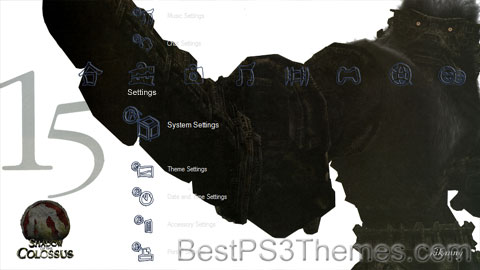
(16 backgrounds)
| Shadow of the Colossus | |
|---|---|
_cover.jpg) European cover art | |
| Developer(s) | Japan Studio (Team Ico) |
| Publisher(s) | Sony Computer Entertainment |
| Director(s) | Fumito Ueda |
| Producer(s) | Kenji Kaido |
| Writer(s) |
|
| Composer(s) | Kow Otani |
| Platform(s) | PlayStation 2 PlayStation 3 PlayStation 4 |
| Release | |
| Genre(s) | Action-adventure, puzzle |
| Mode(s) | Single-player |
Shadow of the Colossus[a] is a 2005 action-adventure game developed by Japan Studio and Team Ico, and published by Sony Computer Entertainment for the PlayStation 2. It takes place in a fantasy setting and follows Wander, a young man who enters an isolated and abandoned region of the realm seeking the power to revive a girl named Mono. The player assumes the role of Wander as he embarks on a mission that might entail Mono's resurrection: to locate and destroy the colossi, sixteen massive beings spread across the forbidden land, which the protagonist traverses by horseback and on foot.
The game was directed by Fumito Ueda and developed at Sony Computer Entertainment's International Production Studio 1, also known as Team Ico, the same development team responsible for the acclaimed PlayStation 2 title Ico, to which the game is considered a spiritual successor. Сonceived as an online multiplayer game titled NICO directly after Ico's completion, Shadow of the Colossus underwent a lengthy production cycle during which it was redeveloped as a single-player title. The team sought to create an outstanding interactive experience by including a distinct visual design, an unorthodox gameplay template, and non-player characters with sophisticated artificial intelligence such as the colossi and Wander's horse, Agro.
Cited as an influential title in the video game industry and one of the best video games ever made, Shadow of the Colossus is often regarded as an important example of video games as art due to its minimalist landscape designs, immersive gameplay, and emotional weight of the player character's journey. It received wide critical acclaim by the media and was met with strong sales compared to Ico, due in part to a larger marketing campaign. The game won several awards for its audio, design, and overall quality. A remastered version for the PlayStation 3 was released alongside Ico as The Ico & Shadow of the Colossus Collection in September 2011, developed by Bluepoint Games, who later produced a high definition remake of the game for the PlayStation 4 in 2018.
Gameplay[edit]
Described by several commentators as an action-adventure game,[2][3] Shadow of the Colossus takes place from a third-person perspective in a three-dimensional (3D) graphic environment and involves combat-based gameplay sequences, as well as platforming and puzzle game elements.[4] The game's environment is largely presented as a seamless open world.[5] Progression through Shadow of the Colossus occurs in cycles. Beginning at a central point in an expansive landscape, the player seeks out and defeats a colossus, and is then returned to the central point to repeat the process.[2] To find each colossus, Wander may raise his sword while in a sunlit area to reflect beams of light, which will converge when the sword is pointed in the right direction of the next encounter.[6] The player's journey to a colossus seldom follows a direct route: stretches of varied terrain often require that a detour be taken along the way. Most colossi are situated in remote areas, such as atop cliffs or within ancient structures.[2][7]
_-_Valus_fight.jpg)
Once a colossus is found, the player must discover its weaknesses to defeat it. Each colossus dwells in a unique lair, and in most encounters the player must use some aspects of the current battlefield to advantage, a necessity that becomes more pronounced as the game progresses.[9] The first two battles take place on simple, vast, flat areas of land, wherein the player's only goal is to discover how to scale the colossi and attack their weak points.[6][9] However, the majority of the following fourteen battles require that the player make use of the surrounding environment.[10][11]
Every colossus has at least one weak point, symbolized by a glowing sigil[12] that can be illuminated and identified by the sword's reflected light.[6][13] Each colossus has areas covered with fur or protruding ledges, which Wander may use to grip and scale the colossus while it thrashes about in an attempt to dislodge him.[2] Wander has a limited stamina gauge that decreases as he hangs onto the colossus; the player thus must act quickly when they scale the creature.[4] Aside from the colossi, who are the only enemies of the game, the environment is inhabited by natural animals. Only one species, however, has an effect on gameplay: eating the tail of a certain kind of lizard increases Wander's stamina gauge. Likewise, the player may find fruit that increases Wander's maximum health.[14]
Wander's horse, Agro,[15] plays a large role in the game. Aside from her capacity as a means of transportation, Agro enables the player to fight from horseback, a critical avenue to defeating some of the colossi.[16] However, the game contains many environments that players cannot traverse by horse, and colossi are often found in areas within deep water or beyond large obstacles that must be scaled. Agro cannot travel beyond these, and when separated from Wander by such obstacles, cannot participate in the following battle.[6] While throughout the game, Wander's equipment consists of only a sword and a bow with arrows,[17] in subsequent playthroughs players may access bonus weapons and in-game features after finishing optional Time Attack trials, which allow the battles with the colossi to be replayed with a restricted time limit.[14]
Synopsis[edit]
Setting[edit]
Presented through a minimalistic narrative,[18] Shadow of the Colossus eschews disclosure of detailed information about the backstories and interrelationships of its characters to the player.[2] The game takes place in a fantasy world,[19][20] wherein a vast and unpopulated peninsula, known as the Forbidden Land, serves as the main setting for the game's events. Separated from the outside realm by a distant mountain range to its north and sea to the south and east, the area contains ruins and remnants of ancient structures, an indication that it had formerly been a settlement.[21][22][23]
The only point of entry to the region is a small cleft in the mountains to the north that leads to a massive stone bridge. This bridge spans half the distance of the landscape and terminates at a large temple called the "Shrine of Worship" located at its center. It is, however, forbidden to enter the land,[24] which includes diverse geographical features, such as lakes, plateaus, canyons, caves, and deserts in addition to human-made structures.[2][11]
Characters[edit]
_-_Mono_and_Wander.jpg)
The protagonist of the game is Wander (ワンダ, Wanda, voiced by Kenji Nojima), a young man whose goal is to resurrect a girl named Mono (モノ, voiced by Hitomi Nabatame). The only established fact regarding Mono is that she was a maiden who was sacrificed because she was believed to have a cursed destiny.[26] Assisting Wander in his quest to revive her is his loyal horse, Agro (アグロ, Aguro), who serves as his sole ally in defeating the colossi;[27] the English-language version of the game refers to Agro as a male steed,[28] although director Fumito Ueda said that he saw Wander's horse as female.[29] Wander also receives aid from an entity called Dormin (ドルミン, Dorumin, voiced by Kazuhiro Nakata and Kyōko Hikami). The story revolves around these characters but features a small supporting cast, represented by Lord Emon (エモン, voiced by Naoki Bandō) and his men.
Speaking with two voices at once (one male and one female), Dormin is a mysterious, disembodied entity. According to legends of the game's world, Dormin has the power to revive the dead;[24][27] this premise serves as the driving cause for Wander's entrance upon the forbidden land, as he seeks the being's assistance in reviving Mono. Dormin offers to revive her in exchange for Wander destroying the sixteen colossi.[26] One of the commentators of the game's plot speculated that the name "Dormin", which spells "Nimrod" backwards, serves as a reference to the body of the biblical King Nimrod which was cut up and scattered.[30]
Lord Emon is a shaman who narrates a vision in the game's introduction that vaguely explains the origin of the land to which Wander has come and establishes that entry to this place is forbidden.[24] As portrayed by the game, he possesses vast knowledge about the nature and containment of Dormin, and wields the ability to use powerful magic. He has a small group of warriors at his command, and is pursuing Wander to prevent the use of "the forbidden spell", the rite that involves the destruction of the sixteen colossi and the restoration of Dormin's power.[31]
The colossi are armored, most often enormous creatures with forms ranging from various humanoids to predatory animals, and live in all manner of surroundings and environments, including underwater and flying through the air.[18][32] Their bodies are a fusion of organic and inorganic parts such as rock, earth, and architectural elements,[4] some of which are weathered or fractured. Some colossi are peaceful and will only attack when provoked, whereas others are aggressive and will attack on sight.[2] Inhabiting specific locations in the forbidden land, they do not venture outside their own territory. Once slain they will remain where fallen, as a mound of earth and rock vaguely resembling the original colossus.[33][34] A pillar of light marks the location of each colossus after they are defeated.[35] The Latin names of the colossi, though spread throughout fan related media, are not official and are never referred to within the game.[36][37]
Plot[edit]
As the game begins, Wander enters the forbidden land and travels across a long bridge on his horse, Agro. After they reach the entrance to the Shrine of Worship, Wander, who has carried with him the body of Mono, brings her to an altar in the temple. A moment later, several humanoid shadow creatures appear and approach Wander before he easily dismisses them with a wave of the ancient sword in his possession.
After the shadow creatures are vanquished, the disembodied voice of Dormin manifests within the shrine and expresses surprise at the fact that Wander possesses the weapon. Wander explains the plight that led him to seek the forbidden land and asks that Dormin return Mono's soul to her body. Dormin offers to grant Wander's request under the condition that he completes a rite designed to destroy the sixteen idols lining the temple's hall. To that end, Wander must use his sword to slay each of the idol's physical incarnations–the colossi, whose presence ranges across the vast expanse outside the temple. Although warned by Dormin that he may have to pay a great price to revive Mono, Wander sets out to search the land for the colossi and destroy them.[38]
An aspect of Wander's mission that is unknown to him is that the colossi contain portions of Dormin's own essence, scattered long ago to render the entity powerless.[26][39] As Wander kills each colossus, a released fragment of Dormin enters his body. Over time, the signs of Wander's deterioration from the gathered essence start to appear: his skin becomes paler, his hair darker, and his face is increasingly covered by dark veins. The outcome of the battle with the twelfth colossus leads to a reveal of a group of warriors that has been pursuing Wander, led by Emon. Urged to hurry with his task by Dormin, Wander soon heads off to defeat the sixteenth and final colossus. On the way to this confrontation, he rides horseback across a long bridge which begins to collapse as he is halfway across, but Agro manages to throw Wander over to the other side before falling into the distant river below.
Soon after, Wander goes on to defeat the final colossus as Emon's company arrives in the Shrine of Worship to witness the last temple idol crumble. Wander appears back in the temple soon after, the signs of his corruption readily apparent: his skin is pallid, his eyes glow silver, and a pair of tiny horns have sprouted from his head. Emon recognizes him as a transgressor who, in an event that occurred before Wander's journey to the forbidden land, stole the ancient sword with which he killed the colossi.[31] Emon orders his warriors to kill the "possessed" man as he approaches Mono and finally falls once stabbed through the heart by one of Emon's men.[40] However, a newly whole Dormin takes control of Wander's body and transforms into a shadowy giant.[39][41] While his men flee, Lord Emon casts the ancient sword into a small pool at the back of the temple's hall to evoke a whirlwind of light. The supernatural vortex consumes Dormin and Wander, which seals Dormin within the temple once again. As Emon and his warriors escape, the bridge that leads to the temple collapses behind them, and its destruction forever isolates the forbidden land from the rest of the world. Although he has condemned Wander for his actions prior to their encounter, Emon expresses hope that Wander may be able to atone for his crimes one day should he have survived.[42]
Back in the temple, Mono awakens and finds Agro limping into the temple with an injured hind leg. Mono follows Agro to the pool into which Wander and Dormin were pulled by Emon's spell, where she finds a male infant with tiny horns on his head. Mono takes the child with her, following the horse to higher levels of the Shrine of Worship, and arrives at a secret garden within the shrine as the game ends.
Development[edit]
Origin[edit]

Shadow of the Colossus is the second project of Team Ico, a group of staff members within Sony Computer Entertainment's (SCEI) International Production Studio 1 that was led by director Fumito Ueda and producer Kenji Kaido.[32][43][44] The game originated from one of Ueda's concepts that he developed directly after the team submitted their debut title Ico, released in late 2001 for Sony's PlayStation 2 video game console, for publication.[45][46][47] As the basis of Team Ico's subsequent game had not been decided, Ueda examined "a number of old ideas kicking around in my head ... that couldn't be realized under previous circumstances".[48] After a brief review of those avenues, Ueda chose to explore one that aligned with his own preferences as a game player.[47][48] Ueda cited The Legend of Zelda series as an influence, as he grew up wanting to make a game like Zelda and designed the Colossi bosses like "inverted Zelda dungeons."[49][50]
Ueda envisioned a work with an underlying motif of "cruelty as a means of expression".[48] He felt that this theme was widely featured in contemporary titles such as Grand Theft Auto III and wanted to use it in a game that he designed.[48] In a discussion with Kaido, Ueda observed that he had played a variety of video games containing battles with large bosses that the player must shoot from a distance to defeat.[51] Ueda believed that the boss sequences of those games could be streamlined if the player character was able to approach and climb the oversized opponents to kill them with a close range weapon.[51] Accordingly, he chose to base the game around the player character's encounters with enormous fictional creatures,[16] a premise that stemmed from Ueda's childhood fascination with monster movies.[46] This led to an emphasis on the inclusion of a large-scale adventure in the title, an element which Ueda regarded as influential in the shaping of the game's stylistic identity.[48]
Originally, the team considered Ueda's idea alongside another concurrently-developed game.[45][46] According to Ueda, the game was unrelated to his former concept, and the team did not give it a working title or outline its design while it was in development.[45][46] Ueda recognized the finished iteration of Team Ico's second title as, "in many ways, a game for boys and men"; conversely, the separately produced game was fashioned to appeal more to a female audience.[46] Its contents, interface and thematic focus differed significantly from those that would ultimately manifest in the team's next game after Ico.[46] The untitled game did not employ 3D graphics, whereas Team Ico applied them to their published game.[46] The team eventually scrapped their plans for a counterpart title to Ueda's intended game,[46] which was advanced into further development.[45]
Prior to the start of the project, Team Ico assessed the opportunity to establish it as a sequel to their first game.[16] This suggestion was opposed by certain staff members who argued that the story and gameplay of their preceding title were largely self-contained, and that the existence of consumer demand for a new Ico game was questionable.[52] According to Ueda, Team Ico assumed that the creation of levels for a single-player game akin to Ico necessitated the construction of elaborate puzzles, a practice that the staff wanted to eschew.[51] Following lengthy deliberations, they decided not to pursue a sequel to Ico and to produce a standalone game provisionally dubbed NICO (a portmanteau of ni, 2 in Japanese, and "Ico").[16][32] The team initially agreed to develop NICO as an online multiplayer game that, unlike Ico, "wouldn't require complex level design".[51] Their foundational goal, according to Kaido, was to create a technology demo that represented a tentative rendition of the game's fictional world and features.[16] Development commenced immediately after the December 2001 release of Ico's Japanese version.[16][53]
Early prototypes[edit]

To develop the concept video for NICO, Team Ico formed a small internal group, which was composed of Ueda, one of Ico's designers and a roughly 10-person animation team.[48] Their objective was to deliver "[a] movie with an extremely final form" that could serve as a visual template for the finalized game.[16] The first storyboard that outlined the video was drafted in January 2002, and the actual short film was completed that May.[54] It depicted a group of three masked, horned boys who rode horseback across a vast landscape and attacked a towering being reminiscent of the second boss in Shadow of the Colossus.[35][55][56] The video was visualized in the Ico game engine and was rendered in real-time on the PlayStation 2 hardware.[16] With those techniques, the team aimed to estimate the extent to which the platform's capabilities allowed the realization of their vision.[16]
According to Kaido, the team deemed the resulting video to have attained a very high level of completion, and thus was able to use it as a reference point throughout the game's production.[16] Although they subsequently modified the game's visuals from those of the demonstration reel, its themes of "fighting a giant enemy" and "[exploring] a giant field" carried over into the final game design.[16] The demo indicated elements that were excluded from the released game.[57] Among these was a showcased gameplay mechanism wherein one of the colossus' attackers who had scaled and killed it proceeded to mount his approaching horse by leaping onto its back from the entity's corpse.[57] The video was later exhibited at many trade shows,[43] such as the 2006 D.I.C.E. Summit in Las Vegas where Kaido and Ueda retrospectively discussed the game's development with Lorne Lanning.[55]
In June 2002, a small group of staff at Team Ico started to build a prototype of NICO for testing purposes.[54] In his role as producer, Kaido tasked the team with the inclusion of technological features that he recognized as important milestones of the development.[55] One of the challenges issued by Kaido involved the creation of "organic collision deformation", a term that alluded to his concept of realistic character physics in relation to the movement of the colossi.[55] For instance, if a colossus' limb was currently horizontal, Kaido expected the player to be able to run across the limb as though it were any other flat surface.[55] Ueda and Team Ico programmers spent over six months to produce a working version of this functionality.[54] They began by adding a character to a virtual environment where the figure was enabled to climb a pole-like object.[51] One of the team's priorities at the time was to code a physics-based simulation of scenarios where characters were "being shaken off or narrowly avoided being stomped on".[58]
In May 2003, Team Ico assembled a demonstrational build of NICO and presented it at a production meeting.[54] Full development of the game was sanctioned directly after it was pitched, and commenced in the same month.[54] That year, the NICO technology demo was shown across Sony's foreign offices among a lineup of prospective PlayStation 2 titles, and its exposure excited the spectators.[57] Although the team attempted to work on the game in secrecy, at a certain point images of NICO's horseriding characters were leaked onto the Internet.[32] Their circulation led enthusiasts to speculate about what they perceived as a sequel to Ico.[32] According to Ueda, the team reused elements of Ico's character designs for NICO to expedite the production of the concept video and minimize its costs.[58] He asserted that NICO was not related to Ico despite their stylistic similarities,[58] and that his colleagues did not identify the former game as a sequel.[4] However, contemporary and retrospective sources described Team Ico's second game as both a spiritual successor[32][47][59] and prequel to Ico.[60]
The staff used player feedback to advance the testing of the "organic collision deformation" system by inputting simple objects to experiment its capabilities.[58] Although Team Ico had conducted an elaborate research of the game's technological framework, they did not finish its validation when they entered the production phase.[51] After evaluating the limited number of personnel that was involved with NICO as well as their professional profiles, Team Ico concluded that they were not qualified to deliver an online-only game.[51] They then resolved to abandon that direction and to reformulate NICO into a single-player title.[51] The team discarded Ico's development tools that they had used at the outset of the project and moved to write new programming utilities.
Heavenly Sword theme by Kikanny Download: HeavenlySword_3.p3t Heavenly Sword is a 2007 action-adventure hack and slash video game developed by Ninja Theory and published by Sony Computer Entertainment for the PlayStation 3.
The game is an action-adventure title with heavy elements of hack and slash gameplay. The gameplay of the game resembles a martial arts title focused on melee combat while featuring opportunities for ranged attacks. The main character, Nariko, uses a weapon called the "Heavenly Sword" which changes into one of three forms depending on what attack stance the player uses as part of a unique fighting style. Speed Stance provides an even balance between damage and speed, where the sword takes the form of two separate blades.[1] Range Stance allows fast, long-range, but weaker attacks, with the sword being two blades chained together. Power Stance is the most powerful, but slowest style, where attacks are made with the sword in the shape of one large, two-handed blade.
For exploration and certain battles, the game also makes use of quick time events (QTE). During a QTE, a symbol for a certain button or for an action such as moving the analog stick to the right or left appears on-screen and the player must match what is shown to successfully complete the scene.[1]
In addition to Nariko, a secondary character, Kai, is controlled for some portions of the game.[1] Many of Kai's stages take the form of sniping missions, using her crossbow to pick off enemies, in some cases to protect characters. While Kai cannot perform hand-to-hand combat,[1] in stages that call for her to explore the level she is able to hop over objects and to free herself from an enemy's grasp by temporarily stunning them.
Projectiles can be maneuvered to their targets using the motion-sensing capabilities of the Sixaxis controller through a feature known as Aftertouch. Such projectiles include guiding Kai's arrows after she has launched them, and for Nariko, guiding a cannon or rocket launcher, or picking up and throwing objects.
The game's story and mythos revolves around the titular Heavenly Sword, a blade said to have been wielded by an unnamed Heavenly deity against a demonic warlord called the Raven Lord.[2] After the battle was won and the Raven Lord defeated, the sword was left in the mortal world, becoming the center of wars over its power.[3] The fighting made the sword lust after the life of its users, eventually killing them after a short time.[4][5] A warrior tribe finally took charge of the sword, ending the wars and pledging to keep it safe and unused for the world's own good.[6] Among the tribe, a legend said that the sword's original wielder would be reborn in the year of the "fire-horse", and that this figure would unite the world's scattered tribes and lead the world to peace.[7]
The game's narrator and main protagonist is Nariko (Anna Torv), a headstrong red-headed woman who was born in the year of the prophesied divine warrior: because she was a woman, her clan saw her as a mockery of the prophecy and a portent of doom.[8] The game's main antagonist is King Bohan (Andy Serkis), a tyrannical ruler who is determined to bring the world's tribes to heel and pave the way for a new golden age.[9] Nariko is trained as a warrior by her father, Master Shen (Ewan Stewart), who both cares for her as a child and has difficulty coping with her role in the clan's seeming undoing and the death of his wife.[10] Nariko's only friend is Kai (Lydia Baksh), a wild and erratic young girl who is the last member of a clan destroyed by the armies of Bohan.[11] Among Bohan's servants are his general, Flying Fox (Steven Berkoff): his serpentine mistress Whiptail (Race Davies): and Roach (Richard Ridings), Bohan's son, of whom the king is so ashamed because of Roach's obese appearance that he will not even acknowledge Roach as his own.[12]
The game begins in medias res, with Nariko fighting the forces of Bohan. As she is fighting the sword finishes draining her life and she seemingly dies, waking in a field and speaking to the power within the sword about what has happened. Five days before, Nariko's clan is assaulted by King Bohan's forces. Before she joins the fight, Shen thrusts the sword into the ground next to her demanding that she take care of it. Nariko fights alongside her father and her clansmen as their defenses are weakened and stretched by scores of Bohan's warriors scaling the city walls accompanied by catapults. As the warriors and Shen escape from Bohan's Army, Nariko protects them until spotting a catapult moving toward the fort. As Shen had earlier instructed her, she flees, as the fortress is apparently destroyed behind her. She passes a large black bird with a golden head, the animal form of the Raven Lord. When Bohan's army captures her father and corners her Nariko has no choice but to wield the sword to defend herself in order to escape. She takes a flying leap off a cliff edge as Bohan's archers begin firing at her. Kai finds Nariko after disobeying Shen's orders to hide and informs her of the temple where her father and clansmen are held captive. Nariko infiltrates the temple and is ambushed by Flying Fox. She defeats the general and continues on to rescue her father. Meanwhile, King Bohan plots to set up a trap for Nariko with Whiptail. Nariko falls into the trap, and Whiptail, after watching most of her personal guards defeated, tells Nariko the truth behind her father's original feelings about her birth - Shen wanted to kill Nariko shortly after her birth, but was unable to bring himself to do so.[13] Nariko tells her father to leave her and fights with Whiptail. After Nariko impales Whiptail with the sword, King Bohan turns up and snaps Whiptail's neck in her dying moments, then captures the sword and an incapacitated Nariko.
As Shen escapes, Kai makes her way to Nariko's cell. Kai is able to find where Nariko is imprisoned and begs that she comes home with her. Nariko explains to Kai that she needs to reacquire the Heavenly Sword to kill King Bohan. She asks Kai to retrieve the sword and Kai accepts the task. Kai succeeds in finding the Heavenly Sword, only to also discover her mother's skeleton. In a flashback, it is revealed that, some years ago, Kai's mother was murdered in front of her eyes by Flying Fox. Returning to the present, Kai is confronted by Flying Fox and barely manages to escape from him with the sword. Meanwhile, Nariko is forced by Bohan to fight before his army against Orangumen, pets of Roach's. During the battle, Kai arrives and throws Nariko the sword. When Nariko defeats all the Orangumen, Bohan orders Roach to murder Nariko. After defeating Roach, both Nariko and Kai flee from the pit. Bohan then commands Flying Fox to kill Kai while his soldiers take on Nariko. As the two try to escape, Flying Fox cuts Kai off from Nariko and they are separated. Nariko desperately tails Flying Fox, but when she finally catches up, he seemingly hangs Kai in front of her. Believing Kai dead, Nariko flies into a rage and battles with Flying Fox. As Nariko and Flying Fox duel, Kai, who survived the drop, uses her crossbow to shoot an arrow into Flying Fox's head, killing him. Nariko releases the injured Kai from the noose and returns her to the care of the clan.
King Bohan rallies his men to launch a final attack to regain the Heavenly Sword. Nariko fights alongside her father and clansmen once more. Nariko kills countless numbers of Bohan's troops with ease and destroys his catapults. Despite her efforts, the sword kills her, bringing the events of the game full circle. But this time, Nariko reverses her death by making a pact with the sword to protect it from becoming a useless and dusty relic, since it needs her more than her clan needs it.[14] Nariko returns as a goddess-like figure, and proceeds to slaughter Bohan's troops. Desperate, Bohan begs the Raven Lord (who has been seen repeatedly throughout the game watching Nariko or being with Bohan) to give him the power to destroy Nariko. Bohan gets his wish and the Raven Lord merges with him.[15] An epic battle ensues similar to the one foretold in the prophecy. After Nariko manages to defeat Bohan, the raven leaves his body, and, despite Bohan begging for mercy, pecks his eyes out and flies away.
As Nariko raises the sword to strike the final blow, Roach comes to his father's side and begs Nariko to let him take Bohan. Nariko relents, then Roach and Bohan leave, with Bohan calling Roach his son for the first time.[16] Though successful in protecting the sword from coming into the hands of Bohan, Nariko still must give her life for wielding it, for that is the price for using the almighty sword, and the story comes to its end. Nariko reflects that she believes they have fought in vain for the prophecy, that the sword was not from Heaven, but feels gratified that she chose to be the one who was going to save her people from evil: she took the sword, paid the price and ultimately defeated Bohan's army, but nevertheless she was still a normal woman.[17] Nariko heals Kai, and gives her the sword for safekeeping, before passing away. At the funeral, Nariko's body is placed into a boat filled with blossoms, and Kai and Shen cast her out to sea.
Heavenly Sword began development in 2002.[18] After establishing early concept, a CGI trailer was produced which helped guide future development, described by the team as an iterative process where many other things changed around the central concept. The team began production without a specific console in mind, tailoring gameplay elements to the PlayStation 3 when the game was picked up by Sony as an exclusive for their upcoming platform.[19] The game was developed using Havok Complete, a combination of Havok Physics and Havok Animation.[20] Production began with the aim of telling a cinematic action adventure inspired by recent films including Crouching Tiger, Hidden Dragon and Hero, with a later fantasy influence inspired by the themes of The Lord of the Rings.[21] Other influences included the game Ico (2001), the graphic novel La Tour, and the South Korean movie Musa.[19] The game eventually developed a distinct visual and narrative identity while maintaining elements from these early inspirations.[21] Nariko's three combat styles drew direct inspiration from the dragon forms in Panzer Dragoon Orta (2002).[19]
The character designs were intended to stand out from each other, with distinct elements ranging from color coding to how a character moved. Nariko was made recognisable both with her unique red hair and the simplicity of her outfit compared to other characters.[21] The early concept designs were heavily influenced by Japanese art, and while it retained a strong Far Eastern theme with influences from Japan and China, the team also incorporated references to Mongolian and South American environments and architecture.[19]
Character movement was an important element for the team. Kai's movements were based on several elements, including cats and Princess Mononoke protagonist San.[19] While they were still faced with technical restrictions, the team had access to hardware which better enabled them to realise their world and character design. Ninja Theory collaborated with Peter Jackson's company Wētā FX to create realistic facial expressions both during cutscenes and in gameplay.[21] All of the actors involved in the project had previously been involved in film or television.[19] Actor Andy Serkis performs as the voice and motion capture actor for King Bohan, one of the major characters in Heavenly Sword; he also acts as dramatic director for the game and is one of the writers of the story of the game. Nariko is voiced by Australian actress Anna Torv.[22]
A demo was released to the PlayStation Store on July 26, 2007, featuring a short, cinematic clip at the beginning and two brief enemy battles, lasting approximately five to ten minutes. An eight-second clip of the game was seen in an episode of the TV series Heroes entitled "Parasite", ostensibly being played by Jessica Sanders and her son, Micah. It featured Nariko running across ropes as they were cut by Bohan's soldiers, before landing on the platform to face them.[23] While the episode was broadcast over four months before the actual release of the game, the level displayed remained in the released build, including the rope sequence shown; the icons in the final game used to inform the player which buttons to press were changed from large, central icons as seen in the clip, to be smaller and positioned at the bottom of the screen. Sony and Ninja Theory have made five 'making-of' videos about the production of Heavenly Sword, with each one detailing a certain aspect of the game's production, from music to motion capture. The videos can either be unlocked while playing the game or downloaded from the PlayStation Store.
Nitin Sawhney composed the music for the soundtrack. It was performed by the City of Prague Philharmonic Orchestra conducted by Stephen Hussey. Tameem Antoniades of Ninja Theory said "we have our big orchestral soundtrack but we wanted to add a more ethnic element and marry those two together. There are actually very few musicians in the world who are experts in both areas. Nitin Sawhney is one of them."[24] Sawhney stated that his creation of "musical textures take in everything from Hollywood, European and Chinese cinema to Indian and middle eastern instrumentation through the orchestras and soloists hovering between sonic tidal waves and reflective moments of intimate grace."[25]
A series of Heavenly Sword animated episodes were released prior to the launch of the game itself, acting as a prologue to the events of the game. The series, which consists of five episodes, was produced by London production company Blinkink and animated by CHASE Animation Studios, headed by Robert Chandler. The videos were made available both online[26] and through the PlayStation Store. The first two videos were also included on the retail version of the game; the latter three videos were not ready in time to be included.[27]
The style of the animated series differs from the graphics of the game itself. The animated series relies on a simple and stylized 2D look, which allowed director Ben Hibon to "create a complete visual re-interpretation of the world and its inhabitants".[28] The videos were produced using a combination of Adobe Photoshop, Flash and After Effects. Initial reference frames were created with Photoshop, which were then animated in Flash and exported as separate layers into After Effects. The layers were composed onto a 3D stage with multiple foreground, middle ground and background elements, which allowed the use of 3D cameras and lighting to give depth and movement to the video.[28]
A computer generated animated film version was produced by Blockade Entertainment and scripted by writer Todd Farmer. The cast includes Anna Torv as Nariko, Alfred Molina as King Bohan and Thomas Jane as Loki.[29] The film was released on Blu-ray, DVD and on PlayStation Network on September 2, 2014.[30]
Nariko appears as a playable character in PlayStation All-Stars Battle Royale, voiced by Jennifer Hale.[31]
Heavenly Sword sold over one million copies by May 2008.[50][51] Tameem Antoniades stated in March 2010 that sales were approximately one-and-a-half million but that the developer did not break even.[52] The game was praised for its graphics[35] and combat system, while criticism stemmed from the short length of the game and lack of online capabilities. It received "generally favorable reviews" according to video game review aggregator Metacritic.[32]
USA Today gave the game nine stars out of ten, saying, "PlayStation 3 fans hungry for more satisfying first-party content from Sony will be satiated with the feverish pace Heavenly Sword provides."[48] Digital Spy gave it four stars out of five, saying, "The lavish sword combat system and the awesome presentation are what make this title a worthy buy. Sony seems to have created this game as a showcase for the PS3 and forgot about getting the gameplay up to scratch. But despite its failings, Heavenly Sword is a great buy for the excellent sword fighting sections and for those who simply want to show their friends just what the PS3 is capable of."[53] The New York Times gave it a favorable review, saying, "The scenery is breathtaking, battles can be exciting, and the intelligent, cruel King Bohan — voiced brilliantly by Andy Serkis (...) — is one of the best video game villains ever. The game is frustrating because it seems as if it should have been a great game and as if its creators tried to make it a great game, but it managed to be only a pretty good one."[54] Maxim gave it a score of six out of ten, saying, "A few of the puzzles are a total bitch, the button-press sequence/finishing moves that the game steals directly from God of War require too much precision, and the sniper sequences wind up being even more tedious than the fighting. It's fun for a little while, and very flashy, but in the end, for everything Heavenly Sword does right, it does two more things wrong."[55] The A.V. Club gave it a C+ and stated that "If Metal Gear Solid and Halo had acting this good, we'd be on to something."[47] In Japan, Famitsu gave the game a score of two sevens and two eights, for a total of 30 out of 40.[36]
During the 11th Annual Interactive Achievement Awards, the Academy of Interactive Arts & Sciences nominated Heavenly Sword in three categories: "Outstanding Character Performance", "Outstanding Achievement in Art Direction", and "Outstanding Achievement in Original Music Composition".[56]
GamesRadar featured Kai in the article "Freakish fashion" in 2007,[57] and Nariko as a "game babe" sex symbol in 2007 and 2009.[58][59] In 2009, MSN featured Nariko in the article "Gaming's Hottest Babes".[60] UGO featured her among the "Top Animated Hotties" in 2008[61] and in their list of the best girls in video games in 2011,[62] and also in the article "11 Strong Gaming Girls We Never Saw Again" in 2010.[63] In 2010, Lisa Foiles of The Escapist ranked Nariko first in the "Top 5 Impractical Female Character Hairstyles".[64] In 2013, she was ranked as the 18th greatest heroine in video game history by Complex.[65]
According to Ninja Theory co-founder Tameem Antoniades, the story for the sequel has already been written; in fact a whole trilogy is being planned. He stated, "We've had the story for the sequel for a while now. Hopefully, if this game is successful, then there's no reason why there shouldn't be a sequel and we'd very much like to go into that."[66]
In March 2008, it was confirmed that Ninja Theory is not planning to create a sequel for Heavenly Sword, and instead has decided to work on a new project[67] (most likely Enslaved: Odyssey to the West). Sony Computer Entertainment retains the intellectual property of Heavenly Sword, and there is always the possibility of production on a sequel being outsourced to another developer.[68] In June 2008, it was reported that a sequel to Heavenly Sword was in-development at SCE Studio Cambridge, but was canceled due to Sony no longer seeing it as a commercially viable product.[69] Concept art for the title later surfaced in 2012.[70][71]
Patapon[a] is a 2007 video game developed by Pyramid and Japan Studio and published by Sony Computer Entertainment for the PlayStation Portable (PSP). The game's unique genre was described to be a combination of rhythm and strategy. The game's concept and design were conceived when game designer Hiroyuki Kotani discovered the Patapon designs from French artist Rolito's personal website. The name Patapon was created by Rolito and was inspired by an old French word for "children". Kotani chose the name because it sounded similar to marching and drumming. It was released in Japan in December 2007 and in February 2008 for North America and Europe.
In the game, the player acts as an invisible deity to a tribe of anthropomorphic eyeballs known as "Patapons" that can be commanded to move forward, attack, defend and retreat by using a sequence of drum beats. The story follows the Patapon tribe in their journey to reach Earthend and gaze upon "IT". They encounter giant beasts and an enemy tribe known as the Zigotons that serve as obstacles throughout their adventure.
Patapon was well-received among critics with multiple reviewers praising the art style of the Patapon tribe and the music. Some reviewers criticized the repetitive nature of it and the lack of a pause option. The game received multiple nominations including a BAFTA award and won Best PSP Game of 2008 by IGN. The game was followed up by two sequels for the PSP; Patapon 2 and Patapon 3, and a remastered version for the PlayStation 4.
In Patapon, the player takes the role of a deity worshipped by an anthropomorphic eye-ball army known as Patapons.[1] The Patapon village serves as the main hub, allowing the player to revive fallen troops, select missions, and play minigames.[1] Before each mission, the player can choose up to three different units for battle with the banner-wielding Hatapon as the leader of the units.[2] There are eight possible units to choose from: The shield and sword-wielding Tatepons, the spear-wielding Yaripons, the bow and arrow-wielding Yumipons, the cavalry lance-wielding Kibapons, the heavy club-wielding Dekapons, bird-riding Toripons, magic-wielding Mahopons, and Tuba-wielding Megapons.[3] Each unit can have a maximum of three or six troops depending on the type of Patapon.[2]
During missions, the player can command the Patapons by inputting specific sequences using the face buttons on the PSP, each representing a drum. These sequences can command the tribe to move forward, attack, defend, and other actions. A pulsating border signals the player at what rhythm to input the commands.[4] Successfully entering a proper sequence in sync with the rhythm will lead the tribe into a "Fever" increasing their attack and defensive bonuses. Fever can be accomplished by maintaining a combination of 10, or achieved early if a combination is 3 or higher and the command was performed perfectly in sync.[1] If the player ceases to command the Patapons or inputs the commands off-beat of the border's rhythm, the combo and fever will be lost.[5][6] During fever, Miracles can be performed that affect the weather. Examples include summoning rain to cool a scorching desert or summoning strong winds assisting in the range of the Yumipons' arrows.[6][7]
Once a mission is complete, the player can return to an earlier mission to acquire additional resources and equipment to build up their troops before a larger battle.[1] Materials, weapons, armour, and a currency known as "Ka-ching" can be gained by fallen enemies to fortify the player's troops. If a Patapon is defeated in battle, it will drop a cap that can be used to revive the Patapon once the mission is completed. If the cap is not retrieved during the mission, the Patapon is permanently lost.[1] New Patapons can be created in the Patapon village using the tree of life and requires Ka-ching and materials such as sticks, stones, and branches. Using rarer versions of those materials creates stronger variants of the Patapons.[1][6]
Patapon follows the tribe of the eponymous eyeball-like creatures, Patapons. In the distant past, the Patapons were a flourishing nation led by their deity, the Mighty Patapon, on a journey to Earthend to gaze upon an enigmatic object known as "IT". The Patapons at one point were banished to the desolate frontier by their sworn enemy of similar eyeball-like creatures known as the Zigotons. The game begins with the Mighty Patapon reuniting with the banner-wielding Hatapon. The Mighty Patapon is led back to the remnants of the tribe to resume their journey to Earthend. The Patapon face large enemies throughout their travels and re-encounter the Zigoton empire. The Zigoton general, Gong the Hawkeye, challenged the Patapons multiple times by provoking them using Patapon hostages and eventually having a final duel. Shortly before his death, Gong reveals to them that the Zigotons have their version of the prophecy foretelling that the world will fall into chaos when the Patapons gaze at "IT".
As the Patapons progress on their journey, many of the Zigoton warriors sell their souls to the dark forces in exchange for power in an attempt to defeat them. Eventually, the ruler of the Zigotons, Queen Kharma, sells her soul in a final effort to destroy the Patapons. When she is defeated, a gateway to the Dark World unleashes the ancient demon, Gorl. The Patapons manage to defeat Gorl and reach the coastline to witness the sunrise which they assume is Earthend and "IT" respectively. However, unfulfilled by the anticlimactic end of their journey, they realize the rising sun is not "IT" and they have not reached Earthend. Queen Kharma joins the Patapons and admits that the Zigotons also fooled themselves into believing the sun was "IT". The game concludes with the Patapons and Zigotons working together to build a ship.
Patapon was developed by Pyramid, produced by Japan Studio, and designed by Hiroyuki Kotani.[8] The game was originally announced on June 11, 2007, during the E3 2007 press conference.[9] The designs for the Patapons were created in 2002 by French artist Rolito and were featured on his personal website in 2004.[10] When Kotani discovered their design, he envisioned the creatures marching into battle and chose to create a video game entirely based on their design.[11] Kotani contacted Rolito through a representative group known as Interlink in 2005 and recruited him to develop the game using the Patapon characters.[12] Rolito was tasked with creating a fictional universe for the characters. The development team would provide drafts and be evaluated by Rolito. Once approved, Rolito would provide the final design.[13] The name "Patapon" was conceived by Rolito taken from an old French nursery rhyme that used the word "Patapon" for children. Kotani chose the name due to it resembling the sounds of drums and marching.[12]
The game developed for two years with the first 21 months developing the prototype and the remaining 3 months dedicated to mass production. Kotani aimed to create a game that never existed before but also to make the game simple.[14][15] Kotani recruited Pyramid to develop their game based on their previous work.[13] The original concept of Patapon was to control the characters using adjectives and complex grammar, however, was simplified to making the commands more onomatopoeic once the name was decided.[16] Due to Patapon having a unique genre with no established name, Kotani dubbed the genre "Command Carnival".[17] The game was developed with the ability to be played as a simple game and as a complex game depending on the player's preference.[15] One of the most difficult challenges to develop was the dialogue for the enemy army, Zigoton, due to the player possibly unable to read it during gameplay.[18]
Kemmei Adachi served as composer while Kotani wrote the lyrics. Kemmei was recruited from the game's conception and proposed ideas to develop the game. Music was composed of multiple African instruments. Pyramid proposed to make the Patapons sing back to the player once a command was sent. Vocals for the songs were provided by Kotani's son who was 10 years old at the time.[13]
Patapon was released in Japan on December 20, 2007.[19] It was later released in Europe on February 22, 2008, and in North America on February 26, 2008.[20][21] To promote the game, an event was held from December 5 to December 17, 2007 at the Sample Lab in Omotesandō, Tokyo.[22] A demo was released on February 7, 2008 in Japan.[23] A different demo for North America and Europe was released later on February 14, 2008 and included an exclusive weapon that can be transferred to the full release.[24][25] The game was ported onto PlayStation 4 under the title, Patapon Remastered, and was released worldwide on August 1, 2017.[26]
Patapon received "generally favorable reviews" according to review aggregator website Metacritic.[27] IGN's Jeff Hayes considers Patapon, "not only one of the best rhythm games ever released, it's also one of the best titles for the PSP."[3] GameSpot reviewer Justin Calvert gave Patapon cited its excellent art design and innovative gameplay.[2] Nick Suttner of 1UP.com noted its understated strategic depth despite the game's faults.[29] Game Informer reviewer Bryan Vore praised the game, calling it" an extremely absorbing gameplay experience". Vore further commended the variety of minigames and missions and noted how it prevented it from becoming a repetitive endeavor.[33] GamePro's Cameron Lewis appreciated the depth of the gameplay, in particular on subtle markers and hidden objects which he deemed vital to progressing the game.[6] Eurogamer reviewer Dave McCarthy praised the gameplay, calling it hypnotic and trance-like and not too complicated to control.[31] Tracy Erickson of Pocket Gamer was pleased that the game wasn't likely to be completed in a single playthrough, noting it had many hours worth of gameplay.[34]
Despite the positive response to the gameplay, multiple reviewers also had criticism towards it. Luke Mitchell of PALGN and Hayes were disappointed in the lack of a pause option during missions.[5] Vore found fault in the reliance of chance for weapon and army-upgrading material drops.[33] Both Hayes and McCarthy made similar criticism for requiring to replay previous missions to obtain resources.[31] X-Play reviewer Gus Mastrapa noted the gameplay can feel like a grind and also criticized the minigames for requiring up to three songs to obtain a specific item.[7]
In regards to the visual style, it was received with praise by multiple reviewers. Mitchell complimented the art design, calling it cute and comparing it to paper cut-outs.[5] Lewis called the art style "eye-catching" and noted the Patapon tribe being full of personality.[6] Hayes made similar comments, compared it to playing a cartoon and how expressive the Patapon tribes are.[3] GameDaily reviewer Grant Holzhauer compared the art to the classic children's book, Where the Wild Things Are.[4] Mastrapa praised the art style by calling it gorgeous, however, noted that it may be too cute for some.[7] Erickson described the visuals as an impossibly stylish 2-D world with the Patapon tribe as unbearably cute.[34]
The music of Patapon was received positively by multiple reviews and described the game as "catchy".[5][4][7] Multiple reviewers also noted the command for attack (Pon-Pon-Pata-Pon) and march (Pata-Pata-Pata-Pon) to be stuck in their head or be chanted after playing the game.[3][6][29] Mitchell particularly praised the music changing when reaching Fever mode.[5] Calvert gave the music a mixed reaction, stating that it's either going to be loved or hated.[2]
The game has sold 229,000 copies in North America by January 2009.[35] Famitsu inducted into their Hall of Fame under their "Platinum" rank.[32] GameSpot nominated it in their "Best of 2008" awards for "Best Graphic, Artistic", "Best original game mechanic", "Best original IP", "Best Rhythm/Music game", "Best PSP game" and won "Best original music" and "Most innovative game".[36] IGN awarded the game for Best Music/Rhythm game,[37] Best Artistic Design,[38] Best Original Score,[39] Best New IP,[40] and PSP Game of the Year.[41] Patapon was nominated at the 5th British Academy Games Awards for the Handheld category.[42] During the 12th Annual Interactive Achievement Awards, the Academy of Interactive Arts & Sciences nominated Patapon for "Hand-Held Game of the Year" and "Casual Game of the Year".[43]
Patapon inspired two sequels for the PSP titled Patapon 2 and Patapon 3, becoming the first entry in a trilogy. Patapon 2 was released in Japan on November 27, 2008.[44] It introduced new Patapon units, a customizable Hero character that can be used in multiplayer with a total of four players, and an evolution system to upgrade Patapons.[45] Patapon 3 was released in Japan on April 28, 2011.[46] In 2013, chinese developer Beijing Q&D created a clone game under the title PATAPON - Siege Of WOW! for iOS.[47] A video game inspired by Patapon and Advance Wars titled Jungle Rumble: Freedom, Happiness, and Bananas was developed by indie developer Disco Pixel and released on May 1, 2014 for iOS and Android.[48][49]
A spiritual successor to the series known as Ratatan was announced by Ratata Arts and Tokyo Virtual Theory. Hiroyuki Kotani serves as director with Kemmei Adachi as director and game designer, Kemmei Adachi as composer, and Kazuto Sakajiri as producer. Initially unveiled at BitSummit 2023, a Kickstarter campaign for Ratatan went live on August 1, 2023 to support the project.[50]
Star Wars for Lawk theme by sjarper Download: StarWarsForLawk.p3t P3T Unpacker v0.12 This program unpacks Playstation 3 Theme files (.p3t) so that you can touch-up an existing theme to your likings or use a certain wallpaper from it (as many themes have multiple). But remember, if you use content from another theme and release it, be sure to give credit! Download for Windows: p3textractor.zip Instructions: Download p3textractor.zip from above. Extract the files to a folder with a program such as WinZip or WinRAR. Now there are multiple ways to extract the theme. The first way is to simply open the p3t file with p3textractor.exe. If you don’t know how to do this, right click the p3t file and select Open With. Alternatively, open the p3t file and it will ask you to select a program to open with. Click Browse and find p3textractor.exe from where you previously extracted it to. It will open CMD and extract the theme to extracted.[filename]. After that, all you need to do for any future p3t files is open them and it will extract. The second way is very simple. Just drag the p3t file to p3textractor.exe. It will open CMD and extract the theme to extracted.[filename]. For the third way, first put the p3t file you want to extract into the same folder as p3textractor.exe. Open CMD and browse to the folder with p3extractor.exe. Enter the following:Heavenly Sword #3
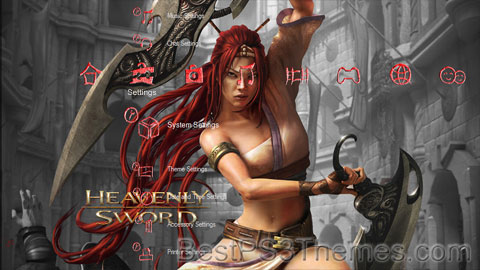
(4 backgrounds)
Heavenly Sword Developer(s) Ninja Theory Publisher(s) Sony Computer Entertainment Director(s) Nina Kristensen
Tameem AntoniadesProducer(s) Mat Hart Artist(s) Hugues Giboire Writer(s) Tameem Antoniades
Rhianna Pratchett
Andy SerkisComposer(s) Nitin Sawhney Platform(s) PlayStation 3 Release Genre(s) Action-adventure, hack and slash Mode(s) Single-player Gameplay[edit]
Plot[edit]
Setting[edit]
Characters[edit]
Story[edit]
Development[edit]
Soundtrack[edit]
Related media[edit]
Animated series[edit]
Film[edit]
Video game appearances[edit]
Reception[edit]
Aggregator Score Metacritic 79/100[32] Publication Score Edge 6/10[33] Electronic Gaming Monthly 8.33/10[34] Eurogamer 7/10[35] Famitsu 30/40[36] Game Informer 8.75/10[37] GamePro [38]GameRevolution B+[39] GameSpot 8/10[40] GameSpy [41]GameTrailers 7.9/10[42] GameZone 8.8/10[43] IGN 7/10[44][45] PlayStation: The Official Magazine 8/10[46] The A.V. Club C+[47] USA Today [48]Publication Award GamePro Editor's Choice[38] OPM (AU) Silver Award[49] Cancelled sequel[edit]
References[edit]
Patapon 
Developer(s) Pyramid
Japan StudioPublisher(s) Sony Computer Entertainment Director(s) Ejun Producer(s) Junichi Yoshizawa Designer(s) Hiroyuki Kotani Programmer(s) Hayato Ikeda Artist(s) Rolito Composer(s) Kemmei Adachi
Daisuke MiyakeSeries Patapon Platform(s) PlayStation Portable, PlayStation 4 Release PlayStation Portable
PlayStation 4 Genre(s) Rhythm game Mode(s) Single-player Gameplay[edit]

Plot[edit]
Development and release[edit]

Reception[edit]
Aggregator Score Metacritic PSP: 86/100[27]
PS4: 72/100[28]Publication Score 1Up.com A[29] Edge 8/10[30] Eurogamer 8/10[31] Famitsu 9/9/8/9[32] Game Informer 8.75/10[33] GameDaily 9/10[4] GamePro 4.4/5[6] GameSpot 9/10[2] IGN 9.2/10[3] PALGN 9/10[5] Pocket Gamer 4.5/5[34] X-Play 4/5[7] Sequels and legacy[edit]
References[edit]
Star Wars for Lawk
(5 backgrounds)
Copyright (c) 2007. Anoop Menon
p3textractor filename.p3t [destination path]Replace filename with the name of the p3t file, and replace [destination path] with the name of the folder you want the files to be extracted to. A destination path is not required. By default it will extract to extracted.filename.