Phantasy Star Online theme by Gekidami
Download: PhantasyStarOnline.p3t
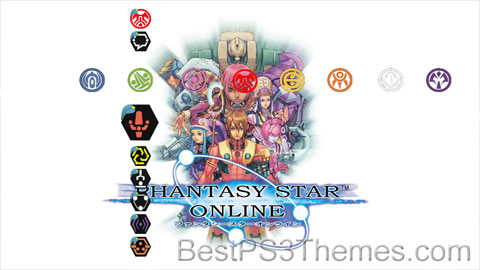
(6 backgrounds)
| Phantasy Star Online | |
|---|---|
 Japanese Dreamcast cover art | |
| Developer(s) | Sonic Team |
| Publisher(s) | Sega |
| Director(s) | Takao Miyoshi |
| Producer(s) | Yuji Naka |
| Programmer(s) | Akio Setsumasa |
| Artist(s) | Satoshi Sakai |
| Writer(s) | Akinori Nishiyama |
| Composer(s) | Hideaki Kobayashi Fumie Kumatani |
| Series | Phantasy Star |
| Platform(s) | Dreamcast Windows GameCube Xbox |
| Release | December 21, 2000
|
| Genre(s) | Action role-playing |
| Mode(s) | Single-player, multiplayer |
Phantasy Star Online is an online role-playing game (RPG) developed by Sonic Team and published by Sega in 2000 for the Dreamcast. It was the first successful online RPG for game consoles; players adventure with up to three others over the internet to complete quests, collect items and fight enemies in real-time action RPG combat. The story is unrelated to previous games in the Phantasy Star series.
Before Phantasy Star Online, online gaming was limited to western PC games, particularly RPGs such as Diablo, Ultima Online, and EverQuest. Believing online play was the future, Sega chairman Isao Okawa instructed Sonic Team to develop an online game for the Dreamcast, produced by Yuji Naka. Sonic Team's experiments led to the development of ChuChu Rocket!, the first online Dreamcast game. Using what they learned from the project, and taking significant inspiration from Diablo, Sonic Team built Phantasy Star Online. As Japanese internet service providers charged for dial-up access per minute, and high-speed connections were not yet widely available, Okawa personally paid for free internet access bundled with Japanese Dreamcasts.
Phantasy Star Online was highly anticipated and launched to positive reviews and commercial success; critics praised the online gameplay as addictive but criticized the single-player mode. It received the Japan Game Award for "Game of the Year" and is recognized as a landmark console game, influencing multiplayer dungeon crawlers such as the Monster Hunter series.
Phantasy Star Online was ported to Windows and rereleased on the Dreamcast as Ver. 2 with expanded content. Following Sega's exit from the console business in 2001, the game was ported to GameCube and Xbox as Episode I & II, featuring new characters, environments and other features. Episode III: C.A.R.D. Revolution, released for GameCube in 2003, was a turn-based card game. The online series continued with Phantasy Star Universe (2006) and Phantasy Star Online 2 (2012). Sega decommissioned the last official servers in 2010; Phantasy Star Online is still played on private servers.
Gameplay[edit]

Phantasy Star Online is an action role-playing game primarily played with other players cooperatively over the internet. Players take on the role of adventurers sent to explore Ragol, an uncharted planet.[8] To create their character, they choose between a handful of races and classes, which define their abilities and statistics; for example, some types are better with "techniques" (magic spells) while others are more skilled with ranged or melee weapons.[9]
Players can play either online or offline. Online, players are brought to a lobby where they can chat and organize teams of up to four.[10][a] Team members can communicate by typing using a physical or onscreen keyboard,[9] even when in different environments.[10] Preset phrases are automatically translated between languages, and custom emoticons are also supported.[9] Players can also exchange "guild cards" to exchange private messages and see when the other is online.[9]
After organizing a team, players are transported to their own instance of the hub spaceship Pioneer 2, where they can buy and sell items, store money and items, heal, and browse quests.[10] At any time, they can transport to Ragol, where combat and exploration take place.[10] The four environments – forests, caves, mines, or ruins[10] – comprise winding passages and large areas where enemies spawn.[10] Players fight enemies in real time, using weapons and techniques and collecting items.[13] Attacks can be chained for more accuracy and speed.[14][15] Typically, all the monsters in a room must be defeated to advance.[9] Each environment ends in a boss battle, which rewards the team with a large sum of experience points.[10] Quests, taken on Pioneer 2, task players with specific challenges; once completed, the team returns to Pioneer 2 to collect their reward.[10] Higher difficulties reward players with more experience points and better items. Some items can be used to feed the player's mag, a small creature that follows the player character and aids them in battle.[10]
Plot[edit]
The story of Phantasy Star Online is unrelated to the original Phantasy Star series,[10] and is less substantial.[8] Threatened by the imminent destruction of their home planet, thousands of refugees arrive at planet Ragol aboard the spaceship Pioneer 2. As they establish contact with colonists sent ahead on Pioneer 1, an enormous explosion shakes the planet. Adventurers from Pioneer 2 land to investigate the explosion and search for Rico Tyrell, daughter of the head of Pioneer 2. They discover the planet overrun by monsters, and follow messages left by Rico leading to an ancient evil, Dark Falz.
Development[edit]
By the late 1990s, the popularity of online gaming on personal computers had grown substantially in the west, but was almost nonexistent in Japan, where consoles were more popular. Sega chairman Isao Okawa believed the internet was the future of gaming and wanted a flagship online game for Sega's Dreamcast console. None of Sega's development studios wanted the project, as they were occupied with their own ventures, such as Jet Set Radio (2000) and the Sakura Wars series.[16] Okawa gave the responsibility to Sonic Team, led by Yuji Naka.[16][17] Sonic Team was not particularly receptive to the decision, but continued with development.[16] After Okawa became ill, Naka sent reports to the hospital to update him on progress.[16]
Concept[edit]
.jpg)
Sonic Team began experimenting with the Dreamcast's network capabilities after completing Sonic Adventure in 1998.[18] They saw the creation of an online game for Japan, a nation of console gamers, as a serious challenge, akin to creating a new genre.[16] Much of their time was spent learning the basic elements of online gaming; they wanted to make sure the network functionality worked before developing the gameplay, setting, and story.[16][19] Their network experiments became ChuChu Rocket!, released in 1999 as the first online game for the Dreamcast.[19][20][21][22] Sonic Team used the lessons learned from ChuChu Rocket! to implement network technology in the larger project.[19][21][22]
Because of the lack of Japanese online games, and the developers' experience with the genre, Naka looked to western games for inspiration,[16] and studied three online RPGs popular at the time: Diablo (1996), Ultima Online (1997), and EverQuest (1999).[16] Diablo in particular impressed him on a gameplay and technical level; he enjoyed how smooth the graphics and action were despite requiring significant system memory.[19] Diablo was a 2D game, however, and Sonic Team wanted to develop a 3D game with the same degree of smoothness and gameplay. This concerned Naka, as he did not want his game to use the cheap and bland graphics associated with online games.[16]
Naka decided against creating a massively multiplayer game similar to Ultima Online and EverQuest, which would handle many players simultaneously in a persistent world; the necessary servers would have required two years of programming, and the Dreamcast did not have a hard disk drive to support continuous online patches. Naka was also more interested in working on new projects instead of continuously updating the same game for years, and doubted Sonic Team would be able to keep the game interesting.[11] The team therefore adopted Diablo as their main inspiration, determined to outclass it.[16]
Art and setting[edit]
Sonic Team built a science fiction-fantasy game under the working title Third World.[16][19] The art style was "comic-like" at first, but became more realistic. One of artist Satoshi Sakai's early concept drawings of a dragon reminded Naka of Sega's Phantasy Star series; which had been dormant since Phantasy Star IV (1993) for the Genesis.[16] Naka had served as main programmer on Phantasy Star (1987) and Phantasy Star II (1989).[23] He had always wanted to develop a multiplayer Phantasy Star game, but previous hardware did not allow for it.[24]
With the Phantasy Star series chosen as the setting, Sonic Team continued developing the gameplay and story. The team was given freedom not to adhere strictly to elements from earlier Phantasy Star games.[16][19] The game would not continue the story from the previous Phantasy Star games, something that made Naka feel liberated.[18][24] Since few of the Phantasy Star IV staff still worked at Sega, the art team felt little obligation to adhere to the previous games' style, retaining only the science fiction look and some enemy and item names. Naka and Sakai believed factors such as the change in graphical fidelity and genre were enough to differentiate it from previous Phantasy Star games.[16]
Music[edit]
The soundtrack was composed by Hideaki Kobayashi using a Roland JV-2080 synthesizer, with live orchestration on some tracks, including the theme song. Kobayashi composed ambient music for calm scenes, and incorporated more rhythm and melody for battles. He composed short four-bar melodies that are sequenced depending on gameplay; for example, when an enemy appears, the system plays music associated with that enemy. The process was a drain on the Dreamcast hardware, and gained the nickname "the crasher" among staff for how often it would crash the game during development.[25]
Online functionality[edit]
Sonic Team had conceived their 1998 Saturn game Burning Rangers as an online game for four players, but abandoned the idea due to insurmountable network problems.[26] They used the ChuChu Rocket! networking system as a template for the online functions for Phantasy Star Online.[19][21][22] This presented new challenges, as the new network would connect players between different countries.[19] Sonic Team ran experiments with different internet service providers, dial-up modems, cable modems, and other networking configurations to ensure the game would work for all players.[23] In Japan, Sonic Team gave beta versions to 10,000 users who pre-ordered the game, so they could work with a variety of equipment and internet services to eliminate problems.[23] They wanted to run a worldwide test but did not have time.[23] 90% of the testers were able to play online.[27] Despite technical success, Sega was concerned that the high cost of internet access in Japan would be prohibitive for gamers and reduce sales.[24] Japanese internet service providers charged per-minute fees for dial-up access, and high-speed options such as broadband were not yet widely available. To combat this, chairman Okawa personally paid for free internet access for one year to be bundled with each Dreamcast.[16]
One of the biggest challenges was bridging the language barrier between global players.[18] Sonic Team felt that developing a universal language system would be the largest barrier to a global gaming network.[19] The team started by developing the word select system, which allows players to select predefined expressions to be translated to other players.[17] The system had about 2000 words near the end of development, and Naka found it difficult to add more words to satisfy all player needs.[11] Sonic Team built support for five languages: Japanese, English, Spanish, German, and French.[28] They omitted Italian and Portuguese due to time constraints. Korean was also considered because of the internet boom in Korea at the time.[11] Japanese and English were easier to implement because the only concern is the word location in the sentence, whereas Spanish and French have grammatical gender. The language system had to be fully redesigned at least once.[11]
Each server could accommodate one thousand players.[29] Sega initially prepared 20 network servers to accommodate 20,000 online users for game's launch, with room to add more servers as necessary.[30] This was increased to support up to 36,000 players right before launch.[27] Sonic Team partnered with Swatch to use Swatch Internet time (or "beat time") as a universal clock for the game.[19] The clock was implemented so players could coordinate with those in other countries on when to play online.[31] The clock system divides each 24 hours into 1000 beats, with one beat equaling one minute and 26.4 seconds.[31][32] The time was maintained directly on the server and not based on the user's clock on their system.[19] Sonic Team decided not to add jumping to keep the levels simple and simplify the network code.[26]
Naka joked that future gamers would laugh at the word "Online" in the title, as he believed that online gaming would become standard; it was included as the concept was new and so important to communicate.[19]
End of production[edit]
Phantasy Star Online was planned for release in March 2000, but was delayed so more features could be added.[11][23] The team planned 18 character types, and had male and female sketches for each, but settled on nine.[23] A player-versus-player mode was included in beta versions given to journalists, but this was omitted in the final version because it distracted players from the cooperative focus and introduced game balance issues;[23] additionally, as the console-playing audience was younger than the PC audience, Naka did not want to evoke competitive behavior.[19] The development team had more ideas for features to implement as development came to a close, with Naka wishing he had six additional months to add more features.[11] Phantasy Star Online took two years to develop.[18] Naka found it difficult to make a networked game for consoles, and developed an appreciation for Microsoft for supporting online games so well.[19]
Promotion[edit]
"As one of the most anticipated games for RPG fans and Dreamcast owners alike, Sonic Team's Phantasy Star Online represents what could be the pinnacle of current next-generation gaming, roleplaying or otherwise."
— Official Dreamcast Magazine (US), December 2000[33]
Sega unveiled Phantasy Star Online at the 1999 Tokyo Game Show with a gameplay demonstration.[24][34] Naka called it the "killer app" for the Dreamcast as it used all aspects of the system, most importantly the modem.[11]
As the first online RPG for consoles, Phantasy Star Online was highly anticipated.[11][28][33][35] Journalists saw it as the next evolutionary step in console-based role-playing games.[11][13] Francesca Reyes of Official Dreamcast Magazine proposed that it would be an "industry-changing title", a landmark in the history of console gaming.[11] Computer and Video Games wrote that the Dreamcast was quickly becoming the platform for innovative games, and wrote that Phantasy Star Online was "arguably the most revolutionary - not the mention most ambitious - console game ever".[36] GameSpot believed it would "change the way we think of RPGs" and could possibly be "the most exciting console RPG ever created".[13][37] Edge wrote that the multiplayer mechanics "would lay the foundations for a new era of console gaming".[17] Video Gamer called it the "Dreamcast's most ambitious project yet".[35] Some journalists had concerns about the viability of the online modes, and saw the single-player option as a fail-safe should it not function correctly.[32][35]
To promote the game, Sega bought a star on the International Star Registry and named it "Ragol".[38] The first 100,000 people to pre-order the game in Japan received Phantasy Star Online branded dog tags.[39] A limited edition in Japan including a branded memory card was canceled and the memory card sold separately on Sega's website.[40][41] Early copies of the game included a demo for Sonic Adventure 2.[42]
Launch[edit]

Phantasy Star Online was released in Japan on December 21, 2000.[40] The language could be changed to English or any of the other supported chat languages, making it "import-friendly".[43] Naka had hoped for a simultaneous global release, but the western release was delayed for beta testing and marketing reasons.[17][40] While subscriptions would be free in North America,[44] in Japan the game included a 30-day free trial, after which Japanese players were required to purchase 30-day or 90-day subscriptions.[45] Immediately after the Japanese release, Sonic Team began maintaining the overworked servers and investigated network problems in Hiroshima and Okayama.[16]
Sonic Team hoped that Phantasy Star Online would be successful in Japan; international sales were seen as a bonus.[16] In North America, which Naka believed would be the biggest market, Phantasy Star Online was released on January 30, 2001.[46][47] It sold 75,000 copies there on the first day and was the bestselling game that week.[48][49] Sega's North American online gaming service SegaNet was not required for online play.[31] While the Japanese version supported the modem and broadband adapters,[27] the North American release did not support the broadband adapter, but IGN explained how to use it by swapping discs with an import copy.[50]
Phantasy Star Online sold 500,000 copies in Japan and one million worldwide, meeting Sega's expectations almost exactly.[30] Naka had hoped to sell more, but believed the servers may not have carried the load.[16] Before its western launch, nearly 100,000 players had registered.[18] By April 2001, over 235,000 players had registered worldwide: 130,000 in Japan, 70,000 in North America, and 35,000 in Europe.[51][52] By May, over 270,000 had registered.[53] The peak number of users connected simultaneously was 26,000.[52]
Phantasy Star Online suffered problems common with other online games, with players cheating and selling rare items online.[54] Several weeks after launch, Japanese players began exploiting bugs to duplicate items, enhance their stats, and kill other players.[55][56] Sonic Team announced they would ban players found cheating or disrupting other players, starting in May 2001.[56][57] According to IGN, cheating was prevalent because Phantasy Star Online used a peer-to-peer communication system. Blizzard Entertainment had similar problems with Diablo, but after moving to a client-server system for Diablo II, cheating became more difficult.[55]
Sonic Team added more quests for players to download, translated into the five languages used in the game.[23] In Japan, a special "Fan Cup" quest was held from March 23 to April 6, developed with the game magazine Famitsu. In the event, over 70,000 players[52] competed for the fastest time; the winner received a cash prize and a rare game item.[51] As he had with ChuChu Rocket!, Naka played online[11] and was happy to see American and Japanese players playing together using the communication system.[23]
Later releases[edit]
Ver. 2[edit]
In April 2001, Sega announced Phantasy Star Online Ver. 2, an updated version of the original game with new content and improved features,[58][59][60] including an increased level cap (to 200),[61] a new difficulty mode for players over level 80,[58] a battle mode that pits players in one-on-one or team battles, a soccer minigame with balls shaped like characters from ChuChu Rocket!,[58] new weapons and monsters, gameplay balance alterations, day and night effects, an improved user interface, and two new areas exclusive to online quests. Ver. 2 also adds a challenge mode, which places teams in a stage with starting equipment and stats; if a teammate dies, the mission ends.[58][59][60][61][62] Players could import their character from the original game or create a new one;[61] characters registered for Ver. 2 could not be used in the original game. Any illegal items were also deleted during the upgrade.[62]
Sonic Team worked a tough schedule to develop Ver. 2 in under six months,[16] releasing it on June 7, 2001, in Japan and September 25, 2001, in North America.[61][63] Unlike the original North American release, Ver. 2 required subscription fees to play.[31] Three months of unlimited gameplay could be purchased at a time.[64] The game still had no dependencies on SegaNet, however.[65] In Europe, DreamKey 3.0 was required.[58] Ver. 2 was ported to Windows in Japan and released on December 20, 2001.[66][67]
Episode I & II[
Sonic The Hedgehog v2 w/ Custom Sounds
Sonic The Hedgehog version 2 theme by LC
Download: SonicTheHedgehogV2.p3t
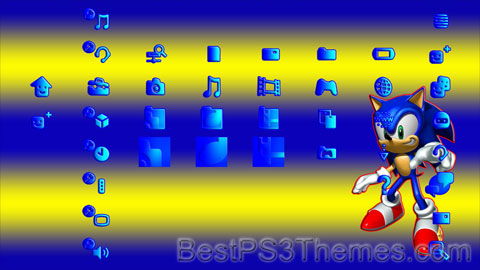
(2 backgrounds HD, 1 background SD)
P3T Unpacker v0.12
Copyright (c) 2007. Anoop Menon
This program unpacks Playstation 3 Theme files (.p3t) so that you can touch-up an existing theme to your likings or use a certain wallpaper from it (as many themes have multiple). But remember, if you use content from another theme and release it, be sure to give credit!
Download for Windows: p3textractor.zip
Instructions:
Download p3textractor.zip from above. Extract the files to a folder with a program such as WinZip or WinRAR. Now there are multiple ways to extract the theme.
The first way is to simply open the p3t file with p3textractor.exe. If you don’t know how to do this, right click the p3t file and select Open With. Alternatively, open the p3t file and it will ask you to select a program to open with. Click Browse and find p3textractor.exe from where you previously extracted it to. It will open CMD and extract the theme to extracted.[filename]. After that, all you need to do for any future p3t files is open them and it will extract.
The second way is very simple. Just drag the p3t file to p3textractor.exe. It will open CMD and extract the theme to extracted.[filename].
For the third way, first put the p3t file you want to extract into the same folder as p3textractor.exe. Open CMD and browse to the folder with p3extractor.exe. Enter the following:
p3textractor filename.p3t [destination path]Replace filename with the name of the p3t file, and replace [destination path] with the name of the folder you want the files to be extracted to. A destination path is not required. By default it will extract to extracted.filename.
Dynasty Warriors 6
Dynasty Warriors 6 theme by Joe
Download: DynastyWarriors6.p3t
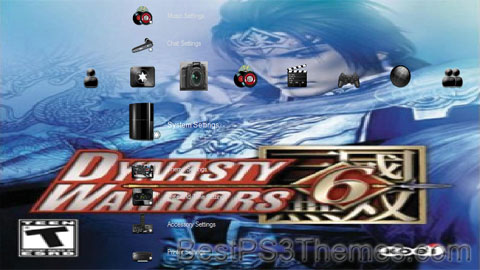
(1 background)
| Dynasty Warriors 6 | |
|---|---|
 The North American box art for Dynasty Warriors 6, featuring Zhao Yun. | |
| Developer(s) | Omega Force |
| Publisher(s) | Koei |
| Director(s) | Tomohiko Sho |
| Designer(s) | Kenichiro Yasuda Fumiya Kato |
| Series | Dynasty Warriors |
| Platform(s) | PlayStation 3, Xbox 360, Microsoft Windows, PlayStation 2, PlayStation Portable |
| Release | PlayStation 3, Xbox 360 Microsoft Windows PlayStation 2 PlayStation Portable |
| Genre(s) | Hack and slash, Action[8] |
| Mode(s) | Single-player, Multiplayer |
Dynasty Warriors 6 (真・三國無双5, Shin Sangoku Musōu 5) is a hack and slash video game set in Ancient China, during a period called Three Kingdoms (around 200AD). This game is the sixth official installment in the Dynasty Warriors series, developed by Omega Force and published by Koei. The game was released on November 11, 2007 in Japan; the North American release was February 19, 2008 while the Europe release date was March 7, 2008. A version of the game was bundled with the 40GB PlayStation 3 in Japan.[9] Dynasty Warriors 6 was also released for Windows in July 2008.[10] A version for PlayStation 2 was released on October and November 2008 in Japan and North America respectively. An expansion, titled Dynasty Warriors 6: Empires was unveiled at the 2008 Tokyo Game Show[11] and released in May 2009.
Gameplay[edit]
This installment varies greatly from past games in the series. One of the game's key additions is the Renbu[12] system, a new way for characters to build up their attack combos. In previous installments in the series, combos were affected by the quality of weapon the character was wielding, with more powerful weapons allowing characters longer, more elaborate and often more powerful consecutive attacks. The Renbu system replaces this system with a gauge that gradually fills as you perform attacks. Performing attacks and dealing damage to the enemy fills the Renbu gauge, eventually earning a new rank/level, while taking damage and not attacking for a time drops the gauge; if you take a lot of damage or go for a long time without inflicting damage then the gauge may even drop back down to the previous level. However even at Renbu Rank 1 characters will be able to perform non-ending combos on the enemy. Without unlocking Renbu Ranks 3 and Infinite from the skill tree though, players can only progress to Renbu Rank 2 (with the exception of the temporary Rank Infinity acquired temporarily by collecting a certain item on the battlefield).
Another major addition is the skill tree, from which characters can earn higher Renbu Ranks, special abilities and improve their attributes. As the progression of the skill tree moves from left to right, those on the right side of the tree are harder to unlock than those on the left. Typically the one which unlocks Infinite Renbu is on the farthest right.
Unique movesets for each character have been largely reduced. Only characters who have Musou Mode receive original movesets (with the exception of Diao Chan); the rest of the characters playable only in Free Mode have cloned movesets based on the Musou Mode characters with altered properties (with the exception of Xiao Qiao, who retains her fan moveset). Due to the addition of Renbu system, the traditional "fourth weapon" from previous games have been removed with the three normal weapons no longer being quality-based. Each weapons obtained have random stats and effects implemented and the "weight system" from previous game have been replaced by weapon categories; Standard (default type), Strength (greater attack power at the cost of Renbu Gauge being kept for a smaller amount of time), and Skill (greater attack speed with low attack power). In addition to the new weapon system, it is now possible to block from any direction, for example, if a character is attacked from behind while blocking, they will rotate their body with their weapon in front of them to guard against the enemy's attack. This eliminates the need to quickly stop blocking, change direction, and press the guard button again. Unlike previous games, horses can be found by obtaining saddles randomly dropped from boxes or beaten officers. These horses can gain levels, skills, and some can even change into the legendary Red Hare, although this is very rare.
Musou Token which enables the use of Musou Rage have been removed. It is instead replaced by Tome item drop which allows the use of unique special attacks. There are five types of attacks; Swift Attack (increases the player's stats), Volley (launches waves of arrows), Fire (sets eruptions of fire), True Speed (boosts the player's speed), and Rockfall (launches giant boulders from above).
Dueling from Dynasty Warriors 4 returns, but has been revamped; duels now take place on the battlefield and the nearby soldiers will circle around the two fighters, and other officers may jump into the circle, as opposed to the duel taking place in an arena that appears out of nowhere.
Bases have been altered too; they are bigger and where, before, in order to open the outer gate to a base, the player had to defeat a defense captain, now they must simply break it down with attacks. There is also a new corporal unit which guards bases. Defeating troops and corporals within the base reduces the base's defense. When the defense of the base drops to zero, the player has claimed the base. However, defeating the corporal is worth defeating 20 troops while defeating the guard captain will automatically capture the base.
Two new 'innovations' to the series are the abilities to swim and climb ladders. The ladder means that the player can now climb onto castle battlements in scenarios such as the Battle of Hu Lao Gate, and dispose of enemy ballistas and the new 'guard' unit. The first ties in with the improvements to enemy AI, allowing them to travel across rivers and other bodies of water in order to attack you or allied bases. Swimming is now a part of scenarios such as the Battle of Fan Castle.
Characters[edit]
The original game features a total of 41 playable characters, a step-down from the previous installment in the series, which featured 48 playable characters. The seven removed characters are Da Qiao, Jiang Wei, Meng Huo, Pang De, Xing Cai, Zhu Rong, and Zuo Ci. Other than brief mentions in cutscenes and character biographies in-game, they otherwise do not make appearance in the game at all. Unlike previous games which featured Musou Modes for all characters, only seventeen of the playable characters received stories, while the others are playable only in Free Mode and Challenge Mode. Dynasty Warriors 6: Special adds Musou Mode for six more characters, while the PSP port of the game adds Meng Huo back to the roster, bringing the character count to 42.
* Denotes characters added through expansion titles
Bold denotes default characters
Reception[edit]
| Aggregator | Score | |||
|---|---|---|---|---|
| PC | PS2 | PS3 | Xbox 360 | |
| GameRankings | 30%[31] | 45%[32] | 59%[33] | 61%[34] |
| Metacritic | N/A | 43/100[35] | 59/100[36] | 60/100[37] |
| Publication | Score | |||
|---|---|---|---|---|
| PC | PS2 | PS3 | Xbox 360 | |
| Destructoid | N/A | N/A | N/A | 7.5/10[13] |
| Edge | N/A | N/A | 7/10[14] | N/A |
| Electronic Gaming Monthly | N/A | N/A | 3.83/10[15] | 3.83/10[15] |
| Eurogamer | N/A | N/A | 8/10[16] | N/A |
| Famitsu | N/A | N/A | 33/40[17] | 33/40[17] |
| Game Informer | N/A | N/A | 7.25/10[18] | 7.25/10[18] |
| GameRevolution | N/A | N/A | N/A | C−[19] |
| GameSpot | N/A | 4/10[20] | 6.5/10[21] | N/A |
| GameSpy | N/A | N/A |    [22] [22] | [22] |
| GameTrailers | N/A | N/A | 6.3/10[23] | 6.3/10[23] |
| GameZone | N/A | 4.5/10[24] | N/A | 5/10[25] |
| IGN | 3/10[26] | 3.5/10[27] | 5.9/10[28] | 6/10[29] |
| Official Xbox Magazine (US) | N/A | N/A | N/A | 5/10[30] |
The Xbox 360 and PlayStation 3 versions of the game received "mixed" reviews and the PlayStation 2 version received "unfavorable" reviews, according to video game review aggregator Metacritic.[37][36][35] In Japan, Famitsu gave the PlayStation 3 and Xbox 360 versions a score of one eight, one nine, and two eights for a total of 33 out of 40.[17]
GameSpot nominated Dynasty Warriors 6 for 'least improved sequel' in their 2008 award show.[38]
Ryan Clements of IGN said of the Xbox 360 version, "Dynasty Warriors 6 is not a good looking game, and it performs even worse on the PS3 than on the 360 (even when you opt to install the game data)." He did note that "Dynasty Warriors 6 does have a number of cool things to note. The amount of leveling up you can do is fairly impressive and each character's campaign takes at least a few hours to work through, providing you with quite a lot of content (despite the repetition)."[29]
Amanda L. Kondolojy of CheatCodeCentral gave the game one of its better reviews, scoring it at 3.4/5. Kondolojy enjoyed the game, saying that "One aspect of Dynasty Warriors 6 Empires that was surprisingly fun to tinker with was the character creator. Although DW5 Empires had a warlord creator, DW6 Empires gives you more creative control over your newly-made character. In addition to having a wide variety of costumes and customizable features, you can also integrate your character into the main Empire mode as a vagrant, and can work your way up to become leader of the land."
Expansions[edit]
PlayStation 2 and PlayStation Portable versions[edit]
Dynasty Warriors 6 (真・三國無双5: Special) was released on October 2, 2008 on the PlayStation 2 in Japan and November 17, 2008 in North America. In this game, Musou modes for Ma Chao, Yue Ying, Cao Pi, Zhang He, Taishi Ci, and Ling Tong were added, and those six characters received new weapons and movesets (rather than being clones). There are also five new stages introduced in this game. The swimming and dueling abilities were removed, however. The graphics are also significantly reduced and the game suffers from heavy slowdown, most likely due to the memory capabilities.
This version of the game was also released to the PlayStation Portable on September 17, 2009. Likely to coincide with the inclusion of Meng Huo in the Empires expansion, he was additionally added as a Free Mode character in this game.
Dynasty Warriors 6: Empires[edit]
| Aggregator | Score | |
|---|---|---|
| PS3 | Xbox 360 | |
| GameRankings | 64%[50] | 61%[51] |
| Metacritic | 62/100[52] | 59/100[53] |
| Publication | Score | |
|---|---|---|
| PS3 | Xbox 360 | |
| Destructoid | N/A | 8/10[39] |
| Game Informer | 6.25/10[40] | 6.25/10[40] |
| GamePro | [41] | [41] |
| GameRevolution | C[42] | C[42] |
| GameSpot | 5.5/10[43] | 5.5/10[43] |
| GameZone | 7.6/10[44] | 6.4/10[45] |
| IGN | 6.8/10[46] | 6.7/10[47] |
| Official Xbox Magazine (US) | N/A | 6/10[48] |
| TeamXbox | N/A | 7.1/10[49] |
Dynasty Warriors 6: Empires was released May 11, 2009 in Japan, June 23, 2009 for North America and June 26 in Europe for PlayStation 3 and Xbox 360.[54] Like all other Empires expansions, the basic premise of the game is to become a leader whose goal is to conquer and maintain all regions of China. However, the player can additionally become a Vagrant (unaligned wanderer) or a vassal serving a lord, in addition to becoming a ruler. The player can step down from any force at any time, betraying their liege, or defecting to another force. The player can also make oaths of friendship with fellow officers and marry other characters.
The level-up system for weapons similar to Dynasty Warriors 4 is introduced. The player can equip various skills and abilities to the weapons. The Renbu system also returns, although it is now merely an element determined by the character's weapons
Meng Huo, who was originally cut from the original game returns with new weapons as well as seven new stages. The game also kept all character changes and new stages exclusive to Dynasty Warriors 6 (PS2/PSP Version).
The Create Character option from Dynasty Warriors 4 returns and greatly revamped; players are given much more freedom in creating characters and the player can create up to 100 characters. Free Mode have been cut from this game however, as the game opted for a more full and rounded Empire Mode. Additionally, the game supports Downloadable Content which mainly includes new costumes for edit characters and music.
Dynasty Warriors 6: Empires received "mixed" reviews on both platforms according to video game review aggregator Metacritic.[52][53]
Kevin VanOrd of GameSpot said that "The combat is still dreadfully repetitive," "The visuals are still ugly," and "The sound effects and voice acting are still awful." VanOrd went on to say of Empires, "Environments are bland and lifeless; water looks awful; and character models, while clearly upgraded from Dynasty Warriors 5 Empires, still look primitive by today's standards," and gave it 5.5/10[43]
References[edit]
- ^ a b Article Detail – PlayStation 3 News – QJ.NET Archived November 24, 2007, at the Wayback Machine
- ^ a b "KOEI official site". Archived from the original on 2016-03-03. Retrieved 2007-10-12.
- ^ a b Parfitt, Ben (November 20, 2007). "Dynasty Warriors 6 announced". MCV. Retrieved 2016-02-28.
- ^ "Dynasty Warriors 6 >> PlayStation 3". Ebgames.com.au. Archived from the original on 2012-02-17. Retrieved 2012-03-05.
Random
Random theme by burt
Download: Random.p3t
(2 backgrounds)
Redirect to:
This page is a redirect. The following categories are used to track and monitor this redirect:- From an adjective: This is a redirect from an adjective, which is a word or phrase that describes a noun, to a related word or topic.
- From a page move: This is a redirect from a page that has been moved (renamed). This page was kept as a redirect to avoid breaking links, both internal and external, that may have been made to the old page name.
- With history: This is a redirect from a page containing substantive page history. This page is kept as a redirect to preserve its former content and attributions. Please do not remove the tag that generates this text (unless the need to recreate content on this page has been demonstrated), nor delete this page.
- This template should not be used for redirects having some edit history but no meaningful content in their previous versions, nor for redirects created as a result of a page merge (use {{R from merge}} instead), nor for redirects from a title that forms a historic part of Wikipedia (use {{R with old history}} instead).
When appropriate, protection levels are automatically sensed, described and categorized.- From a printworthy page title: This is a redirect from a title that would be helpful in a printed or CD/DVD version of Wikipedia. See Wikipedia:Printability and Version 1.0 Editorial Team for more information.
Call of Duty 4 #9
Resident Evil #3
Resident Evil theme by Louxx
Download: ResidentEvil_3.p3t
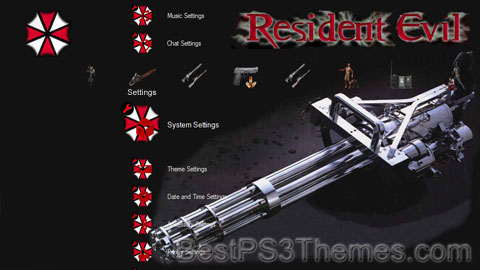
(3 backgrounds, wallpapers HD only)
Resident Evil 
Created by Shinji Mikami
Tokuro FujiwaraOriginal work Resident Evil (1996) Owner Capcom Years 1996–present Print publications Novel(s) Novel list Comics Comic list Films and television Film(s) Television series Television list Games Video game(s) Video game list Official website game .capcom .com /residentevil / Resident Evil is a Japanese horror game series and media franchise created by Capcom. It consists of survival horror, third-person shooter and first-person shooter games, with players typically surviving in post-apocalyptic urban environments infested with mutant humanoids and bizarre animals (such as mutated dogs), zombies and other lethal creatures. The franchise has expanded into other media, most notably a live-action film series, as well as animated films, television series, comic books, novels, audiobooks, and merchandise including clothing, costumes, action figures and toys. Resident Evil is the highest-grossing horror franchise.
The first Resident Evil game was created by Shinji Mikami and Tokuro Fujiwara for PlayStation, and released in 1996.[1][2] It is credited for defining the survival horror genre and returning zombies to popular culture. By the time of Resident Evil 4 (2005), the franchise shifted to more dynamic shooting action, achieved critical acclaim, and influenced the evolution of the survival horror and third-person genres, popularizing the "over-the-shoulder" third-person view.[3]
The franchise returned to survival horror with Resident Evil 7: Biohazard (2017) and Resident Evil Village (2021), which used a first-person perspective. Capcom has also released four Resident Evil remakes: Resident Evil (2002), Resident Evil 2 (2019), Resident Evil 3 (2020) and Resident Evil 4 (2023). Resident Evil is Capcom's best-selling franchise and the best-selling horror game series, with 154 million copies sold worldwide, as of December 2023.[4]
The first Resident Evil action film was released in 2002, starring Milla Jovovich, followed by five further sequels and a reboot, Welcome to Raccoon City (2021). The films have received mostly negative critical reviews, including on Rotten Tomatoes and some on Metacritic; however, some of the films have received mixed reviews on Metacritic. Nevertheless, the films have grossed more than $1.2 billion, making Resident Evil the third-highest-grossing video game film series.
History[edit]
The development of the first Resident Evil, released as Biohazard in Japan, began in 1993 when Capcom's Tokuro Fujiwara told Shinji Mikami and other co-workers to create a game using elements from Fujiwara's 1989 game Sweet Home on the Family Computer (Famicom) in Japan.[5][6] When in late 1994 marketing executives were setting up to release Biohazard in the United States, it was pointed out that securing the rights to the name Biohazard would be very difficult as a DOS game had been registered under that name, as well as a New York hardcore punk band called Biohazard. A contest was held among company personnel to choose a new name; this competition turned up Resident Evil, the name under which it was released in the west.[7] Resident Evil made its debut on the PlayStation in 1996 and was later ported to the Sega Saturn.
The first entry in the series was the first game to be dubbed a "survival horror", a term coined for the new genre it initiated,[8] and its critical and commercial success[9] led to the production of two sequels, Resident Evil 2 in 1998 and Resident Evil 3: Nemesis in 1999, both for the PlayStation. A port of Resident Evil 2 was released for the Nintendo 64. In addition, ports of all three were released for Windows. The fourth game in the series, Resident Evil – Code: Veronica, was developed for the Dreamcast and released in 2000, followed by ports of Resident Evil 2 and Resident Evil 3: Nemesis. Resident Evil – Code: Veronica was later re-released for Dreamcast in Japan in an updated form as Code: Veronica Complete, which included slight changes, many of which revolved around story cutscenes. This updated version was later ported to the PlayStation 2 and GameCube under the title Code: Veronica X.
Despite earlier announcements that the next game in the series would be released for the PlayStation 2, which resulted in the creation of an unrelated game titled Devil May Cry, series' creator and producer Shinji Mikami decided to make the series exclusively for the GameCube.[10] The next three games in the series—a remake of the original Resident Evil and the prequel Resident Evil Zero, both released in 2002, as well as Resident Evil 4 (2005)—were all released initially as GameCube exclusives. Resident Evil 4 was later released for Windows, PlayStation 2, and Wii.
A trilogy of GunCon-compatible light gun games known as the Gun Survivor series featured first-person gameplay. The first, Resident Evil Survivor, was released in 2000 for the PlayStation and PC but received mediocre reviews.[11] The subsequent games, Resident Evil Survivor 2 – Code: Veronica and Resident Evil: Dead Aim, fared somewhat better.[12] Dead Aim is the fourth Gun Survivor game in Japan, with Gun Survivor 3 being the Dino Crisis spin-off Dino Stalker. In a similar vein, the Chronicles series features first-person gameplay, albeit on an on-rails path. Resident Evil: The Umbrella Chronicles was released in 2007 for the Wii, with a sequel, Resident Evil: The Darkside Chronicles released in 2009 (both were later ported to the PlayStation 3 in 2012).[13]
Resident Evil Outbreak is an online game for the PlayStation 2, released in 2003, depicting a series of episodic storylines in Raccoon City set during the same period as Resident Evil 2 and Resident Evil 3: Nemesis. It was the first in the series and the first survival horror title to feature cooperative gameplay.[14] It was followed by a sequel, Resident Evil Outbreak: File #2. Raccoon City is a metropolis located in the Arklay Mountains of the Midwestern United States that succumbed to the deadly T-virus outbreak and was consequently destroyed via a nuclear missile attack issued by the United States government. The town served as a critical junction for the series' progression as one of the main catalysts to Umbrella's downfall and the entry point for some of the series' most notable characters.
Resident Evil Gaiden is an action-adventure game for the Game Boy Color featuring a role-playing-style combat system. There have been several downloadable mobile games based on the Resident Evil series in Japan. Some of these mobile games have been released in North America and Europe through T-Mobile. At the Sony press conference during E3 2009, Resident Evil Portable was announced for the PlayStation Portable,[15][16][17] described as an all-new title being developed with "the PSP Go in mind" and "totally different for a Resident Evil game". No further announcements have been made, and the game is considered to have been canceled.[18][19]
In 2009, Resident Evil 5 was released for PlayStation 3, Windows and Xbox 360, becoming the best selling game of the franchise despite mixed fan reception. Capcom revealed the third-person shooter Resident Evil: Operation Raccoon City, which was developed by Slant Six Games for the PlayStation 3, Xbox 360 and Windows and released in March 2012. A survival horror game for the Nintendo 3DS, Resident Evil: Revelations, was released in February 2012.[20] In October of the same year, the next numbered entry in the main series, Resident Evil 6, was released to mixed reviews,[21] but enthusiastic pre-order sales.[22]
In 2013, producer Masachika Kawata said the Resident Evil franchise would return to focus on elements of horror and suspense over action, adding that "survival horror as a genre is never going to be on the same level, financially, as shooters and much more popular, mainstream games. At the same time, I think we need to have the confidence to put money behind these projects, and it doesn't mean we can't focus on what we need to do as a survival horror game to meet fan's needs."[23] Resident Evil: Revelations 2, an episodic game set between Resident Evil 5 and Resident Evil 6, was released in March 2015. A series of team-based multiplayer games were developed beginning with the poorly received Umbrella Corps, which was released in June 2016.[24] Resident Evil: Resistance was released in April 2020, followed by Resident Evil Re:Verse in October 2022, with both being available for free to those who bought Resident Evil 3 and Village respectively.[25][26]
Using the new RE Engine, which would develop the next generation of Resident Evil games, the series continued to shift back towards more horror elements. The next mainline game, Resident Evil 7: Biohazard was released for Windows, PlayStation 4 and Xbox One in January 2017.[27][28] Set in a dilapidated mansion in Louisiana, the game uses a first-person perspective and emphasizes horror and exploration over action, unlike previous installments.[29][30][31][32] The first-person perspective continued in the eighth mainline game Resident Evil Village. Released in May 2021, the game, set in a mysterious European village, is a direct sequel to Resident Evil 7: Biohazard although it incorporates more action elements inspired from Resident Evil 4.[33][34] The game also marked the franchise's debut on PlayStation 5 and Xbox Series X/S[35]
A new generation of remakes of older entries began in 2019 with a remake of Resident Evil 2, being released for the PlayStation 4, Windows, and Xbox One. The remake outsold the original game within a year, selling over five million copies.[36] Following in the success of the Resident Evil 2 remake, Capcom revealed a remake of Resident Evil 3: Nemesis in December 2019, known as Resident Evil 3. It was released in April 2020.[37] In June 2022, a remake of Resident Evil 4 was announced and released on March 24, 2023 for PlayStation 4, PlayStation 5, Xbox Series X/S, and PC.[38]
Story overview[edit]

Logo for Umbrella Corporation, a prominent antagonistic faction in the franchise The early Resident Evil games focused on the Umbrella Corporation, an international pharmaceutical company that secretly develops mutagenic viruses to further their "bio-organic weapons" (BOW) research. The company's viruses can transform humans into mindless zombies while also mutating plants and animals into horrifying monstrosities. The Umbrella Corporation uses its vast resources to effectively control Raccoon City, a fictional midwestern American city. In the original Resident Evil, members of an elite police task force, Special Tactics and Rescue Service (STARS), are lured to a derelict mansion on the outskirts of Raccoon City. The STARS team is mostly decimated by zombies and other BOWs, leaving only a handful of survivors, including Chris Redfield, Jill Valentine, and Albert Wesker. Chris and Jill explore the zombie-infested mansion and uncover a secret underground Umbrella research facility. Wesker reveals himself to be a double agent for Umbrella and betrays his comrades. However, Wesker is seemingly murdered by a Tyrant, a special BOW that is the culmination of the Umbrella Corporation's research.[39][40]
Chris and Jill escape the mansion, but their testimony is ridiculed by Raccoon City's officials due to Umbrella's influence. Meanwhile, a separate viral outbreak occurs in another Umbrella research facility underneath Raccoon City. Most of the city's residents are infected and become zombies. Resident Evil 2 introduces two new protagonists, Leon S. Kennedy, a rookie police officer and Claire Redfield, the younger sister of Chris. Leon and Claire arrive in Raccoon City amidst the chaos of the viral outbreak. Leon is aided by Ada Wong, a corporate spy posing as an FBI agent, while Claire rescues Sherry Birkin, the daughter of two prominent Umbrella researchers. At the same time, Jill makes her escape from the city in Resident Evil 3: Nemesis. She is relentlessly pursued by a new Tyrant, Nemesis, who is deployed by Umbrella to eliminate all surviving STARS members. The U.S. Government destroys Raccoon City with a missile strike to sterilize the viral outbreak.[41] Leon, Claire, Sherry, Ada, and Jill escape the city before its eradication. Claire continues to look for Chris, whereas Leon is recruited to work for the U.S. Government. Resident Evil – Code: Veronica follows Claire as she escapes from a prison camp in the Southern Ocean and later reunites with Chris at an Umbrella research facility in Antarctica. Resident Evil 4 is set six years after the Raccoon City incident and focuses on Leon as he tries to rescue the U.S. President's daughter from a cult in Spain.[39][40]
A government investigation into the Umbrella Corporation reveals its involvement in the Raccoon City disaster and leads to the company's dissolution. Despite the downfall of the Umbrella Corporation, the company's research and BOWs proliferate across the black market and lead to the rise of bioterrorism. Chris and Jill establish the Bioterrorism Security Assessment Alliance (BSAA) to combat these ever-growing threats on a global scale. Wesker is revealed to be alive and involved in the development of new potent viral agents and BOWs. In Resident Evil 5, Wesker seeks to unleash a highly mutagenic virus that will infect all of humanity. Chris and the BSAA confront and kill Wesker in Africa before he can fulfill his mission.[42] Resident Evil 6 features Leon and Chris meeting for the first time in the video game series.[43] The two work separately to triage bioterrorist attacks in the United States, Eastern Europe, and China. They are assisted by Sherry, Wesker's illegitimate son Jake Muller, Ada, and many members of the BSAA and U.S. government.
Resident Evil 7: Biohazard and Resident Evil Village introduce a new protagonist, Ethan Winters, who becomes entangled in a bioterrorism incident while searching for his missing wife. He encounters Chris and the BSAA, who help him rescue his wife and defeat Eveline, a powerful BOW. Ethan, Mia, and their newborn daughter, Rosemary, are relocated to Eastern Europe but are abducted by a cult. Ethan ultimately sacrifices himself to destroy a fungal colony being weaponized by bioterrorists and save his family.[39][40][44]
Gameplay[edit]
The Resident Evil franchise has had a variety of control schemes and gameplay mechanics throughout its history. Puzzle-solving has figured prominently throughout the series.[45]
Tank controls[edit]
The first game introduced a control scheme that the player community has come to refer to as "tank controls" to the series. In a game with tank controls, players control movement relative to the position of the player character, rather than relative to the fixed virtual camera from which the player views the current scene.[46] Pressing up (for example on a D-pad, analog stick, or cursor movement keys) on the game controller moves the character in the direction being faced, pressing down backpedals, and left and right rotates the character.[46] This can feel counter-intuitive when the character is facing the camera, as the controls are essentially reversed in this state. This differs from many 3D games, in which characters move in the direction the player pushes the controls from the perspective of the camera.[46] Some critics have posited that the control scheme is intentionally clumsy, meant to enhance stress and exacerbate difficulty.[47]
While the first three entries in the series featured this control scheme, the third, Resident Evil 3: Nemesis, saw some action-oriented additions. These included a 180 degree turn and dodge command that, according to GameSpot, "hinted at a new direction that the series would go in." Later games in the series, like Resident Evil 4, would feature a more fluid over-the-shoulder third-person camera instead of a fixed camera for each room, while Resident Evil 7 and Resident Evil Village are played from the first-person perspective.
Third-person shooter gameplay[edit]
Resident Evil 4 saw significant changes to the established gameplay, including switching from fixed camera perspectives to a tracking camera, and more action-oriented gameplay and mechanics. This was complemented by an abundance of ammunition and revised aiming and melee mechanics. Some critics claimed that this overhauled control scheme "made the game less scary."[47] The next two games in the franchise furthered the action-oriented mechanics: Resident Evil 5 featured cooperative play and added strafing, while Resident Evil 6 allowed players to move while aiming and shooting for the first time, fully abandoning the series' signature tank controls.[47]
First-person shooter gameplay and VR[edit]
Resident Evil 7 is the first main Resident Evil game to use the first-person perspective and to use virtual reality. It drew comparisons to modern survival horror games such as Outlast and PT.[47] The eighth main-series game, Resident Evil Village, also features a first-person perspective.[48] A VR version of Resident Evil 4 was released on the Oculus Quest 2 on October 21, 2021.[49]
Other media[edit]
The Resident Evil franchise features video games and tie-in merchandise and products, including various live-action and animated films, comic books, and novels.
Films[edit]
Live-action films[edit]

The live-action film series logo From 2002 to 2016, six live-action Resident Evil films were produced, all written and produced by Paul W. S. Anderson. The films do not follow the games' premise but feature some game characters. The series' protagonist is Alice, an original character created for the films portrayed by Milla Jovovich. Despite a negative reaction from critics, the live-action film series has made over $1 billion worldwide.[50] They are, to date, the only video game adaptations to increase the amount of money made with each successive film.[51] The series holds the record for the "Most Live-Action Film Adaptations of a Video Game" in the 2012 Guinness World Records Gamer's Edition, which also described it as "the most successful movie series to be based on a video game."[14]
A reboot, Resident Evil: Welcome to Raccoon City, was released on November 24, 2021, with Johannes Roberts as writer/director.[52]
Animated films[edit]
The first computer animated film for the franchise was Biohazard 4D-Executer. It was a short 3D film produced for Japanese theme parks and did not feature any characters from the game.[53]
Starting in 2008, a series of feature-length computer-animated films have been released. These films take place in the same continuity with the games of the series, and feature characters such as Leon Kennedy, Claire Redfield, Ada Wong, Chris Redfield,
Clan 502
Clan 502 theme by nighthawk1492
Download: Clan502.p3t
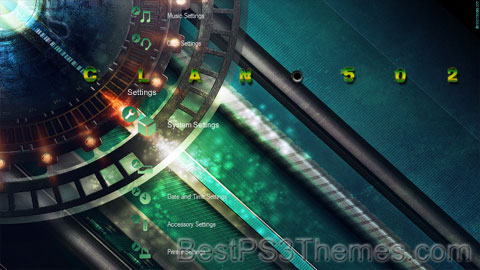
(1 background)
P3T Unpacker v0.12
Copyright (c) 2007. Anoop MenonThis program unpacks Playstation 3 Theme files (.p3t) so that you can touch-up an existing theme to your likings or use a certain wallpaper from it (as many themes have multiple). But remember, if you use content from another theme and release it, be sure to give credit!
Download for Windows: p3textractor.zip
Instructions:
Download p3textractor.zip from above. Extract the files to a folder with a program such as WinZip or WinRAR. Now there are multiple ways to extract the theme.
The first way is to simply open the p3t file with p3textractor.exe. If you don’t know how to do this, right click the p3t file and select Open With. Alternatively, open the p3t file and it will ask you to select a program to open with. Click Browse and find p3textractor.exe from where you previously extracted it to. It will open CMD and extract the theme to extracted.[filename]. After that, all you need to do for any future p3t files is open them and it will extract.
The second way is very simple. Just drag the p3t file to p3textractor.exe. It will open CMD and extract the theme to extracted.[filename].
For the third way, first put the p3t file you want to extract into the same folder as p3textractor.exe. Open CMD and browse to the folder with p3extractor.exe. Enter the following:
p3textractor filename.p3t [destination path]Replace filename with the name of the p3t file, and replace [destination path] with the name of the folder you want the files to be extracted to. A destination path is not required. By default it will extract to extracted.filename.Resistance: Fall of Man #4
Resistance: Fall of Man theme by Draicus
Download: ResistanceFallOfMan_4.p3t
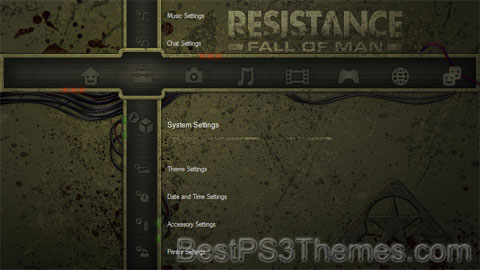
(1 background)
Resistance: Fall of Man  European cover art
Developer(s) Insomniac Games Publisher(s) Sony Computer Entertainment Director(s) Ted Price[1] Designer(s) Colin Munson[2] Writer(s) Josh Wall[2] Composer(s) David Bergeaud Series Resistance Platform(s) PlayStation 3 Release Genre(s) First-person shooter Mode(s) Single-player, multiplayer Resistance: Fall of Man is a 2006 first-person shooter video game for the PlayStation 3. It was developed by Insomniac Games and published by Sony Computer Entertainment. The game is set in an alternate history 1951, and follows Sergeant Nathan Hale as he and the human resistance forces attempt to drive a mysterious alien-like invasion out of the United Kingdom. The story continues in Resistance 2.
The game was originally developed under the title I-8, as it was the eighth title to be in production by Insomniac Games. It was released as a PlayStation 3 launch title in the United States on November 17, 2006 and in the PAL region on March 23, 2007. Resistance had positive critical reception, garnering particular praise in view of its status as a launch title[3] and winning several awards. As of 2007, the game sold more than 2.1 million copies.[4]
Sony and Insomniac Games became embattled with the Church of England for using interior shots of Manchester Cathedral to recreate the building within the game, as well as "promoting violence" within the building.
The game, along with its sequels Resistance 2 and Resistance 3, shut down its online servers on April 8, 2014. Digital versions of the first two games were released after the servers' closure in Europe.
Plot[edit]
In the 1900s, an insect-like alien race known as the Chimera arrive in Russia. Using advanced technology, they infect hundreds of civilians and subject them to artificial evolution, creating a diverse army of creatures ranging from simple foot soldiers to spider-like giants. By 1949, all of Europe has fallen to the Chimera. 12 months later, a vast invasion force tunnels under the English Channel, conquering much of England and leaving only scattered pockets of human resistance.
In 1951, the United States, despite taking a position of neutrality in the conflict, finally elects to deploy a task force to assist the UK as part of "Operation Deliverance". Among the soldiers is Army Ranger Sgt. Nathan Hale. However, soon after landing in York, he and his squad are ambushed by enemy troops, who infect them with the Chimera virus. Hale, the only survivor, discovers that he has an innate resistance to full infection. Instead, he gains increased strength and faster reflexes, the ability to instantly heal light injuries, and gold-colored irises, a common trait of the Chimera.
Sent to a Chimera conversion center in Grimsby, Hale meets British intelligence officer Captain Rachel Parker and helps her escape. In turn, Parker allows him to accompany British forces launching an offensive in Manchester to recover a missing convoy. The convoy's cargo is subsequently transferred to a resistance command center in Cheshire, which soon comes under attack from the Chimera. While attempting to provide assistance, Hale is separated from Parker and ends up fighting off the attack single-handedly. He then investigates the cargo, which turns out to be an Angel, a powerful creature that directs the Chimera's hive mind. The Angel tries to use its telepathy to control Hale, forcing him to kill it.
Hale then links up with Lieutenant Stephen Cartwright, a UK Royal Marines Commando. The two of them learn that the Chimera have established a series of metallic towers throughout Britain, connected by a network of tunnels and power conduits. To make the matter even more puzzling, Parker learns that the towers were excavated, not built. After the Chimera destroy the last British command post in Bristol, Hale undertakes a solo mission into the tunnels, following them all the way to a nexus point in London. Recognizing that the towers are altering the Earth's climate, Hale concludes that destroying them is the key to victory.
Under Parker and Cartwright's leadership, a massive joint American-British force of soldiers enters London and storms the central tower. Despite their best efforts, the Chimera rally themselves and initiate a counterattack, killing countless soldiers and leaving Cartwright seriously wounded. Against all odds, Hale destroys the tower's power core, causing it to ignite in a massive explosion. This triggers a chain reaction, destroying the other towers and leading to a mass extinction of the Chimera in the UK, ending their threat.
As Hale's body is never found, the US Army lists him as killed in action. Parker is not convinced, though, and believes that he may somehow have survived. In a post-credits scene, Hale is indeed still alive. He is shown walking through the snow when a squad of unknown soldiers surround him. Hale briefly contemplates suicide with his last grenade, but ultimately surrenders himself to their custody.
Gameplay[edit]
 This section needs additional citations for verification. (March 2009)
Gameplay image, facing a Chimeran Hybrid. The player is using the XR-005 Hailstorm. Resistance: Fall of Man is a first-person shooter set in an alternate history. Many of its gameplay features stem from this, most notably the weapons. Some weapons are based on real weapons circa the 1950s, while some weapons are futuristically altered in accordance with the game's storyline. Insomniac Games has combined its passion for creating exotic weapons and vehicles, such as those found in the Ratchet and Clank series, with its proprietary development engine and physics system to create unique human and Chimeran weaponry. Each weapon provides a unique play style and strategy. An example of this is found with the Auger (Chimeran). The primary fire for this weapon is simple rapid fire, but the bullets burrow through walls, actually coming out stronger on the other side, opening up a whole new level of strategy. The secondary fire creates a barrier that is resistant to all bullets but its own. In addition to the usual short- and long-range weapons, the game features several different types of grenades, with both historical and futuristic varieties. For example, one grenade, known as the Backlash grenade, is capable of creating a dome-shaped barrier, where the player can enter for cover. The barrier reflects shots from opposing Chimera except projectiles from very powerful enemies. Some weapons are not available on the first play-through of the game but can be found at certain locations on replaying the game.[5]
The game features melee attacks, and the motion sensing feature of the SIXAXIS controller is used for a number of things including shaking off enemies that grab onto the player, shaking off tags and flames in multiplayer, and quickly bringing up a map or leaderboard in a multiplayer match. The player also has access to turrets and a drivable jeep with a gun turret on certain levels. The game was also on Sony's list of titles to receive an online update to support the vibration feature of the DualShock 3 controller for Japan, North America, and Europe.
There are also skill points that can be earned throughout the single player game. These are awarded for certain actions[5] that are hinted at by their titles; however, the specific details are not revealed until the skill point is actually earned. There are generic skill points that can be earned during any single level, and some that are specific to certain levels of the game. Each task is worth a different number of points which are used to unlock additional media for the game. The requirements for the skill points are not told to the player until unlocked making it more difficult to achieve these points
In addition, multiple Intel documents can be found scattered throughout each level. These give the player an insight into what has happened, is happening, and will happen.
Multiplayer[edit]
Resistance: Fall of Man featured a multiplayer mode for up to 40 players online and up to 4 players offline.
Multiplayer games had little to no latency (subject to player's connection and host location), even while playing the 40 player online due to the implementation of dedicated servers across the PlayStation Network.[6]
The multiplayer version of the game also enabled players to create their own clan, create their own matches (custom games) or join pre-set games (Ranked Games). While in games, players could talk to their team mates by using a Bluetooth or USB headset. Text chat was also enabled in pre-game lobbies.
The online multiplayer had an integrated friends system which allowed players to add one another without becoming friends on the PSN. The online friends list showed a player's friend to be either In Lobby, staging or in-game. From here players could Invite to Game, Invite to Party or Send a Message. This in game system allowed for user-friendly interaction between friends and bypassed the need for players to exit the game to talk to friends; a feature that was absent from most other PS3 titles, until system firmware 2.40 was released.
The online servers for the game (and the sequels) were closed on March 28, 2014 and the online multiplayer is now unavailable. The closure also disabled the game updates, as it used a different updating system, through the multiplayer servers.[7] However, a workaround was found in 2021 and released on April 2022.[8]
Downloadable content[edit]
On June 7, 2007, a spokesperson from SCEA posted a message on MyResistance.net, informing players that complications had arisen and that the Worldwide Update and map pack had been delayed for an unspecified amount of time. However, the spokesperson did mention that it was only for a short period of time.[9]
In addition to the above maps, Insomniac made available two additional maps on June 29, 2007 in one map pack for $7.99 USD, $8.99 CAD, £2.99 GBP, €4.49 and $7.45 AU.
An additional map pack was released on November 29, 2007 that includes two additional maps for the price of $4.99 USD.
As of December 11, 2008, all map packs for Resistance: FoM were made available for free as a holiday gift from Insomniac due to the release of Resistance 2.
All map packs are available for local split-screen multiplayer.
The map packs were removed from PlayStation Store on March 2014, although only in Europe. They're still available on PlayStation Store in USA although they cannot be used because of the aforementioned server closure. Since the game used a different system to download the game updates (by entering the multiplayer modes, unlike most titles which search for updates from the XMB or after starting them), and since the updates were required for DLC compatibility, the map packs became usable only by people who downloaded the updates before the server closure, on March 2014. Shortly after the closure of the game servers, a digital version of the game was released on PlayStation Store, exclusively in Europe. It comes with all game updates and map packs, and full compatibility with savegames from the physical edition.
Maps[edit]
There are many different places the player can play during the game, all of which are based on places in England. The maps all vary in size and some of the more popular locations such as "Nottingham" and "Grimsby" come in four different sizes.
Just a few days after releasing Patch 6, Insomniac Games unveiled two new maps for Resistance: Fall of Man for the PS3. The two maps, Bracknell and Axbridge, will be suitable to all types of games and can accommodate from 8 to 40 players per round.
Bracknell is an all-interior map where players battle it out amidst the backdrop of Chimeran node and Widowmaker breeding grounds, perfect for vertical and close-quarters combat. Axbridge, on the other hand, is a narrow corridor with two human bases on each end. Aside from good sniping spots, the Axbridge map also provides the perfect venue for close-quarters combat.
Rumble[edit]
In November 2007, an update for the game was made available that enabled rumble functionality for DualShock 3 controllers.[10] However, it is no longer available for download after the online multiplayer servers shut down on April 8, 2014. It is currently available only with the digital version of the game, released in Europe.[citation needed]
Ranked Matches[edit]
Ranked matches automatically place players in a match from a chosen category. The matches intend to group players whose ranks are the same or very close together, to make the matches competitive. Ranked matches give the player experience, which will allow the player to move up different ranks. As the player moves up ranks, special rewards are unlocked for their character.
There are three categories the player can choose from, each with its own modes with one the player will automatically be placed in. The three categories are:
Free-for-all: In this category there is a deathmatch mode, which is a simple free-for all deathmatch. There is also conversion mode, an elimination game type.
Team Deathmatch, is the second selectable category which directly takes the player to a Team Deathmatch where two teams battle to see who can get to the point objective first (Normal scoring) by killing the members of the opposing team. Map Pack Mayhem was recently added to the Team Deathmatch game mode.
Team Objective: When selecting this category the player will either be taken to a Meltdown, Capture the Flag, Breach or Assault game type. The most common mode the player is automatically taken to is Meltdown, in which two teams fight to capture nodes.
Custom Matches[edit]
The multiplayer for Resistance also allows highly customizable unranked matches, known as 'Custom' matches, allowing the hosts to set different parameters such as hit points and weapon sets. Custom matches already in progress can also be joined. The player may use a search filter that finds matches meeting the player's chosen criteria. Other players can also be invited to games using the buddy list. Custom games grant less XP than Ranked matches.
Offline modes[edit]
The offline (splitscreen) multiplayer also features a range of modes, These include: Deathmatch, Team-Deathmatch, Capture the Flag, Breach, Assault, Meltdown and Skirmish.
In all of these modes the player can decide the map they play the game on, the time limit, the number of lives, the teams (if applicable), the points limit and plenty of other variables.
Resistance's competitive multiplayer does not feature the vehicles found in the game's Campaign mode.
Resistance: Fall Of Man also features an offline co-operative mode that allows players to play through the campaign mode with a friend.
Different species[edit]
While playing in multiplayer, the player will either be assigned to the Human or Chimera species, each of which has its strengths and weaknesses.
Development[edit]
The game was previously known as I-8 when a demo of the game was first shown in E3 2005 as a World War II-inspired, alien-infested first-person shooter. Insomniac Games, who developed the Spyro and Ratchet & Clank series of video games, were going to be developers of the game. A new demo was shown by Sony Computer Entertainment in the Game Developers Conference (GDC) in March 2006. The new demo was in real-time, demonstrating the gameplay, graphics and effects like bump mapping. Insomniac was said to "love the Blu-ray's contribution of tremendous space to gaming". The team also "loved the multiple simultaneous processor units".[11]
Officially-renamed Resistance (Fall of Man), it was unveiled as part of Phil Harrison's "Beyond the Box" keynote address, and was fully playable on the GDC stage. Insomniac President Ted Price spoke about the benefits of PlayStation 3, the advantages of Blu-ray storage, and the reasons that his team at Insomniac decided to develop for Sony Computer Entertainment in the next generation. It was also officially revealed that Resistance would be released before the end of 2006, but no information about it being a launch title.[12]
Reception[edit]
ReceptionAggregate score Aggregator Score Metacritic 86/100[3] Review scores Publication Score 1Up.com A−[13] Edge 7/10[14] Electronic Gaming Monthly 8.5/10[15] Eurogamer (US) 7/10[16]
(UK) 6/10[17]Famitsu 33/40[18] Game Informer 9.5/10[19] GamePro 
 [20]
[20]GameRevolution B+[21] GameSpot 8.6/10[22] GameSpy [23]GameTrailers 9/10[24] GameZone 9.5/10[25] IGN (US) 9.1/10[26]
(AU) 8.4/10[27]
(UK) 8/10[28]Official U.S. PlayStation Magazine 9/10[29] The Sydney Morning Herald  [30]
[30]USA Today [31]Awards Publication Award IGN PlayStation 3 Game of the Year of 2006,[32] Best First-Person Shooter, Graphics Technology, Original Score, Use of Sound, Online Multiplayer on PlayStation 3 in 2006 GameSpot Best and Worst of 2006 – Winner of Best PlayStation 3 game[33] Game Informer Game of the month award (Tie) and top 50 games of 2006 GameSpy PlayStation 3 Game of The Year, Shooter and Online Multiplayer[34] Resistance: Fall of Man received a "Platinum" sales award from the Entertainment and Leisure Software Publishers Association (ELSPA),[35] indicating sales of at least 300,000 copies in the United Kingdom.[36] As of September 30, 2007, the game sold more than 2.1 million copies worldwide.[4]
Resistance: Fall of Man received "generally favorable reviews" according to the review aggregation website Metacritic.[3]
Within the first few hours of the PS3's Japanese launch, the game had already received praise from some publications. Famitsu gave the game a score of 33 out of 40.[18] IGN was the first Western site to review the game, with reviewer Jeremy Dunham declaring that while other consoles had to wait years to get their killer app, "PlayStation 3 users get theirs on day one."[26]
Following closely GameBrink.com posted their review.[37] However, the scores at the time of European launch were less brilliant. Eurogamer's UK review complained that, while functional, and even occasionally entertaining, the game completely failed to innovate.[17]
411Mania gave it a score of 9.6 out of 10 and said that it initially "felt like Call of Duty, but as I progressed through the game, I found that there was substantially more. The game plays it by the numbers in many ways but it's very polished and fun. The multiplayer will keep you occupied for months. Any PS3 owner will do themselves a disservice by not picking up this game."[38] USA Today gave it a score of four stars out of five, saying, "Easily the best game for the new Sony PlayStation 3 game console, Resistance: Fall of Man is a first-person shooter that lets you, as an American soldier stationed in the United Kingdom, lead the fight to rid the world of a vicious alien race."[31] Maxim similarly gave it a score of eight out of ten, saying that the game "managed to exceed our lofty expectations, but only by an wirey [sic] crotch hair."[39] The Sydney Morning Herald also gave it four stars out of five and called it "an accomplished shooter providing many fun online modes, engaging solo missions and superb weapons."[30] However, The New York Times gave it an average review, saying that "In spite of rave reviews it’s a fairly pedestrian humans-versus-aliens first-person shooter that brings nothing new to the genre. The artificial intelligence of combatants is lackluster, and the semi-sepia-toned graphics are surprisingly unimpressive, no better than what you would see on the five-year-old Xbox."[40]
During the 10th Annual Interactive Achievement Awards, the Academy of Interactive Arts & Sciences nominated Resistance for "First-Person Action Game of the Year" and "Outstanding Achievement in Visual Engineering".[41]
Manchester Cathedral controversy[edit]
Following the game's release, a level containing a shootout against aliens within an unidentified, abandoned church was purported to be an unauthorized depiction of Manchester Cathedral by leaders of the Church of England.[42] They claimed its depiction to be desecration and copyright infringement, and that it was inappropriate of Sony to allow players to fire guns in a city with a gun problem, making several legal threats.[43] While apologizing for any perceived offense, Sony countered that the game took place in an alternate, fictional universe, and that the building was never intended to depict the cathedral.[42] Nevertheless, the cathedral drew up a set of rules requiring game developers to ask for permission to use religious spaces.[44] Georgia Tech professor and Persuasive Games CEO Ian Bogost defended use of the cathedral in the game, believing the set piece to be significant to the story, and called Sony disappointing for apologizing.[45] The church leaders were called "uninformed" by critics, who stated that they mistook "science fiction for simulated murder".[46]
In analyzing the legal grounds for the complaint, Alex Chapman of Campbell Hooper solicitors cited a provision in the UK's
Kingdom Hearts Fan Dub
Kingdom Hearts Fan Dub theme by Kh2lover10
Download: KingdomHeartsFanDub.p3t
(1 background)
P3T Unpacker v0.12
Copyright (c) 2007. Anoop MenonThis program unpacks Playstation 3 Theme files (.p3t) so that you can touch-up an existing theme to your likings or use a certain wallpaper from it (as many themes have multiple). But remember, if you use content from another theme and release it, be sure to give credit!
Download for Windows: p3textractor.zip
Instructions:
Download p3textractor.zip from above. Extract the files to a folder with a program such as WinZip or WinRAR. Now there are multiple ways to extract the theme.
The first way is to simply open the p3t file with p3textractor.exe. If you don’t know how to do this, right click the p3t file and select Open With. Alternatively, open the p3t file and it will ask you to select a program to open with. Click Browse and find p3textractor.exe from where you previously extracted it to. It will open CMD and extract the theme to extracted.[filename]. After that, all you need to do for any future p3t files is open them and it will extract.
The second way is very simple. Just drag the p3t file to p3textractor.exe. It will open CMD and extract the theme to extracted.[filename].
For the third way, first put the p3t file you want to extract into the same folder as p3textractor.exe. Open CMD and browse to the folder with p3extractor.exe. Enter the following:
p3textractor filename.p3t [destination path]Replace filename with the name of the p3t file, and replace [destination path] with the name of the folder you want the files to be extracted to. A destination path is not required. By default it will extract to extracted.filename.PixelJunk Monsters #2
PixelJunk Monsters theme by Q-Games
Download: PixelJunkMonsters_2.p3t
(1 background)
PixelJunk Monsters  PlayStation Store icon
Developer(s) Q-Games[a]
Double Eleven (Ultimate HD, Wii U)Publisher(s) - JP: Q-Games
- WW: Sony Computer Entertainment (PS3)
- WW: Double Eleven (Ultimate HD, Wii U)
Series PixelJunk Platform(s) PlayStation 3
PlayStation Portable
PlayStation Vita
Microsoft Windows
Mac OS X
Linux
Wii URelease December 6, 2007-
PlayStation 3Encore
- JP: December 6, 2007
- WW: January 24, 2008
PSP
Ultimate HD
PlayStation Vita
Microsoft Windows
August 26, 2013
Mac OS X & Linux
October 1, 2013
Wii U
May 19, 2016
Genre(s) Tower defense Mode(s) Single-player; Two player co-op (local) PixelJunk Monsters is a tower defense video game developed by Q-Games for the PlayStation 3. The second game in the PixelJunk series, it was originally released in Japan on December 6, 2007 and worldwide by Sony Computer Entertainment on the PlayStation Store on January 24, 2008.[1] The game was released for the PlayStation Portable under the title PixelJunk Monsters Deluxe.
PixelJunk Monsters Encore, an expansion pack for the game, was released on April 24, 2008 in Japan;[citation needed] May 8, 2008 in North America; and May 15, 2008 in Europe.[2]
In 2013, an enhanced version developed by Double Eleven titled PixelJunk Monsters Ultimate HD was released in 2013 for the PlayStation Vita, Windows, Mac OS X and Linux. In May 2016, a port of the original game also developed by Double Eleven was released for the Wii U.[3]
In 2018, PixelJunk Monsters 2 was released, incorporating 3D graphics and new features.
Gameplay[edit]

A screenshot of gameplay in PixelJunk Monsters Encore. Gameplay in PixelJunk Monsters has similarities to various tower defense titles. The objective is to build defense towers along the enemies' path to keep them from reaching a hut, or base. Several small creatures dwell at the base. For each enemy that survives the defense towers and reaches the hut, one creature is killed. If all creatures are wiped out, the level is failed.
Towers have distinct attributes, such as rapid fire, long range, air-focused, etc. Destroyed enemies usually drop coins and occasionally give gems, which then can be used to upgrade and research new towers.
There are a total of 21 different levels (36 with the expansion pack) at 3 stages of difficulty. There are also 3 special stages that unlock unique abilities for the player character. Several "Trophy Challenges" were also added to the game after a patch.
Unlike more traditional tower defense games, the player controls a character around the screen, collecting coins and building towers. This replaces the standard cursor controls. A second player can also join in and assist in building towers.
Encore[edit]
The PixelJunk Monsters Encore expansion pack includes an additional 15 levels, including layouts inspired by classic arcade games such as Pac-Man and Space Invaders. There are also small tweaks to gameplay; for instance, the ice tower is unlocked at the beginning of every level and the Tesla tower is less expensive to purchase.
Deluxe[edit]
A new version of PixelJunk Monsters was available for the PlayStation Portable. Titled PixelJunk Monsters Deluxe, it has been described by Dylan Cuthbert as the "ultimate version" of the game. It contains all of the level content from the original game and its Encore expansion pack, as well as new levels, enemies, and towers. Additional music, videos, concept art, and other special features are also included.[4]
Soundtrack[edit]
Dive into PixelJunk Monsters Studio album by Released May 22, 2008 Length 40:53 The music for the game was developed by Otograph. On May 22, 2008, a soundtrack album for the game titled Dive into PixelJunk Monsters was released via the PlayStation Store. It is the first audio album to be released through PSN.
Track listing - "Dive into PixelJunk Monsters" – 1:02
- "Melodie" – 1:48
- "45X8 60X6 90X4" – 0:54
- "Good Morning" – 1:08
- "Circle Flight Sketches" – 2:02
- "A-maze-ing Maze" – 2:17
- "Flux" – 1:23
- "Hyper Puzzle Like a Sherbet" – 1:46
- "Chocolate Ripples" – 2:26
- "It's a Sonny" – 2:02
- "Fantasia" – 2:29
- "Mono No Aware" – 2:26
- "Phase Lunaire" – 1:45
- "High-Pressure Area" – 0:34
- "Cracked Big Egg" – 2:16
- "Visualize Your Enemy" – 1:13
- "Rythmes" – 0:18
- "Bye Bye Monsters" – 3:36
- "Cool Brain" – 0:25
- "Lumiere Tremblotante" – 2:02
- "Final Bit Explosion" – 2:01
- "Another Chance" – 2:03
- "Lovely Brain" – 2:50
- "Game Over" – 0:07
Reception[edit]
The PlayStation 3 version of PixelJunk Monsters, Encore, Deluxe, and the Vita version of Ultimate received "favorable" reviews, while the PC version of Ultimate and the Wii U version of PixelJunk Monsters received "average" reviews, according to the review aggregation website Metacritic.[5][6][7][8][9][10]
ReceptionAggregate score Aggregator Score PC PS Vita PS3 PSP Wii U Metacritic 72/100[5] 84/100[6] 83/100[7]
(E.) 82/100[8]86/100[9] 73/100[10] Review scores Publication Score PC PS Vita PS3 PSP Wii U 1Up.com N/A N/A A[11] A[12] N/A Destructoid N/A N/A N/A 9/10[13] N/A Edge N/A N/A 7/10[14] N/A N/A Eurogamer N/A N/A 8/10[15] N/A N/A GamePro N/A N/A [16]N/A N/A GameSpot N/A N/A 7.5/10[17]
(E.) 7/10[18]8/10[19] N/A GameZone N/A N/A 8/10[20] 9/10[21] N/A IGN N/A 9/10[22] 8.5/10[23]
(E.) 7.9/10[24]9/10[25] N/A Nintendo Life N/A N/A N/A N/A 8/10[26] PlayStation Official Magazine – UK N/A 8/10[27] 7/10[28] 8/10[29] N/A The A.V. Club N/A N/A B[30] N/A N/A Notes[edit]
- ^ Additional work by Santa Monica Studio.
References[edit]
- ^ Cuthbert, Dylan (January 16, 2008). "PixelJunk Monsters Set to Launch Next Week". PlayStation Blog. Sony Interactive Entertainment. Archived from the original on April 14, 2019. Retrieved April 14, 2019.
- ^ Mars, Deborah (April 29, 2008). "PixelJunk Monsters Encore details + interview". PlayStation Blog. Sony Interactive Entertainment. Archived from the original on March 8, 2019. Retrieved April 15, 2019.
- ^ McMinn, Kevin (May 18, 2016). "Double Eleven Talks Tiki in PixelJunk Monsters on Wii U". Nintendo News. Archived from the original on May 26, 2016. Retrieved April 15, 2019.
- ^ Cuthbert, Dylan (April 29, 2009). "PixelJunk Monsters Deluxe - The Biggest Version Yet is Portable". PlayStation Blog. Sony Interactive Entertainment. Archived from the original on May 1, 2009. Retrieved April 30, 2009.
- ^ a b "PixelJunk Monsters: Ultimate for PC Reviews". Metacritic. CBS Interactive. Archived from the original on May 16, 2019. Retrieved April 15, 2019.
- ^ a b "PixelJunk Monsters: Ultimate HD for PlayStation Vita Reviews". Metacritic. CBS Interactive. Archived from the original on March 10, 2019. Retrieved April 15, 2019.
- ^ a b "PixelJunk Monsters for PlayStation 3 Reviews". Metacritic. CBS Interactive. Archived from the original on March 4, 2019. Retrieved April 15, 2019.
- ^ a b "PixelJunk Monsters Encore for PlayStation 3 Reviews". Metacritic. CBS Interactive. Archived from the original on March 4, 2019. Retrieved April 15, 2019.
- ^ a b "PixelJunk Monsters Deluxe for PSP Reviews". Metacritic. CBS Interactive. Archived from the original on March 14, 2019. Retrieved April 15, 2019.
- ^ a b "PixelJunk Monsters for Wii U Reviews". Metacritic. CBS Interactive. Archived from the original on January 13, 2019. Retrieved April 15, 2019.
- ^ Suttner, Nick (February 1, 2008). "PixelJunk Monsters". 1UP.com. Ziff Davis. Archived from the original on March 7, 2016. Retrieved April 16, 2019.
- ^ Liang, Alice (October 6, 2009). "PixelJunk Monsters Deluxe Review". 1UP.com. Ziff Davis. Archived from the original on May 26, 2016. Retrieved April 16, 2019.
- ^ North, Dale (October 6, 2009). "Review: PixelJunk Monsters Deluxe". Destructoid. Enthusiast Gaming. Archived from the original on April 16, 2019. Retrieved April 16, 2019.
- ^ Edge staff (March 2008). "PixelJunk Monsters (PS3)". Edge. No. 186. Future plc. p. 101.
- ^ Reed, Kristan (January 25, 2008). "PixelJunk Monsters (PlayStation 3)". Eurogamer. Gamer Network. Archived from the original on April 16, 2019. Retrieved April 16, 2019.
- ^ Herring, Will (May 28, 2008). "Review: PixelJunk Monsters (PS3)". GamePro Arcade. IDG Entertainment. Archived from the original on January 6, 2009. Retrieved April 16, 2019.
- ^ VanOrd, Kevin (January 30, 2008). "PixelJunk Monsters Review (PS3)". GameSpot. CBS Interactive. Archived from the original on April 15, 2019. Retrieved April 15, 2019.
- ^ VanOrd, Kevin (June 20, 2008). "PixelJunk Monsters Encore Review". GameSpot. CBS Interactive. Archived from the original on April 15, 2019. Retrieved April 15, 2019.
- ^ Walton, Mark (October 13, 2009). "PixelJunk Monsters Deluxe Review". GameSpot. CBS Interactive. Archived from the original on April 16, 2019. Retrieved April 15, 2019.
- ^ David, Mike (February 7, 2008). "PixelJunk Monsters - PS3 - Review". GameZone. Archived from the original on February 10, 2008. Retrieved April 16, 2019.
- ^ Platt, Dylan (October 21, 2009). "PixelJunk Monsters Deluxe - PSP - Review". GameZone. Archived from the original on October 27, 2009. Retrieved April 16, 2019.
- ^ Miller, Greg (July 30, 2013). "PixelJunk Monsters: Ultimate HD Review (Vita)". IGN. Ziff Davis. Archived from the original on April 15, 2019. Retrieved April 15, 2019.<


.png)


