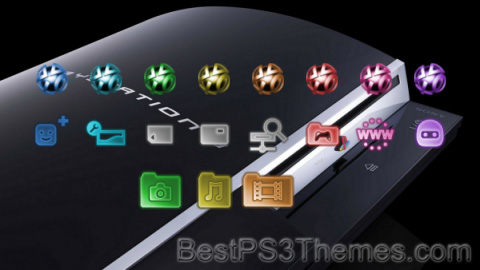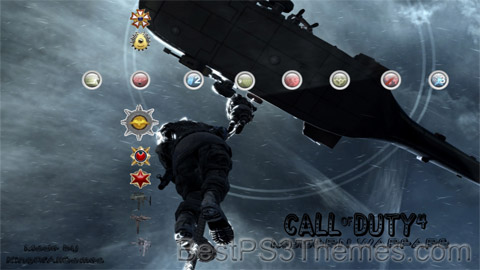
Rock Band theme by Skyker
Download: RockBand.p3t
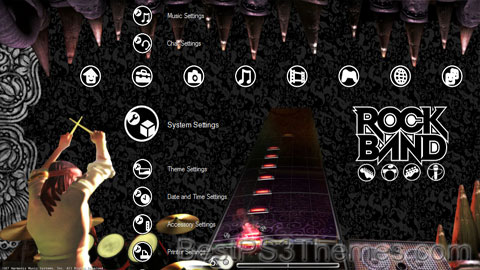
(1 background)
| Rock Band | |
|---|---|
 | |
| Genre(s) | |
| Developer(s) |
|
| Publisher(s) |
|
| Platform(s) | PlayStation 2, PlayStation 3, PlayStation 4, PlayStation Portable, Xbox 360, Xbox One, Wii, Nintendo DS, mobile devices, iOS, Oculus Rift |
| First release | Rock Band November 20, 2007 |
| Latest release | Rock Band VR March 23, 2017 |
Rock Band is a series of rhythm games first released in 2007 and developed by Harmonix. Based on their previous development work from the Guitar Hero series, the main Rock Band games has players use game controllers modeled after musical instruments and microphones to perform the lead guitar, bass guitar, keyboard, drums and vocal parts of numerous licensed songs across a wide range of genres though mostly focusing on rock music by matching scrolling musical notes patterns shown on screen. Certain games support the use of "Pro" instruments that require special controllers that more closely mimic the playing of real instruments, providing a higher challenge to players. Players score points for hitting notes successfully, but may fail a song if they miss too many notes. The series has featured numerous game modes, and supports both local and online multiplayer modes where up to four players in most modes can perform together.
Harmonix had worked with Red Octane for the Guitar Hero series first released in 2005; when Red Octane was acquired by Activision to continue Guitar Hero in 2007, MTV Games, a division of Viacom at the time, acquired Harmonix to expand the concept to Rock Band, and served as the game's publisher and manufacturer for the instrument controllers, with distribution handled by Electronic Arts. In 2009, due to saturation of the rhythm game market, sales of both Guitar Hero and Rock Band dropped; Harmonix's investors were able to buy the company from Viacom and making Harmonix an independent company, giving them more flexibility in options for the series. Harmonix transitioned to Mad Catz in 2011 for the publication and instrumentation controller manufacture. By 2013, Harmonix stopped producing downloadable content (DLC) for the current Rock Band 3, though stated that it would consider its options for the series upon the arrival of the next-generation of consoles. Following the release of the PlayStation 4 and Xbox One, Harmonix released Rock Band 4 in 2015 for the new consoles. While Mad Catz initially manufactured the new instrument controllers. the game was not as financially successful, a partial cause for Mad Catz to declare bankruptcy and requiring Harmonix to switch production to Performance Designed Products (PDP) for ongoing instrument controller manufacture.
To date, there have been four main games in the series, two band-specific spin-offs (including The Beatles: Rock Band), and several additional spin-off titles and Track Packs. Harmonix has continued to supported Rock Band through a persistent DLC model through January 2024, with routine releases of new songs on a weekly basis as well as the ability for players to import songs from previous games into newer ones, and as of January 2024, the latest title Rock Band 4 supports over 3000 songs from this approach. Harmonix had also offered the Rock Band Network to allow bands and labels to publish their songs as Rock Band tracks that can be purchased by players, though the service has since been discontinued; at the height of this service, over 4,000 tracks from 1,200 artists were available for Rock Band players.[1][2]
By 2009, over 13 million copies of Rock Band titles have been sold,[3][1] netting more than $1 billion in total sales.[4] Over 130 million downloadable song purchases have been made by 2009.[1][2][5][6][7][8][9]
History[edit]
| 2007 | Rock Band |
|---|---|
| 2008 | Rock Band 2 |
| 2009 | Rock Band Unplugged |
| The Beatles: Rock Band | |
| Rock Band Mobile | |
| Rock Band (iOS) | |
| Lego Rock Band | |
| 2010 | Green Day: Rock Band |
| Rock Band 3 | |
| Rock Band Reloaded | |
| 2011 | |
| 2012 | Rock Band Blitz |
| 2013 | |
| 2014 | |
| 2015 | Rock Band 4 |
| 2016 | |
| 2017 | Rock Band VR |
Transition from Guitar Hero (2005–2008)[edit]
Prior to Guitar Hero and Rock Band, Harmonix had already established itself as a company that made game products that focused on music interactivity. Born out of Massachusetts Institute of Technology's Media Lab, the first product made by Harmonix was The Axe: Titans of Classic Rock for DOS-based computers, challenging the player to use four keys on the keyboard to match notes in several songs.[10] Looking to find a place for this type of game, Harmonix' founders Alex Rigopulos and Eran Egozy looked to Japan where music games like PaRappa the Rapper were becoming popular. This led to the creation of Frequency and its sequel Amplitude for the PlayStation 2; both games featured the concept of matching notes for specific instrument tracks along lanes. However, in retrospect, Harmonix found that players had difficulty initially understanding the game, as the presentation was an abstract concept that did not immediately connect the gameplay to the music.[10] The idea of making an easy connection between the game and the music was used as a basis for their Karaoke Revolution games, which including using avatars singing and dancing in time to the music to strengthen the connection; this series was financially successful and helped grow the company.[10]
Harmonix was approached by RedOctane to help develop the software for the first Guitar Hero game, itself based on Japanese games like Guitar Freaks. Harmonix used their previous experience in note-matching techniques from Frequency and Amplitude, as well as the lessons learned in developed Karaoke Revolution to create the Guitar Hero software. Harmonix was less concerned on developing gameplay, and instead more on connecting the player to the music, working to track the notes of the songs appropriately on the five-button controller as to make the player feel like they are playing the real instrument.[10] Guitar Hero would go on to be a major success and found the basis of the Guitar Hero series.[10]
As the success of the Guitar Hero series grew, Harmonix and RedOctane were purchased by MTV Games and Activision, respectively, in 2006; MTV paid $175 million to acquire Harmonix.[11] RedOctane continued to publish the Guitar Hero series, bringing Neversoft on board for development duties. Harmonix was contractually committed to completing one final title, Guitar Hero Encore: Rocks the 80s, during and after the purchase negotiations.
With MTV Games, a subsidiary of Viacom, Harmonix took their experience from developing Guitar Hero and Karaoke Revolution to create the Rock Band series. According to Harmonix Vice President of Product Development, Greg LoPiccolo, the Harmonix team had already envisioned the possibility of different instruments before they were finished with the Guitar Hero series;[12] Rigopulos noted that the Guitar Hero work was only a partial approach to this, limited to what they could do on a "shoe-string budget".[10] Harmonix also embraced the idea of Rock Band as a platform rather than a software title, and took steps to incorporate downloadable content to extend players' music libraries without having them need to buy a new software disk. Rock Band was considered a success, leading to the development of sequels and spinoff titles. Viacom, under the terms of the acquisition, paid out $150 million in performance-based bonuses to Harmonix in early 2008 for their 2007 results, and were planning on a similar amount by the end of 2008.[13][14] The Rock Band series scored what was considered a major coup by journalists when it successfully negotiated the rights to use the music of the Beatles in a video game, long considered a "holy grail" for music games.[15][16]
Rhythm game saturation and decline (2009–2014)[edit]
By 2009, the market for rhythm games in general started to fall. The market had become saturated with titles, mostly from Activision's expansion of the Guitar Hero series, and consumers affected by the late-2000s recession were less likely to buy costly instrument controllers. Viacom had already reported significant losses on the Rock Band series, and sales of The Beatles: Rock Band did not meet their expectation.[17] Viacom sought a refund on the $150 million already paid for the 2007 bonuses following its reassessment of the series' 2009 performance.[18] Harmonix, anticipating the slowness of the market, developed Rock Band 3 with the introduction of several new features, most notably including the capability to connect real MIDI keyboards, MIDI guitars, and MIDI electronic drum kits, to create a "disruptive" game in the ailing rhythm game market by expanding to include real instruments.
Though Viacom continued to support the series throughout 2010, it announced that it was seeking a buyer for Harmonix, citing the series' continued profit losses and Viacom's inexperience at being a video game publisher.[19][20][21] Harmonix was eventually sold at the end of 2010 to Harmonix-SBE Holdings LLC, an affiliate of investment firm Columbus Nova, LLC that included Harmonix shareholders.[22] Though the net liability of the sale was valued at nearly $200 million, including existing unsold inventory and ongoing music license fees, analysts believe that Harmonix-SBE paid only $50 for the company, taking on the total financial liability that Viacom was able to write off in their books.[23] The MTV Games division at Viacom was later closed.[24]
As a shareholder-held company, Harmonix retained the rights to the Rock Band and Dance Central franchises, and continued to support and develop the games.[25][26] The company still faced some fallout from the sale, laying off about 15% of its staff in February 2011.[27] In the same month, Activision announced that it abandoned ongoing development of planned Guitar Hero titles, which many journalists considered to signal the end of peripheral-based rhythm games.[28] Though Harmonix considered the closure of Guitar Hero as "discouraging", they affirmed that they would continue to develop Rock Band and Dance Central and support their downloadable content for the immediate future.[29] Other journalists believed that without competition, Harmonix no longer needed to develop under the same pressure, allowing them to polish and innovate for future titles in the series, bringing a likely future resurgence of the market.[30]
In March 2012, Harmonix affirmed that it had no plans for a fourth major release title within the year, but was still strongly supporting the game through downloadable content through the year.[31] By early 2013, the company stated that while they may come back to Rock Band at a future time, they were shifting resources to develop new titles, and later announced that it would discontinue its regular downloadable content for the series after providing over 275 continuous weeks of such content.[32]
Reintroduction for eighth-generation consoles (2015–current)[edit]
Rigopulos stated at his keynote at the 2014 Penny Arcade Expo East that the studio had plans to bring Rock Band to eighth-generation consoles "at some point" and with "guns blazing".[33] Rigopulos states that the studio was "waiting for just the right moment in the new generation of consoles to bring it back".[34] Following two sets of unexpected DLC releases in early 2015 as a survey sent to Rock Band fans, the industry started to speculate that Harmonix was looking to revive the series. Bloomberg reported that Harmonix was working on a new version of Rock Band for the next-generation of consoles in late February.[35]
Rock Band 4 was officially announced in March 2015, for release later in October 2015 on the PlayStation 4 and Xbox One. Rock Band 4 supported nearly all previous content released for the series, including imports from the Rock Band 3 and all prior official DLC.[36] Initially Rock Band 4 was released in partnership with Mad Catz for production of the instrument peripherals and co-publishing, but the game did not sell as well as expected leading to a US$11 million loss for Mad Katz, who subsequently terminated the agreement by June 2016 and temporarily had entered a period of bankruptcy.[37] Harmonix switched to Performance Designed Products (PDP) to continue hardware manufacturing and co-publishing with the release of the "Rivals" expansion for Rock Band 4.[38][39] Harmonix attempted to crowdfund the development of Rock Band 4 for personal computers through Fig (which Harmonix's Rigopulos had become a board member of), but this failed to meet the target goal, though Harmonix had not ruled out other means to bring the series to personal computers through other means.[40] Harmonix continues to support Rock Band 4 with weekly DLC and, with the introduction of its "Rivals" gameplay mode, eight-week seasonal challenges for players to earn new cosmetics, and as of April 2020[update], supports over 2,800 songs.
A separate Rock Band VR title was developed for the Oculus Rift virtual reality headset and released in March 2017.[41]
Harmonix was acquired by Epic Games in 2021, but has continued to support Rock Band with DLC into at least 2024. As part of Epic, Harmonix developed a new mode for Fortnite, Fortnite Festival, which was released in December 2023. This mode mimicked much of the Rock Band aspects within the Fortnite game.[42] With this new game, Harmonix ended its weekly DLC for Rock Band in January 2024, though all online service would remain active for the foreseeable future.
Games[edit]
Main games[edit]
Harmonix has released four mainline titles in the Rock Band series: Rock Band (2007), Rock Band 2 (2008), Rock Band 3 (2010), and Rock Band 4 (2015). Each game provides from 57 to 84 songs on-disc with support for additional songs to be purchased as downloadable content. The games feature a variety of modes, including single player career modes, offline and online cooperative modes as part of a band, and competitive modes. Most songs from earlier iterations can be exported for play in future versions for a small licensing fee. However, premium or upgraded DLC content cannot be transferred to Rock Band 4.
Band-specific games[edit]

In October 2008, Harmonix, along with MTV Games, announced an exclusive agreement with Apple Corps, Ltd. to produce a standalone title, titled The Beatles: Rock Band, based on the Rock Band premise and featuring the music of the Beatles. The game was released on September 9, 2009, coinciding with the release of remastered collections of the Beatles' albums, and features a visual and musical history of the Beatles with United Kingdom-released versions of songs from their albums Please Please Me through Abbey Road. The game also has been supported by downloadable content, with three full albums, Abbey Road, Sgt. Pepper's Lonely Hearts Club Band, and Rubber Soul, available to purchase. Though branded as a Rock Band game, the title remains as a standalone game in the series. It includes a function to add new songs to the game disc.[43]
Following on the success of The Beatles: Rock Band, Green Day: Rock Band was released in June 2010. It includes the band's songs, including full albums for Dookie, American Idiot, and 21st Century Breakdown, avatars of the band's members and venues after real-life performances of the group.[44] The track list is fully exportable to other Rock Band games.[45]
Several bands stated they were seeking to or working with Harmonix to develop band-specific content for the series. The band Pearl Jam worked with Harmonix and MTV Games along with Rhapsody on a Rock Band-related project that was to be released in 2010, allowing for users to vote for their favorite live versions of the band's music. In August 2011 it was rumoured that the Pearl Jam related project would be released as downloadable content,[46] but Harmonix spokesman John Drake later clarified that while a Pearl Jam-based game was deep in development, it was ultimately cancelled.[47]
The band U2, after declining an option to place themselves in a Rock Band game in 2008, were reconsidering their stance after seeing the success of The Beatles: Rock Band, according to bassist Adam Clayton.[48] Similarly, Queen were in behind-the-scenes talks about a possible title for their group within Rock Band, according to Brian May.[49] Even though no game based on the band was released, Lego avatars of the band members appeared in Lego Rock Band. Roger Daltrey of The Who had stated that a Rock Band-title based on his group's music would be available in 2010;[50] however, no such title was released in 2010, or after that year for that matter. Though Janie Hendrix had stated she allowed for Jimi Hendrix's works to be used for a Rock Band game to be released in 2010,[51][52] this was later clarified as licensing several full albums from Hendrix to be made as downloadable content.[53] Harmonix had also considered standalone band games for Pink Floyd and Led Zeppelin, but neither project proceeded past developing concept art and cinematics.[47]
Spin-offs[edit]

Harmonix and MTV Games have worked with TT Fusion and Warner Bros. Interactive Entertainment to create Lego Rock Band.[54] The game includes songs that are "suitable for younger audiences."[54] The game also includes the "fun, customization and humor of the Lego videogame franchise" by allowing players to create their own Lego-style avatars. The game added a new "super easy" gameplay mode in order to accommodate younger players. The game, which was released on November 3, 2009 on the Xbox 360, PlayStation 3, and Wii consoles, supports all existing Rock Band instruments.[54] The game is able to utilize selected existing downloadable content for the other Rock Band games that have been deemed acceptable for the game's audience, except on the Nintendo Wii, and all songs on the game's main setlist can be exported for use in other Rock Band games.
Harmonix had planned to release a spin-off of Rock Band for Japanese audiences in co-development with Q Entertainment. The title, initially announced in 2008, would have featured J-pop music, and would have been "the first US-originated rock music game to be heavily localized for the Japanese market".[55][56] Japanese artists had expressed interest in the venture, such as X Japan.[57] Harmonix has since stated that this project has been discontinued, but have considered the inclusion of popular Japanese music within Rock Band's regular downloadable content.[58] Alex Rigopulos later clarified that they found it difficult to license Japanese music for such a release, and had considered both the cost of manufacturing and shipping instrument controllers to Japan, and the limited space that many Japanese players would have in their homes.[47][59]
Rock Band Blitz is a downloadable title in the series released for the Xbox 360 and PlayStation 3 in October 2012. It is similar to Rock Band Unplugged, using gameplay similar to Frequency and Amplitude. The game included 25 songs (23 new to the series, and two that were previously unavailable to export due to licensing issues), but can use any previously downloaded song in the player's library; the 25 songs were also available to be played within Rock Band 3. Unlike the previous games in the series, Blitz is designed for use with a standard console controller, using buttons on the controller to switch tracks and match notes. The single-player game is designed with numerous "arcade" elements including a number of power-ups that make it more a score attack game than previous titles. Released alongside the game was a Facebook application, Rock Band World, that connected to players' games, offering challenges and tracking players scores in both Blitz and Rock Band 3.
Shortly after release of Rock Band 3, Harmonix began work on Rock Band Sessions. Instead of matching notes as in the main games, Sessions would have players making their own music in songs where several of the other instrument tracks were already completed; one example given by Daniel Sussman was to complete a bass line atop existing guitar, drums, and vocal tracks. If the player opted, they would have been able to allow the pre-existing track to be played instead and only provide their own music in certain sections of the song. Sessions was originally conceived as a multiplayer title but Harmonix found that having multiple players attempt to make their own music at the same time was too chaotic, and instead reworked it as a single-player game, with the player able to work each track separately and eventually bring them together in a final song. Though Harmonix had developed a working prototype for the game, they found that it would not adapt well to their existing licensed song library and would be difficult to use in future Rock Band games, and that they did not feel this was a type of game they could sell to their player base at full price. Sessions has been shelved, though some of the lessons they learned were used to help develop Rock Band 4, and may come back to the title at a later date.[60]
Harmonix also was involved with BandFuse: Rock Legends, released in November 2013, which for a time was referred to as "Rock Band 3.1".[citation needed]
In 2015, Oculus VR announced at The Game Awards that they would be partnering with Harmonix to make a virtual reality Rock Band game for the Rift titled Rock Band VR, to be released in 2016.[61] Harmonix began work on the title in October 2015. The game, focused solely on guitar players, uses the Oculus Rift Touch controllers in addition to the headset, one which is attached to the guitar controller. These provide the player with a first-person view of their guitarist on stage which reacts to the player's movements. In a demonstration at the 2016 Game Developers Conference, the game was set up so that the player could see the note tracks located on the floor monitors on the virtual stage, requiring the player to look down to track them, but Harmonix stated they were exploring other means to provide this input. The player can engage other actions in the VR world by looking at certain stage elements, such as by keeping their focus on a foot pedal, they can activate pyrotechnics on the virtual stage. The game was released on March 23, 2017 and shipped with 60 songs on release[62][63] and has 21 DLC songs. It was nominated for "Best Game Audio Article, Publication or Broadcast" ("Steve Pardo: Creating Rock Band VR") and "Best VR Audio" at the 16th Annual Game Audio Network Guild Awards.[64]
In November 2021, Harmonix was acquired by Epic Games. They developed Fortnite's music game Fortnite Festival, which released on December 9th, 2023.
Portable games[edit]
Rock Band Unplugged was developed by Backbone Entertainment and was released for the PlayStation Portable in North America on June 9, 2009[65] and later that year in Europe. The game uses the PSP's Wi-Fi capabilities to provide an online store for additional downloadable content from music providers.[66] The gameplay is similar to the previous Harmonix games Frequency and Amplitude, with the player using the face buttons on the PSP to match notes; after completing a length of a phrase on a given instrument, that instrument will then play by itself for a while, allowing the player to switch to another instrument.[67] The DS versions of Lego Rock Band and Rock Band 3 use a similar gameplay system to Rock Band Unplugged.
A mobile phone version of Rock Band was developed by EA Mobile to work with various phones; the game was released to Verizon users on September 16, 2009. The game features many of the same modes as the main Rock Band series, including the ability to play with other users through the software. The game offers the ability to play any of the four instruments on 25 songs selected from the existing Rock Band library.[68] A version simply titled Rock Band for iOS was also released in October 2009, with gameplay described as similar to Tap Tap Revenge and allowing up to four people to play together with Bluetooth connections.[69] Rock Band Reloaded was released on December 2, 2010.
Gameplay[edit]
The Rock Band games are score-based music video games that combine elements of two of Harmonix' previous efforts: Guitar Hero and Karaoke Revolution, allowing up to four players to play on lead and bass guitar, drums, and vocals. Rock Band 3 expands this number to seven, including a keyboardist and two harmony vocalists. Players use these instruments to play scrolling musical "notes" on-screen in time with music.
Rock Band titles' gameplay and on-screen interface use a combination of elements from Guitar Hero and Karaoke Revolution.[70] Rock Band has up to three tracks of vertically scrolling colored music notes, one section each for lead guitar, drums, and bass.[70] The colored notes on-screen correspond to buttons on the guitar and drum peripherals.[70] For lead and bass guitar, players play their notes by holding down colored fret buttons on the guitar peripheral and pushing the controller's strum bar; for drums, players must strike the matching colored drumhead, or step on the pedal to simulate playing bass drum notes. Along the top of the screen is the vocals display, which scrolls horizontally, similar to Karaoke Revolution. The lyrics display beneath green bars, which represent the pitch of the individual vocal elements.[70] When singing vocals, the player must sing in
Death by Design theme by Divine Download: DeathByDesign.p3t Death by Design is a 1943 British mystery film directed by Germain Burger and starring John Longden, Wally Patch and Barbara James.[1]
Eye of Judgment (Judgement) theme by Xehos Download: EyeOfJudgment.p3t P3T Unpacker v0.12 This program unpacks Playstation 3 Theme files (.p3t) so that you can touch-up an existing theme to your likings or use a certain wallpaper from it (as many themes have multiple). But remember, if you use content from another theme and release it, be sure to give credit! Download for Windows: p3textractor.zip Instructions: Download p3textractor.zip from above. Extract the files to a folder with a program such as WinZip or WinRAR. Now there are multiple ways to extract the theme. The first way is to simply open the p3t file with p3textractor.exe. If you don’t know how to do this, right click the p3t file and select Open With. Alternatively, open the p3t file and it will ask you to select a program to open with. Click Browse and find p3textractor.exe from where you previously extracted it to. It will open CMD and extract the theme to extracted.[filename]. After that, all you need to do for any future p3t files is open them and it will extract. The second way is very simple. Just drag the p3t file to p3textractor.exe. It will open CMD and extract the theme to extracted.[filename]. For the third way, first put the p3t file you want to extract into the same folder as p3textractor.exe. Open CMD and browse to the folder with p3extractor.exe. Enter the following: Assassin’s Creed theme by Assassin Creed Eddy Download: AssassinsCreed_5.p3t
Assassin's Creed is a historical action-adventure video game series and media franchise published by Ubisoft and developed mainly by its studio Ubisoft Montreal using the game engine Anvil and its more advanced derivatives. Created by Patrice Désilets, Jade Raymond, and Corey May, the Assassin's Creed video game series depicts a fictional millennia-old struggle between the Order of Assassins, who fight for peace and free will, and the Knights Templar, who desire peace through order and control. The series features historical fiction, science fiction, and fictional characters intertwined with real-world historical events and historical figures. In most games, players control a historical Assassin while also playing as an Assassin Initiate or someone caught in the Assassin–Templar conflict in the present-day framing story. Considered a spiritual successor to the Prince of Persia series, Assassin's Creed took inspiration from the novel Alamut by the Slovenian writer Vladimir Bartol, based on the historical Hashashin sect of the medieval Middle East.
The first Assassin's Creed game was released in 2007, and the series has featured thirteen main installments in total, the most recent being Assassin's Creed Mirage in 2023. Main games in the Assassin's Creed series are set in an open world and played from the third-person view. Gameplay revolves around combat, stealth, and exploration, including the use of parkour to navigate the environment. The games feature both main and side missions, and some titles also include competitive and cooperative multiplayer game modes.
A new story and occasionally new time periods are introduced in each entry, with the gameplay elements also evolving. There are three overarching story arcs in the series. The first five main games follow Desmond Miles, a descendant of several important Assassins throughout history, who uses a machine called the Animus to relive his ancestors' memories and find powerful artifacts called Pieces of Eden in an attempt to prevent a catastrophic event, referencing the 2012 phenomenon. From Assassin's Creed IV: Black Flag to Assassin's Creed Syndicate, Assassin initiates and employees of Abstergo (a company used as a front by the modern-day Templars) record genetic memories using the Helix software, helping the Templars and Assassins find new Pieces of Eden in the modern world. The next three games, Assassin's Creed Origins, Odyssey, and Valhalla, follow ex-Abstergo employee Layla Hassan on her own quest to save humanity from another disaster.
The main games in the Assassin's Creed franchise have received generally positive reviews for their ambition in visuals, game design, and narratives, with criticism for the yearly release cycle and frequent bugs, as well as the prioritising of role-playing mechanics in later titles. The series has received multiple awards and nominations, including multiple Game of the Year awards. It is commercially successful, selling over 200 million copies as of September 2022[update], becoming Ubisoft's best-selling franchise and one of the highest selling video game franchises of all time. While main titles are produced for major consoles and desktop platforms, multiple spin-off games have been released for consoles, mobiles, and handheld platforms. A series of art books, encyclopedias, comics, and novels have also been published. A live-action film adaptation of the series, titled Assassin's Creed, was released in 2016.
While the games in the series have had several narrative arcs, Ubisoft views the series as currently having three periods of development and design philosophy. Until 2015's Assassin's Creed Syndicate, the franchise was structured around single-player content, and while centering on open world spaces and several role-playing elements, were more action-adventure and stealth-oriented. Period two, covering from Assassin's Creed Origins to Assassin's Creed Mirage, brought in more role-playing elements and live-service features to increase player engagement. Period three will launch with Assassin's Creed Shadows, using lessons from the second period of development to make engrossing single-player games similar to the original titles but with features to allow players to share achievements and content with others, all to be backed by the Infinity hub system.[1]
The first Assassin's Creed game originated out of ideas for a sequel for Ubisoft's video game Prince of Persia: The Sands of Time, aiming for the seventh generation of video game consoles. The Ubisoft Montreal team decided to take the gameplay from The Sands of Time into an open-world approach, taking advantage of the improved processing power to render larger spaces and crowds. Narratively, the team wanted to move away from the Prince being someone next in line for the throne but to have to work for it; combined with research into secret societies led them to focus on the Order of Assassins, based upon the historical Hashashin sect of Ismaili, who were followers of Shia Islam, heavily borrowing from the novel Alamut.[2][3] Ubisoft developed a narrative where the player would control an Assassin escorting a non-playable Prince, leading them to call this game Prince of Persia: Assassin,[4] or Prince of Persia: Assassins.[5] Ubisoft was apprehensive to a Prince of Persia game without the Prince as the playable character, but this led the marketing division to suggest the name Assassin's Creed, playing off the creed of the Assassins, "nothing is true; everything is permitted". Ubisoft Montreal ran with this in creating a new intellectual property, eliminating the Prince, and basing it around the Assassins and the Knights Templar in the Holy Land during the 12th century. Additionally, in postulating what other assassinations they could account for throughout history, they came onto the idea of genetic memory and created the Animus device and modern storyline elements. This further allowed them to explain certain facets of gameplay, such as accounting for when the player character is killed, similar to The Sands of Time.[5]
After Assassin's Creed was released in 2007, Ubisoft Montreal said they looked to "rework the global structure" in developing the sequel, Assassin's Creed II. They felt that parkour was underutilized in the first game and designed the world in the sequel to feature freerun highways to make it easier to enter into parkour moves, for example using rooftops to escape pursuits.[6] The change in setting meant that the game would feature a new cast of characters, including a new protagonist, Ezio Auditore da Firenze. Assassin's Creed II also brought in more use of crowds to hide in plain sight that the developers had seen used in Hitman: Blood Money, adding more to the concept of social stealth as a gameplay option.[6] Finally, Ubisoft Montreal completely reworked the repetitive mission structure from the first game through numerous side activities, collectibles, and secrets. These additions became a central part of the series going forward as well as other Ubisoft games like Watch Dogs, Far Cry, and Tom Clancy's Ghost Recon.[6] Assassin's Creed II was followed by two sequels, Assassin's Creed: Brotherhood and Assassin's Creed: Revelations, which also featured Ezio as the main protagonist and introduced the ability for players to recruit NPCs as Assassins and manage them in missions.[6]
Assassin's Creed III originated from both Ubisoft Montreal, who wanted to progress the series' narrative forward in time, and to an unattached project that had been developed at Ubisoft Singapore and featured naval ship combat. As the main team had settled into the American Revolution period for the game, they found the ship-to-ship combat system fitted with the story and redesigned the setting to incorporate it further. Another major change in Assassin's Creed III was transitioning the parkour and freerun systems to work in the natural woodlands of 18th-century Massachusetts and New York. This further allowed the adding of trees and other vegetation within the city areas themselves, not just as part of the parkour systems, but to add more varied environments, which would continue as part of the series' ongoing design.[6]
For Assassin's Creed III's sequel, Assassin's Creed IV: Black Flag, the Ubisoft team built upon the foundation of its predecessor, particularly with regards to the naval gameplay, merging it seamlessly with the land-based gameplay.[6] The team also used the game as a chance to address aspects of the series' storyline. Choosing to focus on an outsider's perspective to the Assassin–Templar conflict, they set the game around the Golden Age of Piracy, with the protagonist, Edward Kenway, starting out as a pirate who initially becomes involved in the conflict with the prospect of wealth. Similarly, after the conclusion of Desmond Miles' story arc in Assassin's Creed III, the modern-day segments put players in the role of a nameless individual controlled from a first-person perspective. The team chose this approach because they believed it allowed players to more easily identify themselves in their character.[6] This trend would continue in the series until Assassin's Creed Syndicate.[6]
Development of Assassin's Creed Unity began shortly after the completion of Brotherhood in 2010,[7] with the core development team splitting off during the early stages of development on Assassin's Creed III.[8] As the first game in the series to be released exclusively for the eighth generation of video game consoles, Unity featured a graphical and gameplay overhaul. The setting chosen for the game was Paris during the early years of the French Revolution, with players taking control of a new Assassin named Arno Dorian.[7][8] After Unity, Ubisoft released Assassin's Creed Syndicate in 2015.[6]
After Syndicate, Ubisoft decided that the series needed a major reinvention across both gameplay and narrative. It was decided to make the next game, Assassin's Creed Origins, closer to a role-playing video game than a stealth-action game, which would also bring a game with many more hours of play than previous titles. Some long-standing features of the series were eliminated for this purpose, such as the social stealth mechanic. This changed how missions were presented — rather than being linearly directed through the Animus, the player character could meet various quest givers in the game's world to receive missions.[6] From the narrative side, Ubisoft placed the game before the formation of the Assassin Brotherhood in Ancient Egypt to make the player character, Bayek of Siwa, a medjay that people would respect and seek the help of.[6] The modern-day storyline also shifted back to a single character, Layla Hassan. The developers limited the number of playable sequences for her character compared to previous games but gave them more meaning, such as allowing the player to explore Layla's laptop with background information on the game's universe.[6]
Origins was followed in 2018 by Assassin's Creed Odyssey, which shifted the setting to Classical Greece and followed a similar approach to its predecessor but with more emphasis on the role-playing elements.[6] 2020's Assassin's Creed Valhalla, set in Medieval England and Norway during the Viking Age, continued the same style as Origins and Odyssey. The developers recognized feedback from the previous two games and brought back the social stealth elements, as well as the concept of a customizable home base that was first introduced in Assassin's Creed II.[6]
In 2023, Ubisoft released Assassin's Creed Mirage, a smaller title which sought to pay tribute to the franchise's earlier installments by focusing on stealth and assassinations over its predecessors' role-playing elements. The game started development as an expansion for Valhalla before being turned into a standalone release, and was set in 9th-century Baghdad during the Islamic Golden Age, a decade before the events of Valhalla, to which it served as a prequel.[9][10]
In 2022, Ubisoft announced several additional games for the series. Assassin's Creed Infinity has been described by its executive producer, Marc-Alexis Côté, as a "new design philosophy" for the series,[1][11] as well as a hub that will provide the releases of future games.[12] The first two games to be included in Infinity will be Assassin's Creed Shadows, set in Japan during the Sengoku period,[9] and Assassin's Creed: Codename Hexe, rumoured to be set in Central Europe during the 16th century.[13]
The Assassin's Creed games are centered around one or more fictional members of the Order of the Assassins. Their memories are experienced by an in-game character in the modern-day period through a device called the Animus and its derivations. The Animus allows the user to explore these memories passed down via genetics. Within the context of the game, this provides a diegetic interface to the real-world player of the game, showing them elements like health bars, a mini-map, and target objectives as if presented by the Animus. Additionally, should the player cause the historical character to die or fail a mission, this is rectified as desynchronization of the genetic memory, allowing the player to try the mission again. Through the Animus interface, the player can retry any past mission already completed; for example, in Assassin's Creed: Brotherhood, the player achieves better synchronization results by performing the mission in a specific manner, such as by only killing the mission's target. The Animus also imparts special abilities to the modern-day character that helps them to see their target in a crowd or other unique points of interest.[14][15]
While playing as the Assassin characters, the games are generally presented from a third-person view in an open world environment, focusing on stealth and parkour. The games use a mission structure to follow the main story, assigning the player to complete an assassination of public figureheads or a covert mission. Alternatively, several side missions are available, such as mapping out the expansive cities from a high perch followed by performing a leap of faith into a haystack below, collecting treasures hidden across the cities, exploring ruins for relics, building a brotherhood of assassins to perform other tasks, or funding the rebuilding of a city through purchasing and upgrading of shops and other features. At times, the player is in direct control of the modern-day character who, by nature of the Animus use, has learned Assassin techniques through the bleeding effect, as well as their genetic ability of Eagle Vision, which separates friend, foe, and assassination targets by illuminating people in different colors.[16][17]
The games use the concept of active versus passive moves, with active moves, such as running, climbing the sides of buildings, or jumping between rooftops, more likely to alert the attention of nearby guards. When the guards become alerted, the player must either fight them or break their line of sight and locate a hiding place, such as a haystack or a well, and wait until the guards' alert is reduced. The combat system allows for a number of unique weapons, armor, and moves, including the use of a hidden blade set in a bracer on the Assassin's arm, which can be used to perform surreptitious assassinations.[18]
The Assassin's Creed games primarily revolve around the rivalry and conflict between two ancient secret societies: the Order of Assassins, who represent freedom, and the Knights Templar, who represent order. Versions of these societies have existed for centuries, with the Assassins seeking to stop the Templars from gaining control of Pieces of Eden, artifacts that can override free will to control people.[19]
These artifacts are remnants of an ancient species pre-dating humanity called the Isu, or Precursors, which created humanity to live in peace alongside them. The Isu ensured humans could not rise against them by creating the Pieces of Eden to control them. When the first hybrid Isu-human beings emerged, named Adam and Eve, they were immune to the effects of the Pieces of Eden. They stole the Pieces of Eden, which led to a great war that ended when a massive solar flare devastated the surface of the Earth. The Isu began to die out while humanity thrived. Three Isu—Minerva, Juno, and Jupiter—attempted to prepare humanity for a solar flare they knew would come centuries later. Minerva and Jupiter prepared vaults from which humanity could activate a protective shield around Earth with the Pieces of Eden and the Eye, a means to communicate how to find and use these vaults; however, Juno saw humanity as a threat and attempted to sabotage Minerva and Jupiter's plan. Minerva and Jupiter were forced to destroy Juno, unaware she had hidden her consciousness to wake upon activation of the Eye. All that remained of the Isu were the traces of their memories in the world's mythologies, and religions, while the Pieces of Eden were lost to time.[19]
The series takes place in the modern era, in which the Templars have established the mega-corporation Abstergo Industries. Abstergo has developed a device, the Animus, whose user can relive the memories of their ancestors through their genetic material. Abstergo has kidnapped people who are descendants of past Assassins to locate the missing Pieces of Eden via the Animus.[19] A user of the Animus can move about in simulated memories as their ancestor, but performing actions outside the bounds of what their ancestor did can lead to desynchronization of the memory.[14][15] Extended use of the Animus creates a bleeding effect that gives users some of the skills and capabilities they experienced with their ancestor.[20]
The first five main games in the series focus on Desmond Miles, a bartender who learns he is a descendant of several important Assassins throughout history, including Altaïr Ibn-LaʼAhad from the Middle East during the Third Crusade; Ezio Auditore da Firenze from the Italian Renaissance during the late 15th and early 16th centuries; and Ratonhnhaké:ton (better known as Connor), a half-Mohawk, half-British Assassin during the American Revolution. Desmond is used by Abstergo to find Pieces of Eden but is freed by Lucy Stillman, an undercover agent for the Assassins. Lucy takes Desmond to meet Shaun Hastings and Rebecca Crane, two other members of the modern-day Assassins. The group is joined later by William Miles, Desmond's father. They continue to explore Desmond's memories and eventually discover the Eye and Minerva's warning of another possible solar flare. They also inadvertently free Juno, who then kills Lucy, revealed to be a double agent for the Templars. The group continues to find the vaults across the globe via Desmond's memories, and Desmond ultimately activates them in time to block the solar flare, at the cost of his own life.[19]
Starting with Assassin's Creed IV: Black Flag, William goes into exile, while Shaun and Rebecca continue to monitor Abstergo by posing as employees of one of their spin-off companies, Abstergo Entertainment. Abstergo has refined the Animus technology to allow anyone to experience genetic memories from the DNA material of another person, allowing Abstergo to continue their search for the Pieces of Eden under the guise of creating entertainment products. In Black Flag, the player assumes the role of an unnamed Abstergo employee tasked with scanning the memories of Edward Kenway, a privateer-turned-pirate during the Golden Age of Piracy and Connor's grandfather. During their investigation, the player is blackmailed into helping a fellow employee, John Standish, recover sensitive information and deliver it to the Assassins. John is later revealed to be a Sage, a human reincarnation of Juno's husband Aita, who is trying to resurrect her, though he is killed by Abstergo before his plan can come to fruition.[19] In Assassin's Creed Rogue, the player controls another Abstergo employee who is recruited by the Templars to clean their servers after the Assassins breach them and recover data on the life of Shay Patrick Cormac, an Assassin-turned-Templar from the 18th century. The Assassins are ultimately forced to go underground once more, and the player character is invited to join the Templars.[19]
By the time of Assassin's Creed Unity, Abstergo distributes its Animus product via a video game console named Helix, tapping into an extensive, unaware player base to help them locate more Pieces of Eden and determine the fates of various Sages as part of the Phoenix Project, an attempt to recreate the genetic structure of the Isu. The game's opening has players control an unnamed Templar during the downfall of the Templar Order, while the different "time anomalies" take them to Paris during the Belle Époque, World War II, and the Hundred Years' War. The Assassins locate select players and bring them in as Initiates to help their cause. In Unity, the player character is contacted by an Assassin named Bishop and asked to experience the memories of Arno Dorian, an Assassin active during the French Revolution, so that the modern-day Assassins can locate the body of a Sage and hide it from Abstergo.[19] Despite the Assassins' efforts, Abstergo collects enough samples of other Sages by the start of Assassin's Creed Syndicate to move forward with the Phoenix Project. Again, Bishop contacts the Initiate and asks them to explore the memories of Jacob and Evie Frye, twin Assassins from Victorian England, to locate a Piece of Eden known as the Shroud, which Abstergo needs to complete the process of recreating the Isu genetic structure. Although the Initiate manages to locate the Shroud, the Templars beat the Assassins to it.[19]
A new storyline is introduced in Assassin's Creed Origins focusing on Abstergo researcher Layla Hassan. Initially tasked with locating historical artifacts in Egypt, Layla stumbles upon the mummified corpses of the medjay Bayek and his wife Aya, co-founders of the Hidden Ones, the precursor organizati Assassin’s Creed theme by Eddy Download: AssassinsCreed_4.p3t
Assassin's Creed is a historical action-adventure video game series and media franchise published by Ubisoft and developed mainly by its studio Ubisoft Montreal using the game engine Anvil and its more advanced derivatives. Created by Patrice Désilets, Jade Raymond, and Corey May, the Assassin's Creed video game series depicts a fictional millennia-old struggle between the Order of Assassins, who fight for peace and free will, and the Knights Templar, who desire peace through order and control. The series features historical fiction, science fiction, and fictional characters intertwined with real-world historical events and historical figures. In most games, players control a historical Assassin while also playing as an Assassin Initiate or someone caught in the Assassin–Templar conflict in the present-day framing story. Considered a spiritual successor to the Prince of Persia series, Assassin's Creed took inspiration from the novel Alamut by the Slovenian writer Vladimir Bartol, based on the historical Hashashin sect of the medieval Middle East.
The first Assassin's Creed game was released in 2007, and the series has featured thirteen main installments in total, the most recent being Assassin's Creed Mirage in 2023. Main games in the Assassin's Creed series are set in an open world and played from the third-person view. Gameplay revolves around combat, stealth, and exploration, including the use of parkour to navigate the environment. The games feature both main and side missions, and some titles also include competitive and cooperative multiplayer game modes.
A new story and occasionally new time periods are introduced in each entry, with the gameplay elements also evolving. There are three overarching story arcs in the series. The first five main games follow Desmond Miles, a descendant of several important Assassins throughout history, who uses a machine called the Animus to relive his ancestors' memories and find powerful artifacts called Pieces of Eden in an attempt to prevent a catastrophic event, referencing the 2012 phenomenon. From Assassin's Creed IV: Black Flag to Assassin's Creed Syndicate, Assassin initiates and employees of Abstergo (a company used as a front by the modern-day Templars) record genetic memories using the Helix software, helping the Templars and Assassins find new Pieces of Eden in the modern world. The next three games, Assassin's Creed Origins, Odyssey, and Valhalla, follow ex-Abstergo employee Layla Hassan on her own quest to save humanity from another disaster.
The main games in the Assassin's Creed franchise have received generally positive reviews for their ambition in visuals, game design, and narratives, with criticism for the yearly release cycle and frequent bugs, as well as the prioritising of role-playing mechanics in later titles. The series has received multiple awards and nominations, including multiple Game of the Year awards. It is commercially successful, selling over 200 million copies as of September 2022[update], becoming Ubisoft's best-selling franchise and one of the highest selling video game franchises of all time. While main titles are produced for major consoles and desktop platforms, multiple spin-off games have been released for consoles, mobiles, and handheld platforms. A series of art books, encyclopedias, comics, and novels have also been published. A live-action film adaptation of the series, titled Assassin's Creed, was released in 2016.
While the games in the series have had several narrative arcs, Ubisoft views the series as currently having three periods of development and design philosophy. Until 2015's Assassin's Creed Syndicate, the franchise was structured around single-player content, and while centering on open world spaces and several role-playing elements, were more action-adventure and stealth-oriented. Period two, covering from Assassin's Creed Origins to Assassin's Creed Mirage, brought in more role-playing elements and live-service features to increase player engagement. Period three will launch with Assassin's Creed Shadows, using lessons from the second period of development to make engrossing single-player games similar to the original titles but with features to allow players to share achievements and content with others, all to be backed by the Infinity hub system.[1]
The first Assassin's Creed game originated out of ideas for a sequel for Ubisoft's video game Prince of Persia: The Sands of Time, aiming for the seventh generation of video game consoles. The Ubisoft Montreal team decided to take the gameplay from The Sands of Time into an open-world approach, taking advantage of the improved processing power to render larger spaces and crowds. Narratively, the team wanted to move away from the Prince being someone next in line for the throne but to have to work for it; combined with research into secret societies led them to focus on the Order of Assassins, based upon the historical Hashashin sect of Ismaili, who were followers of Shia Islam, heavily borrowing from the novel Alamut.[2][3] Ubisoft developed a narrative where the player would control an Assassin escorting a non-playable Prince, leading them to call this game Prince of Persia: Assassin,[4] or Prince of Persia: Assassins.[5] Ubisoft was apprehensive to a Prince of Persia game without the Prince as the playable character, but this led the marketing division to suggest the name Assassin's Creed, playing off the creed of the Assassins, "nothing is true; everything is permitted". Ubisoft Montreal ran with this in creating a new intellectual property, eliminating the Prince, and basing it around the Assassins and the Knights Templar in the Holy Land during the 12th century. Additionally, in postulating what other assassinations they could account for throughout history, they came onto the idea of genetic memory and created the Animus device and modern storyline elements. This further allowed them to explain certain facets of gameplay, such as accounting for when the player character is killed, similar to The Sands of Time.[5]
After Assassin's Creed was released in 2007, Ubisoft Montreal said they looked to "rework the global structure" in developing the sequel, Assassin's Creed II. They felt that parkour was underutilized in the first game and designed the world in the sequel to feature freerun highways to make it easier to enter into parkour moves, for example using rooftops to escape pursuits.[6] The change in setting meant that the game would feature a new cast of characters, including a new protagonist, Ezio Auditore da Firenze. Assassin's Creed II also brought in more use of crowds to hide in plain sight that the developers had seen used in Hitman: Blood Money, adding more to the concept of social stealth as a gameplay option.[6] Finally, Ubisoft Montreal completely reworked the repetitive mission structure from the first game through numerous side activities, collectibles, and secrets. These additions became a central part of the series going forward as well as other Ubisoft games like Watch Dogs, Far Cry, and Tom Clancy's Ghost Recon.[6] Assassin's Creed II was followed by two sequels, Assassin's Creed: Brotherhood and Assassin's Creed: Revelations, which also featured Ezio as the main protagonist and introduced the ability for players to recruit NPCs as Assassins and manage them in missions.[6]
Assassin's Creed III originated from both Ubisoft Montreal, who wanted to progress the series' narrative forward in time, and to an unattached project that had been developed at Ubisoft Singapore and featured naval ship combat. As the main team had settled into the American Revolution period for the game, they found the ship-to-ship combat system fitted with the story and redesigned the setting to incorporate it further. Another major change in Assassin's Creed III was transitioning the parkour and freerun systems to work in the natural woodlands of 18th-century Massachusetts and New York. This further allowed the adding of trees and other vegetation within the city areas themselves, not just as part of the parkour systems, but to add more varied environments, which would continue as part of the series' ongoing design.[6]
For Assassin's Creed III's sequel, Assassin's Creed IV: Black Flag, the Ubisoft team built upon the foundation of its predecessor, particularly with regards to the naval gameplay, merging it seamlessly with the land-based gameplay.[6] The team also used the game as a chance to address aspects of the series' storyline. Choosing to focus on an outsider's perspective to the Assassin–Templar conflict, they set the game around the Golden Age of Piracy, with the protagonist, Edward Kenway, starting out as a pirate who initially becomes involved in the conflict with the prospect of wealth. Similarly, after the conclusion of Desmond Miles' story arc in Assassin's Creed III, the modern-day segments put players in the role of a nameless individual controlled from a first-person perspective. The team chose this approach because they believed it allowed players to more easily identify themselves in their character.[6] This trend would continue in the series until Assassin's Creed Syndicate.[6]
Development of Assassin's Creed Unity began shortly after the completion of Brotherhood in 2010,[7] with the core development team splitting off during the early stages of development on Assassin's Creed III.[8] As the first game in the series to be released exclusively for the eighth generation of video game consoles, Unity featured a graphical and gameplay overhaul. The setting chosen for the game was Paris during the early years of the French Revolution, with players taking control of a new Assassin named Arno Dorian.[7][8] After Unity, Ubisoft released Assassin's Creed Syndicate in 2015.[6]
After Syndicate, Ubisoft decided that the series needed a major reinvention across both gameplay and narrative. It was decided to make the next game, Assassin's Creed Origins, closer to a role-playing video game than a stealth-action game, which would also bring a game with many more hours of play than previous titles. Some long-standing features of the series were eliminated for this purpose, such as the social stealth mechanic. This changed how missions were presented — rather than being linearly directed through the Animus, the player character could meet various quest givers in the game's world to receive missions.[6] From the narrative side, Ubisoft placed the game before the formation of the Assassin Brotherhood in Ancient Egypt to make the player character, Bayek of Siwa, a medjay that people would respect and seek the help of.[6] The modern-day storyline also shifted back to a single character, Layla Hassan. The developers limited the number of playable sequences for her character compared to previous games but gave them more meaning, such as allowing the player to explore Layla's laptop with background information on the game's universe.[6]
Origins was followed in 2018 by Assassin's Creed Odyssey, which shifted the setting to Classical Greece and followed a similar approach to its predecessor but with more emphasis on the role-playing elements.[6] 2020's Assassin's Creed Valhalla, set in Medieval England and Norway during the Viking Age, continued the same style as Origins and Odyssey. The developers recognized feedback from the previous two games and brought back the social stealth elements, as well as the concept of a customizable home base that was first introduced in Assassin's Creed II.[6]
In 2023, Ubisoft released Assassin's Creed Mirage, a smaller title which sought to pay tribute to the franchise's earlier installments by focusing on stealth and assassinations over its predecessors' role-playing elements. The game started development as an expansion for Valhalla before being turned into a standalone release, and was set in 9th-century Baghdad during the Islamic Golden Age, a decade before the events of Valhalla, to which it served as a prequel.[9][10]
In 2022, Ubisoft announced several additional games for the series. Assassin's Creed Infinity has been described by its executive producer, Marc-Alexis Côté, as a "new design philosophy" for the series,[1][11] as well as a hub that will provide the releases of future games.[12] The first two games to be included in Infinity will be Assassin's Creed Shadows, set in Japan during the Sengoku period,[9] and Assassin's Creed: Codename Hexe, rumoured to be set in Central Europe during the 16th century.[13]
The Assassin's Creed games are centered around one or more fictional members of the Order of the Assassins. Their memories are experienced by an in-game character in the modern-day period through a device called the Animus and its derivations. The Animus allows the user to explore these memories passed down via genetics. Within the context of the game, this provides a diegetic interface to the real-world player of the game, showing them elements like health bars, a mini-map, and target objectives as if presented by the Animus. Additionally, should the player cause the historical character to die or fail a mission, this is rectified as desynchronization of the genetic memory, allowing the player to try the mission again. Through the Animus interface, the player can retry any past mission already completed; for example, in Assassin's Creed: Brotherhood, the player achieves better synchronization results by performing the mission in a specific manner, such as by only killing the mission's target. The Animus also imparts special abilities to the modern-day character that helps them to see their target in a crowd or other unique points of interest.[14][15]
While playing as the Assassin characters, the games are generally presented from a third-person view in an open world environment, focusing on stealth and parkour. The games use a mission structure to follow the main story, assigning the player to complete an assassination of public figureheads or a covert mission. Alternatively, several side missions are available, such as mapping out the expansive cities from a high perch followed by performing a leap of faith into a haystack below, collecting treasures hidden across the cities, exploring ruins for relics, building a brotherhood of assassins to perform other tasks, or funding the rebuilding of a city through purchasing and upgrading of shops and other features. At times, the player is in direct control of the modern-day character who, by nature of the Animus use, has learned Assassin techniques through the bleeding effect, as well as their genetic ability of Eagle Vision, which separates friend, foe, and assassination targets by illuminating people in different colors.[16][17]
The games use the concept of active versus passive moves, with active moves, such as running, climbing the sides of buildings, or jumping between rooftops, more likely to alert the attention of nearby guards. When the guards become alerted, the player must either fight them or break their line of sight and locate a hiding place, such as a haystack or a well, and wait until the guards' alert is reduced. The combat system allows for a number of unique weapons, armor, and moves, including the use of a hidden blade set in a bracer on the Assassin's arm, which can be used to perform surreptitious assassinations.[18]
The Assassin's Creed games primarily revolve around the rivalry and conflict between two ancient secret societies: the Order of Assassins, who represent freedom, and the Knights Templar, who represent order. Versions of these societies have existed for centuries, with the Assassins seeking to stop the Templars from gaining control of Pieces of Eden, artifacts that can override free will to control people.[19]
These artifacts are remnants of an ancient species pre-dating humanity called the Isu, or Precursors, which created humanity to live in peace alongside them. The Isu ensured humans could not rise against them by creating the Pieces of Eden to control them. When the first hybrid Isu-human beings emerged, named Adam and Eve, they were immune to the effects of the Pieces of Eden. They stole the Pieces of Eden, which led to a great war that ended when a massive solar flare devastated the surface of the Earth. The Isu began to die out while humanity thrived. Three Isu—Minerva, Juno, and Jupiter—attempted to prepare humanity for a solar flare they knew would come centuries later. Minerva and Jupiter prepared vaults from which humanity could activate a protective shield around Earth with the Pieces of Eden and the Eye, a means to communicate how to find and use these vaults; however, Juno saw humanity as a threat and attempted to sabotage Minerva and Jupiter's plan. Minerva and Jupiter were forced to destroy Juno, unaware she had hidden her consciousness to wake upon activation of the Eye. All that remained of the Isu were the traces of their memories in the world's mythologies, and religions, while the Pieces of Eden were lost to time.[19]
The series takes place in the modern era, in which the Templars have established the mega-corporation Abstergo Industries. Abstergo has developed a device, the Animus, whose user can relive the memories of their ancestors through their genetic material. Abstergo has kidnapped people who are descendants of past Assassins to locate the missing Pieces of Eden via the Animus.[19] A user of the Animus can move about in simulated memories as their ancestor, but performing actions outside the bounds of what their ancestor did can lead to desynchronization of the memory.[14][15] Extended use of the Animus creates a bleeding effect that gives users some of the skills and capabilities they experienced with their ancestor.[20]
The first five main games in the series focus on Desmond Miles, a bartender who learns he is a descendant of several important Assassins throughout history, including Altaïr Ibn-LaʼAhad from the Middle East during the Third Crusade; Ezio Auditore da Firenze from the Italian Renaissance during the late 15th and early 16th centuries; and Ratonhnhaké:ton (better known as Connor), a half-Mohawk, half-British Assassin during the American Revolution. Desmond is used by Abstergo to find Pieces of Eden but is freed by Lucy Stillman, an undercover agent for the Assassins. Lucy takes Desmond to meet Shaun Hastings and Rebecca Crane, two other members of the modern-day Assassins. The group is joined later by William Miles, Desmond's father. They continue to explore Desmond's memories and eventually discover the Eye and Minerva's warning of another possible solar flare. They also inadvertently free Juno, who then kills Lucy, revealed to be a double agent for the Templars. The group continues to find the vaults across the globe via Desmond's memories, and Desmond ultimately activates them in time to block the solar flare, at the cost of his own life.[19]
Starting with Assassin's Creed IV: Black Flag, William goes into exile, while Shaun and Rebecca continue to monitor Abstergo by posing as employees of one of their spin-off companies, Abstergo Entertainment. Abstergo has refined the Animus technology to allow anyone to experience genetic memories from the DNA material of another person, allowing Abstergo to continue their search for the Pieces of Eden under the guise of creating entertainment products. In Black Flag, the player assumes the role of an unnamed Abstergo employee tasked with scanning the memories of Edward Kenway, a privateer-turned-pirate during the Golden Age of Piracy and Connor's grandfather. During their investigation, the player is blackmailed into helping a fellow employee, John Standish, recover sensitive information and deliver it to the Assassins. John is later revealed to be a Sage, a human reincarnation of Juno's husband Aita, who is trying to resurrect her, though he is killed by Abstergo before his plan can come to fruition.[19] In Assassin's Creed Rogue, the player controls another Abstergo employee who is recruited by the Templars to clean their servers after the Assassins breach them and recover data on the life of Shay Patrick Cormac, an Assassin-turned-Templar from the 18th century. The Assassins are ultimately forced to go underground once more, and the player character is invited to join the Templars.[19]
By the time of Assassin's Creed Unity, Abstergo distributes its Animus product via a video game console named Helix, tapping into an extensive, unaware player base to help them locate more Pieces of Eden and determine the fates of various Sages as part of the Phoenix Project, an attempt to recreate the genetic structure of the Isu. The game's opening has players control an unnamed Templar during the downfall of the Templar Order, while the different "time anomalies" take them to Paris during the Belle Époque, World War II, and the Hundred Years' War. The Assassins locate select players and bring them in as Initiates to help their cause. In Unity, the player character is contacted by an Assassin named Bishop and asked to experience the memories of Arno Dorian, an Assassin active during the French Revolution, so that the modern-day Assassins can locate the body of a Sage and hide it from Abstergo.[19] Despite the Assassins' efforts, Abstergo collects enough samples of other Sages by the start of Assassin's Creed Syndicate to move forward with the Phoenix Project. Again, Bishop contacts the Initiate and asks them to explore the memories of Jacob and Evie Frye, twin Assassins from Victorian England, to locate a Piece of Eden known as the Shroud, which Abstergo needs to complete the process of recreating the Isu genetic structure. Although the Initiate manages to locate the Shroud, the Templars beat the Assassins to it.[19]
A new storyline is introduced in Assassin's Creed Origins focusing on Abstergo researcher Layla Hassan. Initially tasked with locating historical artifacts in Egypt, Layla stumbles upon the mummified corpses of the medjay Bayek and his wife Aya, co-founders of the Hidden Ones, the precursor organizati Assassin’s Creed theme by Eddy Download: AssassinsCreed_3.p3t
Assassin's Creed is a historical action-adventure video game series and media franchise published by Ubisoft and developed mainly by its studio Ubisoft Montreal using the game engine Anvil and its more advanced derivatives. Created by Patrice Désilets, Jade Raymond, and Corey May, the Assassin's Creed video game series depicts a fictional millennia-old struggle between the Order of Assassins, who fight for peace and free will, and the Knights Templar, who desire peace through order and control. The series features historical fiction, science fiction, and fictional characters intertwined with real-world historical events and historical figures. In most games, players control a historical Assassin while also playing as an Assassin Initiate or someone caught in the Assassin–Templar conflict in the present-day framing story. Considered a spiritual successor to the Prince of Persia series, Assassin's Creed took inspiration from the novel Alamut by the Slovenian writer Vladimir Bartol, based on the historical Hashashin sect of the medieval Middle East.
The first Assassin's Creed game was released in 2007, and the series has featured thirteen main installments in total, the most recent being Assassin's Creed Mirage in 2023. Main games in the Assassin's Creed series are set in an open world and played from the third-person view. Gameplay revolves around combat, stealth, and exploration, including the use of parkour to navigate the environment. The games feature both main and side missions, and some titles also include competitive and cooperative multiplayer game modes.
A new story and occasionally new time periods are introduced in each entry, with the gameplay elements also evolving. There are three overarching story arcs in the series. The first five main games follow Desmond Miles, a descendant of several important Assassins throughout history, who uses a machine called the Animus to relive his ancestors' memories and find powerful artifacts called Pieces of Eden in an attempt to prevent a catastrophic event, referencing the 2012 phenomenon. From Assassin's Creed IV: Black Flag to Assassin's Creed Syndicate, Assassin initiates and employees of Abstergo (a company used as a front by the modern-day Templars) record genetic memories using the Helix software, helping the Templars and Assassins find new Pieces of Eden in the modern world. The next three games, Assassin's Creed Origins, Odyssey, and Valhalla, follow ex-Abstergo employee Layla Hassan on her own quest to save humanity from another disaster.
The main games in the Assassin's Creed franchise have received generally positive reviews for their ambition in visuals, game design, and narratives, with criticism for the yearly release cycle and frequent bugs, as well as the prioritising of role-playing mechanics in later titles. The series has received multiple awards and nominations, including multiple Game of the Year awards. It is commercially successful, selling over 200 million copies as of September 2022[update], becoming Ubisoft's best-selling franchise and one of the highest selling video game franchises of all time. While main titles are produced for major consoles and desktop platforms, multiple spin-off games have been released for consoles, mobiles, and handheld platforms. A series of art books, encyclopedias, comics, and novels have also been published. A live-action film adaptation of the series, titled Assassin's Creed, was released in 2016.
While the games in the series have had several narrative arcs, Ubisoft views the series as currently having three periods of development and design philosophy. Until 2015's Assassin's Creed Syndicate, the franchise was structured around single-player content, and while centering on open world spaces and several role-playing elements, were more action-adventure and stealth-oriented. Period two, covering from Assassin's Creed Origins to Assassin's Creed Mirage, brought in more role-playing elements and live-service features to increase player engagement. Period three will launch with Assassin's Creed Shadows, using lessons from the second period of development to make engrossing single-player games similar to the original titles but with features to allow players to share achievements and content with others, all to be backed by the Infinity hub system.[1]
The first Assassin's Creed game originated out of ideas for a sequel for Ubisoft's video game Prince of Persia: The Sands of Time, aiming for the seventh generation of video game consoles. The Ubisoft Montreal team decided to take the gameplay from The Sands of Time into an open-world approach, taking advantage of the improved processing power to render larger spaces and crowds. Narratively, the team wanted to move away from the Prince being someone next in line for the throne but to have to work for it; combined with research into secret societies led them to focus on the Order of Assassins, based upon the historical Hashashin sect of Ismaili, who were followers of Shia Islam, heavily borrowing from the novel Alamut.[2][3] Ubisoft developed a narrative where the player would control an Assassin escorting a non-playable Prince, leading them to call this game Prince of Persia: Assassin,[4] or Prince of Persia: Assassins.[5] Ubisoft was apprehensive to a Prince of Persia game without the Prince as the playable character, but this led the marketing division to suggest the name Assassin's Creed, playing off the creed of the Assassins, "nothing is true; everything is permitted". Ubisoft Montreal ran with this in creating a new intellectual property, eliminating the Prince, and basing it around the Assassins and the Knights Templar in the Holy Land during the 12th century. Additionally, in postulating what other assassinations they could account for throughout history, they came onto the idea of genetic memory and created the Animus device and modern storyline elements. This further allowed them to explain certain facets of gameplay, such as accounting for when the player character is killed, similar to The Sands of Time.[5]
After Assassin's Creed was released in 2007, Ubisoft Montreal said they looked to "rework the global structure" in developing the sequel, Assassin's Creed II. They felt that parkour was underutilized in the first game and designed the world in the sequel to feature freerun highways to make it easier to enter into parkour moves, for example using rooftops to escape pursuits.[6] The change in setting meant that the game would feature a new cast of characters, including a new protagonist, Ezio Auditore da Firenze. Assassin's Creed II also brought in more use of crowds to hide in plain sight that the developers had seen used in Hitman: Blood Money, adding more to the concept of social stealth as a gameplay option.[6] Finally, Ubisoft Montreal completely reworked the repetitive mission structure from the first game through numerous side activities, collectibles, and secrets. These additions became a central part of the series going forward as well as other Ubisoft games like Watch Dogs, Far Cry, and Tom Clancy's Ghost Recon.[6] Assassin's Creed II was followed by two sequels, Assassin's Creed: Brotherhood and Assassin's Creed: Revelations, which also featured Ezio as the main protagonist and introduced the ability for players to recruit NPCs as Assassins and manage them in missions.[6]
Assassin's Creed III originated from both Ubisoft Montreal, who wanted to progress the series' narrative forward in time, and to an unattached project that had been developed at Ubisoft Singapore and featured naval ship combat. As the main team had settled into the American Revolution period for the game, they found the ship-to-ship combat system fitted with the story and redesigned the setting to incorporate it further. Another major change in Assassin's Creed III was transitioning the parkour and freerun systems to work in the natural woodlands of 18th-century Massachusetts and New York. This further allowed the adding of trees and other vegetation within the city areas themselves, not just as part of the parkour systems, but to add more varied environments, which would continue as part of the series' ongoing design.[6]
For Assassin's Creed III's sequel, Assassin's Creed IV: Black Flag, the Ubisoft team built upon the foundation of its predecessor, particularly with regards to the naval gameplay, merging it seamlessly with the land-based gameplay.[6] The team also used the game as a chance to address aspects of the series' storyline. Choosing to focus on an outsider's perspective to the Assassin–Templar conflict, they set the game around the Golden Age of Piracy, with the protagonist, Edward Kenway, starting out as a pirate who initially becomes involved in the conflict with the prospect of wealth. Similarly, after the conclusion of Desmond Miles' story arc in Assassin's Creed III, the modern-day segments put players in the role of a nameless individual controlled from a first-person perspective. The team chose this approach because they believed it allowed players to more easily identify themselves in their character.[6] This trend would continue in the series until Assassin's Creed Syndicate.[6]
Development of Assassin's Creed Unity began shortly after the completion of Brotherhood in 2010,[7] with the core development team splitting off during the early stages of development on Assassin's Creed III.[8] As the first game in the series to be released exclusively for the eighth generation of video game consoles, Unity featured a graphical and gameplay overhaul. The setting chosen for the game was Paris during the early years of the French Revolution, with players taking control of a new Assassin named Arno Dorian.[7][8] After Unity, Ubisoft released Assassin's Creed Syndicate in 2015.[6]
After Syndicate, Ubisoft decided that the series needed a major reinvention across both gameplay and narrative. It was decided to make the next game, Assassin's Creed Origins, closer to a role-playing video game than a stealth-action game, which would also bring a game with many more hours of play than previous titles. Some long-standing features of the series were eliminated for this purpose, such as the social stealth mechanic. This changed how missions were presented — rather than being linearly directed through the Animus, the player character could meet various quest givers in the game's world to receive missions.[6] From the narrative side, Ubisoft placed the game before the formation of the Assassin Brotherhood in Ancient Egypt to make the player character, Bayek of Siwa, a medjay that people would respect and seek the help of.[6] The modern-day storyline also shifted back to a single character, Layla Hassan. The developers limited the number of playable sequences for her character compared to previous games but gave them more meaning, such as allowing the player to explore Layla's laptop with background information on the game's universe.[6]
Origins was followed in 2018 by Assassin's Creed Odyssey, which shifted the setting to Classical Greece and followed a similar approach to its predecessor but with more emphasis on the role-playing elements.[6] 2020's Assassin's Creed Valhalla, set in Medieval England and Norway during the Viking Age, continued the same style as Origins and Odyssey. The developers recognized feedback from the previous two games and brought back the social stealth elements, as well as the concept of a customizable home base that was first introduced in Assassin's Creed II.[6]
In 2023, Ubisoft released Assassin's Creed Mirage, a smaller title which sought to pay tribute to the franchise's earlier installments by focusing on stealth and assassinations over its predecessors' role-playing elements. The game started development as an expansion for Valhalla before being turned into a standalone release, and was set in 9th-century Baghdad during the Islamic Golden Age, a decade before the events of Valhalla, to which it served as a prequel.[9][10]
In 2022, Ubisoft announced several additional games for the series. Assassin's Creed Infinity has been described by its executive producer, Marc-Alexis Côté, as a "new design philosophy" for the series,[1][11] as well as a hub that will provide the releases of future games.[12] The first two games to be included in Infinity will be Assassin's Creed Shadows, set in Japan during the Sengoku period,[9] and Assassin's Creed: Codename Hexe, rumoured to be set in Central Europe during the 16th century.[13]
The Assassin's Creed games are centered around one or more fictional members of the Order of the Assassins. Their memories are experienced by an in-game character in the modern-day period through a device called the Animus and its derivations. The Animus allows the user to explore these memories passed down via genetics. Within the context of the game, this provides a diegetic interface to the real-world player of the game, showing them elements like health bars, a mini-map, and target objectives as if presented by the Animus. Additionally, should the player cause the historical character to die or fail a mission, this is rectified as desynchronization of the genetic memory, allowing the player to try the mission again. Through the Animus interface, the player can retry any past mission already completed; for example, in Assassin's Creed: Brotherhood, the player achieves better synchronization results by performing the mission in a specific manner, such as by only killing the mission's target. The Animus also imparts special abilities to the modern-day character that helps them to see their target in a crowd or other unique points of interest.[14][15]
While playing as the Assassin characters, the games are generally presented from a third-person view in an open world environment, focusing on stealth and parkour. The games use a mission structure to follow the main story, assigning the player to complete an assassination of public figureheads or a covert mission. Alternatively, several side missions are available, such as mapping out the expansive cities from a high perch followed by performing a leap of faith into a haystack below, collecting treasures hidden across the cities, exploring ruins for relics, building a brotherhood of assassins to perform other tasks, or funding the rebuilding of a city through purchasing and upgrading of shops and other features. At times, the player is in direct control of the modern-day character who, by nature of the Animus use, has learned Assassin techniques through the bleeding effect, as well as their genetic ability of Eagle Vision, which separates friend, foe, and assassination targets by illuminating people in different colors.[16][17]
The games use the concept of active versus passive moves, with active moves, such as running, climbing the sides of buildings, or jumping between rooftops, more likely to alert the attention of nearby guards. When the guards become alerted, the player must either fight them or break their line of sight and locate a hiding place, such as a haystack or a well, and wait until the guards' alert is reduced. The combat system allows for a number of unique weapons, armor, and moves, including the use of a hidden blade set in a bracer on the Assassin's arm, which can be used to perform surreptitious assassinations.[18]
The Assassin's Creed games primarily revolve around the rivalry and conflict between two ancient secret societies: the Order of Assassins, who represent freedom, and the Knights Templar, who represent order. Versions of these societies have existed for centuries, with the Assassins seeking to stop the Templars from gaining control of Pieces of Eden, artifacts that can override free will to control people.[19]
These artifacts are remnants of an ancient species pre-dating humanity called the Isu, or Precursors, which created humanity to live in peace alongside them. The Isu ensured humans could not rise against them by creating the Pieces of Eden to control them. When the first hybrid Isu-human beings emerged, named Adam and Eve, they were immune to the effects of the Pieces of Eden. They stole the Pieces of Eden, which led to a great war that ended when a massive solar flare devastated the surface of the Earth. The Isu began to die out while humanity thrived. Three Isu—Minerva, Juno, and Jupiter—attempted to prepare humanity for a solar flare they knew would come centuries later. Minerva and Jupiter prepared vaults from which humanity could activate a protective shield around Earth with the Pieces of Eden and the Eye, a means to communicate how to find and use these vaults; however, Juno saw humanity as a threat and attempted to sabotage Minerva and Jupiter's plan. Minerva and Jupiter were forced to destroy Juno, unaware she had hidden her consciousness to wake upon activation of the Eye. All that remained of the Isu were the traces of their memories in the world's mythologies, and religions, while the Pieces of Eden were lost to time.[19]
The series takes place in the modern era, in which the Templars have established the mega-corporation Abstergo Industries. Abstergo has developed a device, the Animus, whose user can relive the memories of their ancestors through their genetic material. Abstergo has kidnapped people who are descendants of past Assassins to locate the missing Pieces of Eden via the Animus.[19] A user of the Animus can move about in simulated memories as their ancestor, but performing actions outside the bounds of what their ancestor did can lead to desynchronization of the memory.[14][15] Extended use of the Animus creates a bleeding effect that gives users some of the skills and capabilities they experienced with their ancestor.[20]
The first five main games in the series focus on Desmond Miles, a bartender who learns he is a descendant of several important Assassins throughout history, including Altaïr Ibn-LaʼAhad from the Middle East during the Third Crusade; Ezio Auditore da Firenze from the Italian Renaissance during the late 15th and early 16th centuries; and Ratonhnhaké:ton (better known as Connor), a half-Mohawk, half-British Assassin during the American Revolution. Desmond is used by Abstergo to find Pieces of Eden but is freed by Lucy Stillman, an undercover agent for the Assassins. Lucy takes Desmond to meet Shaun Hastings and Rebecca Crane, two other members of the modern-day Assassins. The group is joined later by William Miles, Desmond's father. They continue to explore Desmond's memories and eventually discover the Eye and Minerva's warning of another possible solar flare. They also inadvertently free Juno, who then kills Lucy, revealed to be a double agent for the Templars. The group continues to find the vaults across the globe via Desmond's memories, and Desmond ultimately activates them in time to block the solar flare, at the cost of his own life.[19]
Starting with Assassin's Creed IV: Black Flag, William goes into exile, while Shaun and Rebecca continue to monitor Abstergo by posing as employees of one of their spin-off companies, Abstergo Entertainment. Abstergo has refined the Animus technology to allow anyone to experience genetic memories from the DNA material of another person, allowing Abstergo to continue their search for the Pieces of Eden under the guise of creating entertainment products. In Black Flag, the player assumes the role of an unnamed Abstergo employee tasked with scanning the memories of Edward Kenway, a privateer-turned-pirate during the Golden Age of Piracy and Connor's grandfather. During their investigation, the player is blackmailed into helping a fellow employee, John Standish, recover sensitive information and deliver it to the Assassins. John is later revealed to be a Sage, a human reincarnation of Juno's husband Aita, who is trying to resurrect her, though he is killed by Abstergo before his plan can come to fruition.[19] In Assassin's Creed Rogue, the player controls another Abstergo employee who is recruited by the Templars to clean their servers after the Assassins breach them and recover data on the life of Shay Patrick Cormac, an Assassin-turned-Templar from the 18th century. The Assassins are ultimately forced to go underground once more, and the player character is invited to join the Templars.[19]
By the time of Assassin's Creed Unity, Abstergo distributes its Animus product via a video game console named Helix, tapping into an extensive, unaware player base to help them locate more Pieces of Eden and determine the fates of various Sages as part of the Phoenix Project, an attempt to recreate the genetic structure of the Isu. The game's opening has players control an unnamed Templar during the downfall of the Templar Order, while the different "time anomalies" take them to Paris during the Belle Époque, World War II, and the Hundred Years' War. The Assassins locate select players and bring them in as Initiates to help their cause. In Unity, the player character is contacted by an Assassin named Bishop and asked to experience the memories of Arno Dorian, an Assassin active during the French Revolution, so that the modern-day Assassins can locate the body of a Sage and hide it from Abstergo.[19] Despite the Assassins' efforts, Abstergo collects enough samples of other Sages by the start of Assassin's Creed Syndicate to move forward with the Phoenix Project. Again, Bishop contacts the Initiate and asks them to explore the memories of Jacob and Evie Frye, twin Assassins from Victorian England, to locate a Piece of Eden known as the Shroud, which Abstergo needs to complete the process of recreating the Isu genetic structure. Although the Initiate manages to locate the Shroud, the Templars beat the Assassins to it.[19]
A new storyline is introduced in Assassin's Creed Origins focusing on Abstergo researcher Layla Hassan. Initially tasked with locating historical artifacts in Egypt, Layla stumbles upon the mummified corpses of the medjay Bayek and his wife Aya, co-founders of the Hidden Ones, the precursor organizati rev S/CON theme by revscott Download: revSCON.p3t P3T Unpacker v0.12 This program unpacks Playstation 3 Theme files (.p3t) so that you can touch-up an existing theme to your likings or use a certain wallpaper from it (as many themes have multiple). But remember, if you use content from another theme and release it, be sure to give credit! Download for Windows: p3textractor.zip Instructions: Download p3textractor.zip from above. Extract the files to a folder with a program such as WinZip or WinRAR. Now there are multiple ways to extract the theme. The first way is to simply open the p3t file with p3textractor.exe. If you don’t know how to do this, right click the p3t file and select Open With. Alternatively, open the p3t file and it will ask you to select a program to open with. Click Browse and find p3textractor.exe from where you previously extracted it to. It will open CMD and extract the theme to extracted.[filename]. After that, all you need to do for any future p3t files is open them and it will extract. The second way is very simple. Just drag the p3t file to p3textractor.exe. It will open CMD and extract the theme to extracted.[filename]. For the third way, first put the p3t file you want to extract into the same folder as p3textractor.exe. Open CMD and browse to the folder with p3extractor.exe. Enter the following: Double Tifa theme by zee Download: DoubleTifa.p3t P3T Unpacker v0.12 This program unpacks Playstation 3 Theme files (.p3t) so that you can touch-up an existing theme to your likings or use a certain wallpaper from it (as many themes have multiple). But remember, if you use content from another theme and release it, be sure to give credit! Download for Windows: p3textractor.zip Instructions: Download p3textractor.zip from above. Extract the files to a folder with a program such as WinZip or WinRAR. Now there are multiple ways to extract the theme. The first way is to simply open the p3t file with p3textractor.exe. If you don’t know how to do this, right click the p3t file and select Open With. Alternatively, open the p3t file and it will ask you to select a program to open with. Click Browse and find p3textractor.exe from where you previously extracted it to. It will open CMD and extract the theme to extracted.[filename]. After that, all you need to do for any future p3t files is open them and it will extract. The second way is very simple. Just drag the p3t file to p3textractor.exe. It will open CMD and extract the theme to extracted.[filename]. For the third way, first put the p3t file you want to extract into the same folder as p3textractor.exe. Open CMD and browse to the folder with p3extractor.exe. Enter the following:Death by Design
(1 background, no SD wallpaper)

Death by Design Directed by Germain Burger Written by Leonard Gribble Produced by Craig Baynes Starring John Longden
Wally Patch
Leonard Sharp
Barbara James
George EllisiaCinematography Geoffrey Faithfull
company18 minutes Country United Kingdom Language English Cast[edit]
References[edit]
Bibliography[edit]
External links[edit]
Eye of Judgment w/ Custom Sounds
(5 backgrounds)
Copyright (c) 2007. Anoop Menon
p3textractor filename.p3t [destination path]Replace filename with the name of the p3t file, and replace [destination path] with the name of the folder you want the files to be extracted to. A destination path is not required. By default it will extract to extracted.filename.Assassin’s Creed #5
(4 backgrounds)
Assassin's Creed 
Genre(s) Developer(s) Publisher(s) Ubisoft Creator(s) First release Assassin's Creed
November 13, 2007Latest release Assassin's Creed Nexus VR
November 16, 2023Development history[edit]
Period one[edit]
Period two[edit]
Future[edit]
Gameplay[edit]

Storyline[edit]

Premise[edit]
Story arcs[edit]
Assassin’s Creed #4
(6 backgrounds)
Assassin's Creed Genre(s) Developer(s) Publisher(s) Ubisoft Creator(s) First release Assassin's Creed
November 13, 2007Latest release Assassin's Creed Nexus VR
November 16, 2023Development history[edit]
Period one[edit]
Period two[edit]
Future[edit]
Gameplay[edit]
Storyline[edit]
Premise[edit]
Story arcs[edit]
Assassin’s Creed #3
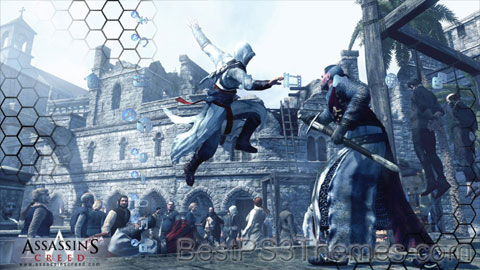
(4 backgrounds)
Assassin's Creed Genre(s) Developer(s) Publisher(s) Ubisoft Creator(s) First release Assassin's Creed
November 13, 2007Latest release Assassin's Creed Nexus VR
November 16, 2023Development history[edit]
Period one[edit]
Period two[edit]
Future[edit]
Gameplay[edit]
Storyline[edit]
Premise[edit]
Story arcs[edit]
PSN #2
rev S/CON (SOCOM) w/ Custom Sounds
(1 background)
Copyright (c) 2007. Anoop Menon
p3textractor filename.p3t [destination path]Replace filename with the name of the p3t file, and replace [destination path] with the name of the folder you want the files to be extracted to. A destination path is not required. By default it will extract to extracted.filename.Double Tifa
(1 background)
Copyright (c) 2007. Anoop Menon
p3textractor filename.p3t [destination path]Replace filename with the name of the p3t file, and replace [destination path] with the name of the folder you want the files to be extracted to. A destination path is not required. By default it will extract to extracted.filename.Call of Duty 4 #8