Snoopy theme by Tony (gaara1978)
Download: Snoopy.p3t
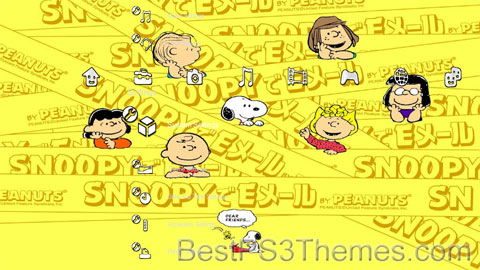
(6 backgrounds, HD only)
| Snoopy | |
|---|---|
| Peanuts character | |
 | |
| First appearance | October 4, 1950 (comic strip) |
| Created by | Charles M. Schulz |
| Voiced by |
|
| In-universe information | |
| Aliases | Joe Cool World Famous World War I Flying Ace The World's Greatest Writer The World Famous Attorney The World Famous Tennis Pro |
| Species | Dog (Beagle) |
| Gender | Male |
| Family | Brothers: Spike, Andy, Olaf, Marbles, Rover Sisters: Belle, Molly Owner: Charlie Brown Sally Brown Lila (previously) Clara ("the annoying girl") |
Snoopy is an anthropomorphic beagle[5] in the comic strip Peanuts by Charles M. Schulz. He can also be found in all of the Peanuts films and television specials. Since his debut on October 4, 1950, Snoopy has become one of the most recognizable and iconic characters in the comic strip and is considered more famous than Charlie Brown in some countries. The original drawings of Snoopy were inspired by Spike, one of Schulz's childhood dogs.[6][7]
Traits[edit]
Snoopy is a loyal, imaginative, and good-natured beagle who is prone to imagining fantasy lives, including being an author, a college student known as "Joe Cool", an attorney, and a World War I flying ace. He is perhaps best known in this last persona, wearing an aviator's helmet and goggles and a scarf while carrying a swagger stick (like a stereotypical British Army officer of World War I and II).
Snoopy can be selfish, gluttonous, and lazy at times, and occasionally mocks his owner, Charlie Brown. But on the whole, he shows great love, care, and loyalty for his owner (even though he cannot even remember his name and always refers to him as "the round-headed kid"). In the 1990s comic strips, he is obsessed with cookies, particularly the chocolate-chip variety. This, and other instances in which he indulges in large chocolate-based meals and snacks, indicate that chocolate is not poisonous to Snoopy, the way it is for real dogs.

All of his fantasies have a similar formula. Snoopy pretends to be something, usually "world famous", and fails. His short "novels" are never published. His Sopwith Camel is consistently shot down by his imaginary rival enemy, the German flying ace the "Red Baron". Schulz said of Snoopy's character in a 1997 interview: "He has to retreat into his fanciful world in order to survive. Otherwise, he leads kind of a dull, miserable life. I don't envy dogs the lives they have to live."[8]
Snoopy imagines himself to speak, but never actually does, other than nonverbal sounds and occasionally uttering "Woof". His very articulate thoughts are shown in thought balloons. In the animated Peanuts films and television specials, Snoopy's thoughts are not verbalized. His moods are instead conveyed through moans, yelps, growls, sobs, laughter, and monosyllabic utterances such as "bleah" or "hey" as well as through pantomime. His vocal effects were usually provided by Bill Melendez, who first played the role during Snoopy's appearances on The Tennessee Ernie Ford Show.[9] The only exceptions are in the animated adaptions of the musicals You're a Good Man, Charlie Brown and Snoopy!!! The Musical, in which Snoopy's thoughts are verbalized by Robert Towers and Cameron Clarke, respectively. (His dialogue, however, is not "heard" by the other characters except Woodstock the bird and other non-human characters; however, he does remember Charlie Brown's name.)
Snoopy's doghouse defies physics and is shown to be bigger on the inside than the outside.
History[edit]

Snoopy appeared on October 4, 1950, two days after the first Peanuts strip. He was one of the four original characters, along with Charlie Brown, Patty, and Shermy. He was named Snoopy for the first time in the November 10 strip.
On March 16, 1952,[10] his thoughts were first shown in a thought balloon. Snoopy first appeared upright on his hind legs on January 9, 1956, when he was shown sliding across a sheet of ice after Shermy and Lucy had first done so.[11] He is first shown sleeping on top of his doghouse rather than inside it on December 12, 1958,[12] and first adopts his World War I Flying Ace persona on October 10, 1965.[13] Snoopy's final appearance in the comic was on February 13, 2000, when he was shown sitting on top of his doghouse typing Schulz's farewell message to his readers.[14]
Popularity[edit]
Snoopy appeared as a character balloon in the Macy's Thanksgiving Day Parade in 1968; the balloon depicted Snoopy in his World War I Flying Ace costume.[15] The beagle has been in almost every parade ever since in different costumes, as an ice skater, a jester (to celebrate the new millennium and the parade's 75th anniversary), and an astronaut.
The Dogs Trust and Wild in Arts created a trail called A Dog's Trail which spanned across Cardiff, Caerphilly, and Porthcawl in spring of 2022. The trail raised money for Dogs Trust to use for dog welfare.[16][17]
Relationship with other Peanuts characters[edit]
 | This section needs additional citations for verification. (March 2023) |
Charlie Brown[edit]
Despite his history of conflicted loyalties, his constant disrespect for Charlie Brown, and his inability to remember his name (he refers to him as "that round-headed kid"), Snoopy has shown both love and loyalty to his owner. Charlie Brown would often get irritated at Snoopy's flights of fancy with the comment, "Why can't I have a normal dog like everyone else?" He joins Charlie Brown in walking out of a game of Ha-Ha Herman when Peppermint Patty insults Charlie Brown, unaware that Charlie Brown is within earshot.[18] He also helps Charlie Brown recover his autographed baseball when a bully takes it and challenges Charlie Brown to fight him for it. When Charlie Brown has to stop dedicating himself to making Snoopy happy, Snoopy replies, "Don't worry about it. I was already happy." In The Peanuts Movie, Snoopy remains loyal to Charlie Brown, supporting and caring for him throughout the movie.
In early Peanuts strips, Charlie Brown was not Snoopy's owner (as seen in the February 2, 1951, strip), and it was not made clear who, if anyone, his actual owner was. At various times, it was suggested that he was Patty's[19] or Shermy's[20] dog. Charlie Brown was first portrayed as being responsible for Snoopy in the strips of November 1 and 3, 1955; it was not until September 1, 1958, that Snoopy was specifically said to be Charlie Brown's dog. (In the September 20, 1980, strip, Charlie Brown comments that he once told Snoopy to "stay" and "he never went home.")
In both the early strips and the movie Snoopy, Come Home, Charlie Brown says that he got Snoopy after being bullied by another kid. His parents took him to the Daisy Hill Puppy Farm to cheer him up, where he met and bought Snoopy. The special Snoopy's Reunion depicts their first meeting.
Lucy[edit]
Snoopy frequently tries to kiss Lucy on the cheek or nose, which Lucy, who is afraid of dog germs, thoroughly hates. Despite her distaste of doggy kisses, Lucy seems to care for Snoopy: in Snoopy, Come Home, Lucy is sad to see him go and is (momentarily) glad when he comes back home. In some strips, Lucy goes to Snoopy for help, such as in the April 16, 1961[21] strip, wherein a jealous Lucy and Frieda are beating each other up at Schroeder's piano, Lucy ends up winning, and shakes hands with Snoopy in the end, looking slightly injured. Snoopy also commandeers Lucy's psychiatric booth either in her absence or when she ends up being the one needing help. In Snoopy!, Lucy and Snoopy hug each other during the song "If Just One Person".
Linus[edit]
Snoopy often tries to steal Linus's blanket, leading to slapstick fights and wild chases, the latter of which usually involve Snoopy running up, grabbing the blanket in his mouth, then running off with Linus holding on for dear life, and finally swinging Linus and the blanket around and around in a circular motion through the air before letting go and they both fly off to who-knows-where.
Lila[edit]
Lila was Snoopy's owner before Charlie Brown. Snoopy visits her in the cartoon Snoopy, Come Home and struggles to decide whether to stay with Charlie Brown or go back to Lila. Lila quickly persuades him to leave Charlie Brown so Snoopy can live with her again. However, upon arriving at her apartment complex, Snoopy is very relieved to see a "NO DOGS ALLOWED" sign and returns to live with Charlie Brown.
Peppermint Patty[edit]
Peppermint Patty often refers to Snoopy as a "funny-looking kid with a big nose", unaware that he is a beagle. In one instance, she has him serve as her attorney in a case involving the school dress code. In the March 21, 1974, strip, Marcie tells Peppermint Patty that Snoopy is a beagle, finally resulting in her realizing his true identity. Snoopy serves as Peppermint Patty's watchdog several times. She is one of the few girls who does not get disgusted after being kissed by him.
Sally Brown[edit]
Like Lucy, Sally does not care that much for Snoopy and often calls him a stupid beagle. Sally usually complains when her big brother asks her to feed Snoopy whenever he is away from home. While she is still an infant, Sally has a friendly and playful relationship with Snoopy. In later years, Sally occasionally enlists Snoopy's help in school assignments. She even treats him to an ice cream cone (a very tall ice cream cone, with scoops of about a dozen flavors) when Snoopy helps her get an "A" on a report about "Our Animal Friends". In one storyline, Sally uses Snoopy as a "weapon" to help protect her from bullies on the playground (Snoopy barks loudly at anyone who threatens Sally, leading Snoopy to comment, "I feel like a can of mace!"), but this ends in disaster when Snoopy sees an old girlfriend of his and runs off to meet her, abandoning Sally and leaving her to get "slaughtered" by the playground bullies.
Schroeder[edit]
Schroeder does not mind much when Snoopy sits against his toy piano, except when Snoopy dances on top of the piano, much to Schroeder's annoyance. He also sometimes plays with the notes coming from the piano.
Rerun van Pelt[edit]
Rerun, the youngest child character in the strip, plays with Snoopy sometimes. In some strips, Rerun and Snoopy are playing cards with each other, both of them clueless about the rules.
Woodstock[edit]
Woodstock is Snoopy's best friend and sidekick. He is a small, yellow bird of indeterminate species. He speaks in a chirping language that only Snoopy and his other bird friends can understand. In return, the birds somehow understand Snoopy's thoughts. In some strips, Snoopy can be seen telling a joke to Woodstock and both laugh so hard they end up falling off the doghouse. Woodstock sometimes sleeps on top of Snoopy's nose, such as in one strip where Snoopy says "Never share your pad with a restless bird".
Fifi[edit]
Fifi is a major love interest of Snoopy and she appears in Life Is a Circus, Charlie Brown and The Peanuts Movie. In Life Is a Circus, Charlie Brown, Snoopy sees Fifi, a white poodle, at a circus and starts to get attracted to her. He and Fifi do a trapeze act and afterward, he runs away, taking Fifi with him. Fifi decides to go back to the circus, however, leaving Snoopy heartbroken and forced to return to Charlie Brown. In The Peanuts Movie, Fifi (voiced by Kristin Chenoweth) is a pilot just like Snoopy (being redesigned to be bipedal while still retaining her poodle traits), and together they have interaction via Snoopy's typewriter against the Red Baron. He shows how much he cares for her when he cries at Schroeder's house after she is captured by the Red Baron. Snoopy, Woodstock, and the Beagle Scouts set out on a mission to save her. Eventually, they save her, and she shows her affection to Snoopy.
Siblings[edit]

In the comic strip, Snoopy has seven siblings. Five appeared at various times in the strip: four brothers, Spike, Andy, Marbles, and Olaf; and one sister, Belle. The two others were never mentioned by name in the comic strip, but the whole family appeared in 1991 television special Snoopy's Reunion, introducing the two unknown siblings, identified in the special as Molly and Rover.
Snoopy having seven siblings was an element of the strip that developed as the strip evolved. Originally described in a June 1959 strip as an "only dog",[22] Snoopy went to a family reunion with several unnamed siblings in a May 1965 sequence, stating that they all spoke different languages and couldn't understand each other.[23] In March 1970, Snoopy wrote in his autobiography that he was one of seven puppies,[24] and the number reached its final count of eight beagles in December 1972.
In a 1987 interview, Schulz said that he felt introducing Snoopy's siblings was a mistake, similar to the introduction of Eugene the Jeep in Thimble Theatre: "I think Eugene the Jeep took the life out of Popeye himself, and I'm sure Segar didn't realize that. I realized it myself a couple of years ago when I began to introduce Snoopy's brothers and sisters. I realized that when I put Belle and Marbles in there it destroyed the relationship that Snoopy has with the kids, which is a very strange relationship. And these things are so subtle when you're doing them, you can make mistakes and not realize them."[25] Schulz elaborated further in another 1987 interview: "Snoopy had a sister, Belle, whom I discovered I really didn't like. I brought in Spike and I like Spike a lot. But when I brought another brother in — I thought Marbles would make a great name for a dog — I discovered almost immediately that bringing in other animals took the uniqueness away from Snoopy. So the only other animal character who works now is Spike, as long as Spike stays out in the desert."[26]
Spike[edit]
Spike, Snoopy's older brother who lived in the desert, was the most frequently seen sibling in the strip.[27] He was introduced in the August 13, 1975, strip.[28] He was a recurring character between 1984 and 1988, and was also used in one-off appearances sporadically through the rest of Peanuts history. Spike is named after Charles Schulz's childhood dog.[29]
Spike's appearance is similar to Snoopy's, but he is substantially thinner, has a perpetually sleepy-eyed look, sports long, droopy whiskers that look like a mustache, and wears a fedora. He is called Snoopy's older brother during the first story in which he appears. Spike lives in the middle of a desert near Needles, California, mostly interacting with inanimate saguaro cacti and rocks.
He temporarily became Rerun's dog in I Want a Dog for Christmas, Charlie Brown, and also starred in his own television special, It's the Girl in the Red Truck, Charlie Brown.[30] He was also a main character in Snoopy's Getting Married, Charlie Brown, where he is shown traveling from Needles to visit Snoopy to be the best beagle at his wedding.
A large statue of Spike resides inside the Needles Regional Museum in Needles, California. The Schulz family lived in Needles from 1928 to 1930.[31]
Belle[edit]
Belle is Snoopy's sister, who first appeared in the strip on June 28, 1976.[32] She lives in Kansas City, Missouri with her teenage son, whom Snoopy noted as resembling the Pink Panther.[33] Belle herself bears a strong resemblance to Snoopy, but with longer eyelashes. In addition, she wears a lace collar and sometimes wears a pearl necklace.
Belle only made a few appearances in the strip but is remembered because of the Belle stuffed animal toys sold in the late 1970s and early 1980s.[34] San Francisco toy merchandiser Determined Productions had the license to make Snoopy plush toys, and they introduced Belle plush after receiving many requests from children who wanted a female "sister" doll.[35]
In 1984, Snoopy and Belle inspired fashion designers around the world, including Lagerfeld, Armani, and de la Renta, to create one-of-a-kind outfits in their honor. Both beagles modeled for the "Snoopy in Fashion" exhibition held that year in Japan. "Snoopy & Belle in Fashion" continues to be exhibited as of 2020[update].[36] Photographs of the exhibition were collected in a 1988 book, Snoopy in Fashion.[37]
There was another traveling exhibition of Snoopy and Belle plush in outfits made by fashion designers in 1990, as a celebration of the comic strip's fortieth anniversary. This exhibition began in Paris at the Louvre Museum, and then to the Mitsukoshi department store in Tokyo, followed by showings in Los Angeles, New York City, London, Milan, and Madrid.[38] Photographs from this collection were published as Snoopy Around the World.[39]
Reception[edit]
Snoopy and Charlie Brown were ranked by TV Guide as the 8th greatest cartoon characters of all time.[40]
Some critics feel that the strip suffered a decline in quality after the 1960s. Writing in 2000, Christopher Caldwell argued that the character of Snoopy, and the strip's increased focus on him in the 1970s, "went from being the strip's besetting artistic weakness to ruining it altogether". Caldwell felt that Snoopy "was never a full participant in the tangle of relationships that drove Peanuts in its Golden Age", as he could not talk. He went on to say that Snoopy "was way too shallow for the strip as it developed in the 1960s, and the strips he featured in were anomalies."[41]
Jim Davis noted that Snoopy was a boon from a marketing standpoint, which inspired him to center his comic strip Garfield around a cat: "Snoopy is very popular in licensing. Charlie Brown is not."[42]
A toy titled The Snoopy Snowcone Machine was popular in the '80s and was later recreated in the 2010s by Cra-z-art.
Awards and honors[edit]
Schulz was a keen bridge player, and Peanuts occasionally included bridge references. In 1997 the American Contract Bridge League (ACBL) awarded both Snoopy and Woodstock the honorary rank of Life Master, and Schulz was delighted.[43][44]
On November 2, 2015, Snoopy was honored with a star on the Hollywood Walk of Fame, becoming the second Peanuts-related figure to be inducted with a star, after Schulz.[45]
In aviation and space[edit]
Use by NASA[edit]

- Following the Apollo 1 fire, Snoopy became the official mascot of aerospace safety, testing and the rebuilding of the Apollo Program.
- The Apollo 10 lunar module was named Snoopy and the command module Charlie Brown. While not included in the official mission logo, Charlie Brown and Snoopy became semi-official mascots for the mission, as seen here and here. Schulz also drew some special mission-related artwork for NASA, and several regular strips related to the mission, one showing Snoopy en route to the Moon atop his doghouse with a fishbowl on his head for a helmet. "We have mentioned," wrote television producer Lee Mendelson, "that Charles Schulz is a gambler, a man who doesn't sit pat on success. The New York Times headlined: 'Creator of Peanuts Tempts Fate on Apollo Mission.' Certainly, if a tragedy had occurred, as well it might have, the symbols would forever remain in man's mind as symbols of disaster. But Sparky has always had faith in the Apollo program, from the very start, and he felt if those men could risk their lives, the least he could do would be to risk the popularity of the characters."[46][47] The strip that ran on July 21, 1969 – one day after Neil Armstrong and Buzz Aldrin landed the Apollo 11 Lunar Module Eagle on the Moon – included a full Moon in the background, with a black mark on it representing the module.[48]
- The fabric cap worn by NASA astronauts as part of the Extravehicular Mobility Unit is known as a "Snoopy cap", a reference to how the white crown and black earflaps of the cap resemble Snoopy's fur and ears.
- The Silver Snoopy award is a special NASA honor, in the form of a sterling silver pin with an engraving of Snoopy in a spacesuit helmet. It is given by an astronaut to someone who works in the space program that has gone above and beyond in pursuit of quality and safety.[49]
- Snoopy and NASA announced, in April 2019, that Snoopy will return to the Moon aboard NASA Orion in 2024.[50]
- He was a gravity indicator aboard Artemis 1 mission that orbited the moon.[51]
- In November 2019, Apple TV made a Snoopy in Space series.
Other uses[edit]
- Snoopy is the name of a United States Air Force B-58 Hustler bomber, serial number 55-0665, which was modified to test a radar system.[52]
- American insurance company MetLife used Snoopy as their corporate mascot between 1985 and 2016. Snoopy One, Snoopy Two, and Snoopy J are three airships owned and operated by MetLife that provide aerial coverage of sporting events, and feature Snoopy as the World War I flying ace on their fuselage. As of October 20, 2016, MetLife no longer features Snoopy in its commercials, due to a global rebranding.[53][54]
- The Charles M. Schulz–Sonoma County Airport in California, named after Schulz, has a logo featuring Snoopy in his World War I flying ace attire flying atop his doghouse.
- Snoopy is the mascot of the 26th Squadron (Barons, pronounced Barones) of the United States Air Force Academy, appearing on their squadron patch.
References[edit]
- ^ "Bill Melendez at Moby Games". Retrieved October 25, 2017.
- ^ This page is a redirect. The following categories are used to track and monitor this redirect:When appropriate, protection levels are automatically sensed, described and categorized.
- From a colloquial name: This is a redirect from a colloquial name – either an unofficial name that is more commonly used than the official name, or a title that is unsuitable as a Wikipedia article title or other project page name – that serves readers because it is a good search term. The official name is given by the target of the redirect. Note that if the target page is named using WP:COMMONNAME, then this template should not be here.
- Pages that use this link should be updated to link directly to the target without the use of a piped link that hides the official name.
- From a colloquial name: This is a redirect from a colloquial name – either an unofficial name that is more commonly used than the official name, or a title that is unsuitable as a Wikipedia article title or other project page name – that serves readers because it is a good search term. The official name is given by the target of the redirect. Note that if the target page is named using WP:COMMONNAME, then this template should not be here.
Anime Girls
Anime Girls theme by Tony (gaara1978)
Download: AnimeGirls.p3t
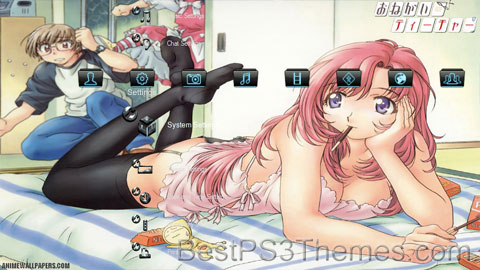
(4 backgrounds, HD only)
P3T Unpacker v0.12
Copyright (c) 2007. Anoop Menon
This program unpacks Playstation 3 Theme files (.p3t) so that you can touch-up an existing theme to your likings or use a certain wallpaper from it (as many themes have multiple). But remember, if you use content from another theme and release it, be sure to give credit!
Download for Windows: p3textractor.zip
Instructions:
Download p3textractor.zip from above. Extract the files to a folder with a program such as WinZip or WinRAR. Now there are multiple ways to extract the theme.
The first way is to simply open the p3t file with p3textractor.exe. If you don’t know how to do this, right click the p3t file and select Open With. Alternatively, open the p3t file and it will ask you to select a program to open with. Click Browse and find p3textractor.exe from where you previously extracted it to. It will open CMD and extract the theme to extracted.[filename]. After that, all you need to do for any future p3t files is open them and it will extract.
The second way is very simple. Just drag the p3t file to p3textractor.exe. It will open CMD and extract the theme to extracted.[filename].
For the third way, first put the p3t file you want to extract into the same folder as p3textractor.exe. Open CMD and browse to the folder with p3extractor.exe. Enter the following:
p3textractor filename.p3t [destination path]Replace filename with the name of the p3t file, and replace [destination path] with the name of the folder you want the files to be extracted to. A destination path is not required. By default it will extract to extracted.filename.
Eye of Judgment Official
Eye of Judgment Official theme by SCEJ
Download: EyeofJudgmentOfficial.p3t
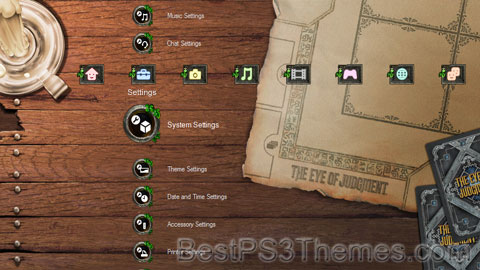
(2 backgrounds)
P3T Unpacker v0.12
Copyright (c) 2007. Anoop Menon
This program unpacks Playstation 3 Theme files (.p3t) so that you can touch-up an existing theme to your likings or use a certain wallpaper from it (as many themes have multiple). But remember, if you use content from another theme and release it, be sure to give credit!
Download for Windows: p3textractor.zip
Instructions:
Download p3textractor.zip from above. Extract the files to a folder with a program such as WinZip or WinRAR. Now there are multiple ways to extract the theme.
The first way is to simply open the p3t file with p3textractor.exe. If you don’t know how to do this, right click the p3t file and select Open With. Alternatively, open the p3t file and it will ask you to select a program to open with. Click Browse and find p3textractor.exe from where you previously extracted it to. It will open CMD and extract the theme to extracted.[filename]. After that, all you need to do for any future p3t files is open them and it will extract.
The second way is very simple. Just drag the p3t file to p3textractor.exe. It will open CMD and extract the theme to extracted.[filename].
For the third way, first put the p3t file you want to extract into the same folder as p3textractor.exe. Open CMD and browse to the folder with p3extractor.exe. Enter the following:
p3textractor filename.p3t [destination path]Replace filename with the name of the p3t file, and replace [destination path] with the name of the folder you want the files to be extracted to. A destination path is not required. By default it will extract to extracted.filename.
Grand Theft Auto: IV (V1.0)
Grand Theft Auto: IV (V1.0) theme by vanillacoke
Download: GTAIV_V1.0.p3t
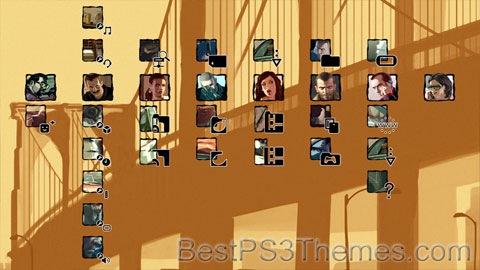
(1 background)
P3T Unpacker v0.12
Copyright (c) 2007. Anoop Menon
This program unpacks Playstation 3 Theme files (.p3t) so that you can touch-up an existing theme to your likings or use a certain wallpaper from it (as many themes have multiple). But remember, if you use content from another theme and release it, be sure to give credit!
Download for Windows: p3textractor.zip
Instructions:
Download p3textractor.zip from above. Extract the files to a folder with a program such as WinZip or WinRAR. Now there are multiple ways to extract the theme.
The first way is to simply open the p3t file with p3textractor.exe. If you don’t know how to do this, right click the p3t file and select Open With. Alternatively, open the p3t file and it will ask you to select a program to open with. Click Browse and find p3textractor.exe from where you previously extracted it to. It will open CMD and extract the theme to extracted.[filename]. After that, all you need to do for any future p3t files is open them and it will extract.
The second way is very simple. Just drag the p3t file to p3textractor.exe. It will open CMD and extract the theme to extracted.[filename].
For the third way, first put the p3t file you want to extract into the same folder as p3textractor.exe. Open CMD and browse to the folder with p3extractor.exe. Enter the following:
p3textractor filename.p3t [destination path]Replace filename with the name of the p3t file, and replace [destination path] with the name of the folder you want the files to be extracted to. A destination path is not required. By default it will extract to extracted.filename.
Grand Theft Auto IV #9
Grand Theft Auto IV theme by schnaebizaegg
Download: GTAIV_9.p3t
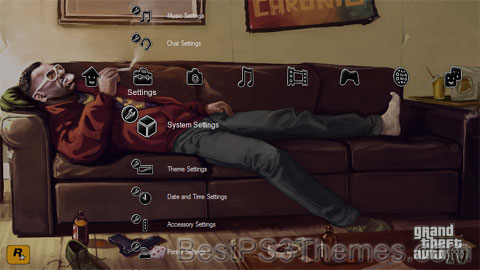
(4 backgrounds)
| Grand Theft Auto IV | |
|---|---|
 | |
| Developer(s) | Rockstar North[a] |
| Publisher(s) | Rockstar Games |
| Producer(s) | Leslie Benzies |
| Programmer(s) |
|
| Artist(s) | Aaron Garbut |
| Writer(s) |
|
| Composer(s) | Michael Hunter |
| Series | Grand Theft Auto |
| Engine | RAGE |
| Platform(s) | |
| Release | PlayStation 3, Xbox 360
|
| Genre(s) | Action-adventure |
| Mode(s) | Single-player, multiplayer |
Grand Theft Auto IV is a 2008 action-adventure game developed by Rockstar North and published by Rockstar Games. It is the sixth main entry in the Grand Theft Auto series, following 2004's Grand Theft Auto: San Andreas, and the eleventh entry overall. Set in the fictional Liberty City, based on New York City, the single-player story follows Eastern European war veteran Niko Bellic and his attempts to escape his past while under pressure from high-profile criminals. The open world design lets players freely roam Liberty City, consisting of three main islands, and the neighbouring state of Alderney, which is based on New Jersey.
The game is played from a third-person perspective and its world is navigated on foot and by vehicle. Throughout the single-player mode, players control Niko Bellic. An online multiplayer mode is also included with the game, allowing up to 32 players to engage in both cooperative and competitive gameplay in a recreation of the single-player setting.[b] Two expansion packs were later released for the game, The Lost and Damned and The Ballad of Gay Tony, which both feature new plots that are interconnected with the main Grand Theft Auto IV storyline, and follow new protagonists.
Development of Grand Theft Auto IV began soon after the release of San Andreas and was shared between many of Rockstar's studios worldwide. The game introduced a shift to a more realistic and detailed style and tone for the series. Unlike previous entries, Grand Theft Auto IV lacked a strong cinematic influence, as the team attempted an original approach to the story. As part of their research for the open world, the development team conducted extensive field research in New York, capturing over 100,000 photographs and several hours of video. The developers considered the world to be the most important element of the game; though not the largest map in the series, they considered it comparable in scope due to its verticality and level of detail. The budget climbed to over US$100 million, making it one of the most expensive video games to develop.
Grand Theft Auto IV was released for the PlayStation 3 and Xbox 360 consoles in April 2008, and for Windows in December. Upon release, the game received critical acclaim, with praise particularly directed at the narrative and open-world design. Grand Theft Auto IV broke industry sales records and became the fastest-selling entertainment product in history at the time, earning US$310 million in its first day and US$500 million in its first week. Considered one of the most significant titles of the seventh generation of video games, and by many critics as one of the greatest video games of all time, it won year-end accolades, including Game of the Year awards from several gaming publications. It is among the best-selling video games with over 25 million copies sold by 2013. The game generated controversy, with criticism directed at the game's depiction of violence and players' ability to drink-drive. Its successor, Grand Theft Auto V, was released in September 2013.
Gameplay[edit]
Grand Theft Auto IV is an action-adventure game played from a third-person perspective.[2] Players complete missions—linear scenarios with set objectives—to progress through the story. It is possible to have several active missions running at one time, as some require players to wait for further instructions or events. Outside of missions, players can freely roam the game's open world and complete optional side missions.[3] Composed of the fictional city of Liberty City, the world is larger in area than most earlier Grand Theft Auto series entries.[4] At the beginning of the game, players can only explore the first island—composed of Dukes and Broker—with all other islands unlocking as the story progresses.[5]
Players use melee attacks, firearms and explosives to fight enemies, and may run, jump, swim or use vehicles to navigate the game's world. There is a first-person perspective option when using vehicles. In combat, auto-aim and a cover system can be used as assistance against enemies. Should players take damage, their health meter can be fully regenerated by consuming food or drinks, using medical kits, or calling for paramedics.[6] If players commit crimes, the game's law enforcement agencies may respond as indicated by a "wanted" meter in the head-up display (HUD). On the meter, the displayed stars indicate the current wanted level (for example, at the maximum six-star level, efforts by law enforcement to incapacitate players become very aggressive). Law enforcement officers will search for players who leave the wanted vicinity. The wanted meter enters a cool-down mode and eventually recedes when players are hidden from the officers' line of sight.[7]

The game's cover system allows players to move between cover, to fire blindly, aim freely, and target a specific enemy. Individual body parts can also be targeted.[8] Melee attacks include additional moves, such as dodging, blocking, disarming an opponent and counter-attacking. Body armour can be used to absorb gunshots and explosive damage, but is used up in the process. When health is entirely depleted, gameplay stops, and players respawn at the nearest hospital.[6]
The single-player mode lets players control an Eastern European war veteran, Niko Bellic. During the story, Niko meets and befriends various new characters. They can then perform favours for Niko whenever he asks; for example, his cousin Roman, who owns a taxi service, can send one of his cabs to take Niko to any destination around the city. Cabs are always available during gameplay for quick travel to a destination. Throughout the course of the game, players are also faced with morality choices, which alter the storyline appropriately depending on the player's choice. While free roaming the game world, players may engage in context-specific activities such as bowling or darts. Other available activities include a vigilante mini-game, and in-game television programming.[9][10][11] Niko has a cell phone for contacting friends and starting activities.[12] The cell phone is also used to access the game's online multiplayer mode, and to enter cheat codes.[13] To access the in-game Internet, which allows Niko to send and receive emails and set up prospective dates with potential girlfriends, Niko can use Internet cafés located around the city.[14] The game also features a subway system, allowing players to quickly traverse through the game's world.[15]
The online multiplayer mode for Grand Theft Auto IV allows up to 32 players[b] to freely roam across the map. Players decide which game mode they wish to play, including deathmatches and street races. Both cooperative and competitive game modes are available, split into ranked and unranked matches.[16] For players to level up through ranks, in-game money has to be earned. The game also features a Free Mode, in which players have the entire map open to explore, with no end goal or mission to complete. Hosts of the game can control many variables, such as police presence, traffic, and weapons.[17] The multiplayer mode was discontinued on Windows in 2020.[18]
Synopsis[edit]
Setting[edit]
Grand Theft Auto IV takes place in 2008, within a redesigned version of Liberty City. The design of the city focuses on a recreation of four of the boroughs of New York City: Broker (based on Brooklyn), Dukes (Queens), Bohan (The Bronx), and Algonquin (Manhattan). The setting also includes the neighbouring state of Alderney (based on New Jersey).[19] Initially, bridges are locked down due to a terrorist threat, and police constantly pursue players if the bridges are crossed. The blockades are lifted as the story progresses, allowing the player to traverse between islands safely.
Grand Theft Auto IV is set in the fictional "HD Universe", which mirrors and parodies the real world. The previous games formed fictional universes of their own,[c] which despite having many similarities with the HD Universe, are considered to be different continuities. Hence, the Liberty City depicted in Grand Theft Auto IV is different from its previous renditions, and the game itself serves as a reboot for the series. The new timeline established by Grand Theft Auto IV would continue with two expansion packs, The Lost and Damned and The Ballad of Gay Tony, and a sequel, Grand Theft Auto V, as well as its online component, Grand Theft Auto Online.[21][22][23] The handheld game Grand Theft Auto: Chinatown Wars is also considered part of the HD Universe, because it features the same map as Grand Theft Auto IV, except for Alderney.[24]
Plot[edit]
Niko Bellic, an Eastern European ex-soldier,[25] arrives in Liberty City aboard a cargo ship, the Platypus, to escape his criminal past, pursue the American Dream, and search for the man who betrayed his unit to an ambush during a war ten years prior. Reuniting with his cousin Roman, he discovers that his tales of riches were lies concealing his small, dirty apartment, unprofitable taxi company, gambling debts, and disputes with loan sharks. Niko begins assisting Roman with his problems, which leads him to make his first criminal contacts in the city. He befriends Yardies second-in-command Little Jacob and is forced to work for Vlad Glebov, Roman's Russian loan shark, whom Niko eventually kills upon learning he had slept with Roman's girlfriend, Mallorie.
In retaliation, Niko and Roman are kidnapped by Russian mobsters on orders of their boss Mikhail Faustin and his lieutenant, Dimitri Rascalov. Indifferent to Vlad's murder, Faustin releases them and employs Niko as a hitman, eventually ordering him to kill the son of Russian crime lord Kenny Petrović. When Petrović threatens retaliation, Dimitri convinces Niko to assassinate Faustin. However, he then betrays and brings Niko to his former employer, Ray Bulgarin, who accuses Niko of stealing from him during a botched human trafficking job years earlier. Niko denies the allegation and a firefight ensues, allowing Dimitri and Bulgarin to escape.
Dimitri's men burn down Niko and Roman's apartment and taxi company, forcing them to flee to Bohan. While Niko finds work with several local drug lords, Dimitri kidnaps Roman in a failed attempt to lure Niko into a trap. Later, Niko discovers that his romantic interest, a woman named Michelle, is a government agent, who then entraps him into working for her agency. In exchange for the murders of several known or suspected terrorists, the agency clears Niko's criminal record and assists him in searching for the traitor he seeks. Niko and Roman's fortunes improve when the latter receives a large amount of insurance money from his destroyed business, which he uses to rebuild it and buy an apartment in Algonquin. Roman also proposes to Mallorie, who accepts.
While working for the Irish Mob, Niko befriends gangster Patrick "Packie" McReary and helps him and his brothers carry out various jobs, including a major bank robbery. Niko is later hired by Ray Boccino, a caporegime in the Pegorino crime family, to oversee a diamond deal, which goes awry. Boccino repays Niko by helping him find his ex-comrade Florian Cravic, now known as Bernie Crane, who claims he was not the one to betray their unit. Niko concludes that the traitor was Darko Brevic, the only other survivor. Niko continues working for the Mafia in Liberty City and eventually earns the trust of Don Jimmy Pegorino, who orders Niko to kill Boccino after suspecting him of being a police informant. Niko also helps Packie kidnap Don Giovanni Ancelotti's daughter to ransom her for the diamonds, but Bulgarin intercepts the exchange. In the ensuing firefight, the diamonds are lost.
Eventually, the government agents find Darko in Romania and bring him to Liberty City for Niko to decide his fate. Afterwards, Niko is summoned by Pegorino for one final favour: to help with a highly lucrative heroin deal in collusion with Dimitri. Niko must either agree to work with Dimitri or exact revenge on him.[26] If Niko goes through with the deal, Dimitri betrays him again,[27] kills Pegorino,[28] and attempts to kill Niko via an assassin at Roman's wedding, but accidentally kills Roman;[29] Niko retaliates by tracking and murdering Dimitri.[28] If Niko chooses to exact revenge, he kills Dimitri aboard the Platypus,[30] prompting a furious Pegorino to target Niko but accidentally kill Packie's sister Kate, whom Niko had been dating, at Roman's wedding;[29] Niko retaliates by tracking and murdering Pegorino.[31] Later, either Mallorie or Roman tells Niko that Mallorie is pregnant.
Development[edit]

Preliminary work on Grand Theft Auto IV began in November 2004,[32] a month after the release of Grand Theft Auto: San Andreas.[33] Rockstar president Sam Houser felt that following up San Andreas was "a nightmare".[34] Rockstar North, the core 220-person team behind the game, co-opted studios owned by parent company Rockstar Games to facilitate development between a full team of over 1,000,[35] including 50 employees at Rockstar NYC, 40 at Rockstar Lincoln, 10 at Rockstar San Diego, and around 600–700 working part-time internally and externally.[36] Some key members of the development team worked 12-hour days during production, often without holidays.[35] The team decided to continue the numbering scheme absent from the previous two main games to represent the same leap in production as Grand Theft Auto 2 (1999) to Grand Theft Auto III (2001).[33] Development of Grand Theft Auto IV ceased by 21 April 2008 when the game was submitted for manufacturing.[37] Producer Leslie Benzies estimated that the budget of the development efforts exceeded US$100 million, making Grand Theft Auto IV one of the most expensive video games ever made.[35]
Research and open world design[edit]
The game's setting, Liberty City, is based on New York City. The team did not look at the previous renditions of Liberty City as inspiration, wanting it to retain the "general feel" but nothing else.[38] The map is roughly three times the size of Grand Theft Auto III's.[38] The developers originally considered using the entire state of New York, before restricting it to Manhattan, and then expanding it out again. They considered including more suburbs with woods, and would regularly vote on which areas to include.[39] Art director Aaron Garbut said that the team chose the setting because of the detail and variety it provided, describing New York as "an amazing, diverse, vibrant, cinematic city".[40] Writer Dan Houser added that the team "wanted to be somewhere where we had a foothold" due to the amount of research required for the world; Rockstar Games's main headquarters are located in New York.[41] The team consciously avoided a precise recreation of New York City to allow for more enjoyable game design,[32] selecting the areas that they felt "characterised it the best".[40] Garbut wanted to capture a caricature of the city as he felt that most people were familiar with "the highlights" from film or literature but did not need to know the areas precisely.[40] The city was not built with specific missions in mind; the area was created first, and missions implemented later.[42]
To achieve a realistic environment, 60–70 employees from Rockstar North travelled to New York for research: first at the beginning of the project in March or April 2005 for a week and a half,[39] and a smaller trip in 2007.[38] Police officers who previously worked the beat drove the team around Washington Heights.[39] A full-time research team based in New York handled further requests for information, such as the ethnic minority of a neighbourhood or videos of traffic patterns. Videos shot in New York were played on televisions at the Rockstar North offices "so while they worked they could look up and there was New York".[39] Benzies claimed that the team took over 100,000 photographs on location in New York,[35] though Garbut estimates that they took around 250,000.[38] They also studied architectural plans for apartments, used satellite images to determine city block layout, researched sales figures for models of cars, and read books that detailed the city's infrastructure, including its subways, sewers, and garbage disposal.[43] Hove Beach is based on Brighton Beach, which Sam Houser found "pretty incredible" and unusual; the name is based on the English city Brighton and Hove, made up of the former neighbouring towns Brighton and Hove.[44] Houser appreciated that Brighton Beach was home to several Eastern Europeans due to the nature of the game's characters.[44]
Dan Houser described Liberty City as "the biggest character" of the game.[40] The Grand Theft Auto IV rendition of Liberty City is more detailed and larger in size than most earlier entries in the series; although smaller than San Andreas, the setting of the previous main game, the developers considered it comparable in scope due to city's verticality, number of buildings, and level of detail.[45] The team wanted less dead spots and irrelevant spaces, such as the wide open deserts in San Andreas.[32] They wanted the game to be "a more focused experience" than San Andreas, and Dan Houser felt that the limited activities of New York allowed this.[33] The team felt that the addition of Niko's mobile phone added to the immersion of the world and represented society's shifted focus on phones.[33] The in-game brands and products are designed over several years; the billboards were implemented in the game around six months prior to release.[38]
Story and character development[edit]


The game's script, written by Dan Houser and Rupert Humphries, is about 1,000 pages.[35] Approximately 660 actors provided voices for the game over 80,000 lines of dialogue.[39] After conceiving the character and setting, Dan Houser spoke with his brother Sam Houser and Leslie Benzies to bounce story ideas before writing a rough synopsis, a six-paged, detailed document. Once the synopsis was reworked, the designers broke it into missions, represented by a large flow document demonstrating each section. The writers then work on the introductions to the missions; the gameplay dialogue comes much later.[41] Unlike previous Grand Theft Auto games, Grand Theft Auto IV does not have cinematic influences. "We were consciously trying to go, well, if video games are going to develop into the next stage, then the thing isn't to try and do a loving tribute or reference other stuff," said Dan Houser.[41] He said that the writers wanted something "fresh and new and not something that was obviously derived from [a] movie".[41] Dan Houser felt that the quality of the writing had to improve alongside the advancements in graphics and technology. He noted that the improvements in facial animation allowed for slower-paced cutscenes.[40] The unique dialogue that plays when a mission is retried was to ensure that the gameplay felt "less canned and less like Groundhog Day".[40]
Dan Houser described Niko Bellic as "a more rounded character" than those in previous games.[40] He felt that his dual personality—often saving innocent people, while also being a "cold-hearted killer"—made him more relatable.[40] He also felt that Niko's unfamiliarity with Liberty City allowed for the player to relate to him more, only driven by his vague past and relationship with Roman. When deciding on Niko's background, the writers felt that being an immigrant could lead to more dangerous situations, and therefore more enjoyable missions; after discussions with criminal experts, Dan Houser found that "the real scary characters are not born in America anymore".[40] He felt that Niko's outsider view of American culture was "fun".[40] The team wanted Niko to be "more of an anti hero than a hero, capable of making positive actions within his criminal world".[46] They wanted his demeanour to reflect the weight of his past and choices.[46]
Niko's design underwent a few changes, but was finalised early in development.[47] His outfit underwent several changes based on Eastern Europeans, particularly photographs of men fighting in winter wars in Yugoslavia and Chechnya. The primary motivation for the design was a face to convey the appropriate emotions and a body that could move nicely with the new animations.[40] The in-game purchasable outfits were also designed to fit with the character.[33] The team ensured that the gameplay choices presented to the player were not too extensive, as they still had to make sense to the character, who is driven by the people around him. Dan Houser felt that the missions in San Andreas had become too linear, and wanted to present choices to the player in Grand Theft Auto IV.[40]
The writers found that Niko needed a motivation to come to America, so they created his cousin, Roman. Dan Houser felt that the two could not be brothers as there would be a deeper level of familiarity than necessary. He described the two as a double act, with Roman's fantasist charm playing off Niko's tough cynicism. The team gave other non-playable characters (NPCs) more definable behaviours and dialogue to make them feel more alive. The writers initially considered having a smaller group of characters, but found that the story became boring and that players were less likely to explore the world. The stranger characters found in the game world were based on the "crazy people" that populate New York, according to Dan Houser, which in previous games were only able to be captured through radio stations or mild pedestrian behaviours.[38] The team based the ethnicities, clothing, and behaviours of the NPCs on the photographs and videos that they captured around New York, divided into different areas;[40] they created mood boards for each location.[38] The NPCs also converse in different languages.[39]
Art design[edit]
Grand Theft Auto IV sees a shift in the series to a more realistic and detailed style and tone, partly a result of the transition to consoles which offered high-definition graphics and the new and improved capabilities of such consoles. The development team worked to represent the upgrade in quality across all design aspects while maintaining the coherence of the previous games.[32] The team took the game's development as an opportunity to "strip things back and start again", refining the art style without losing the style of the series;[40] they distanced the game from the "cartoon-like style" of its predecessors while creating a new style that was consistent across all aspects of the game.[48] Garbut found the increased demand of detail brought on by the advanced technology daunting.[49] A technique used to make the visuals look real was to avoid harsh edges, instead blending surfaces together to make the world look dirty and lived-in.[50] The props department created multiple variations of different objects to make the world more interesting and unique.[40] G
Simpsons #5
The Simpsons theme by Rasenki
Download: Simpsons_5.p3t
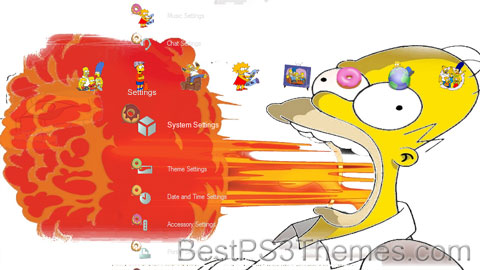
(3 backgrounds)
Redirect to:
This page is a redirect. The following categories are used to track and monitor this redirect:
|
Wipeout HD
Wipeout HD theme by SebChevy18
Download: WipeoutHD.p3t
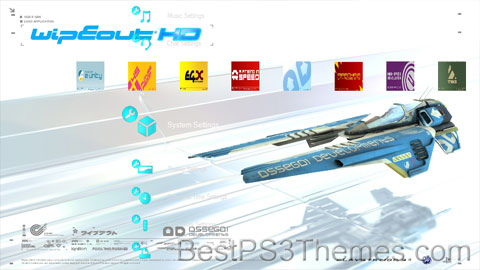
(13 backgrounds)
| Wipeout HD | |
|---|---|
 Cover art for the retail version | |
| Developer(s) | Studio Liverpool |
| Publisher(s) | Sony Computer Entertainment |
| Series | Wipeout |
| Platform(s) | PlayStation 3 |
| Release | PlayStation Network
|
| Genre(s) | Racing |
| Mode(s) | Single-player, multiplayer |
Wipeout HD is a futuristic racing video game developed by Studio Liverpool and published by Sony Computer Entertainment for the PlayStation 3. It is the eighth installment of the Wipeout series and was first released on the PlayStation Network on 25 September 2008 in both Europe and North America, and on 29 October in Japan. A major expansion pack titled Wipeout HD Fury was released worldwide via the PlayStation Network worldwide on 23 July 2009. A retail version was later made available in Europe on 16 October. Both Wipeout HD and its HD Fury Expansion are playable in 3D when connected to a 3D TV.
The game revolves around players competing in the FX350 anti-gravity racing league, and features selected tracks from the PlayStation Portable games Wipeout Pure and Wipeout Pulse, although the content has been upgraded to render 1080p visuals in 60 frames per second. Wipeout HD was developed by Studio Liverpool, who had desired to release a game for the PlayStation store to stress that downloadable content was not reserved for smaller games. The game was delayed for a few months due to reports of it failing epilepsy tests.
Wipeout HD and its expansion pack received positive reviews upon release. Critics unanimously praised the game's 1080p visuals, smooth frame rate, and techno soundtrack – a feature many critics recognised as a hallmark of the Wipeout series. The game received controversy over its in-game advertising at the time of the Fury expansion pack's release, with many players complaining of extended loading times due to in-game advertisements. Wipeout HD, along with its Fury expansion pack, was also chosen as a free offering as part of Sony's "Welcome Back" programme due to the 2011 PlayStation Network outage. The expanded Fury version and the subsequent Wipeout 2048 were remastered for PlayStation 4 and released as Wipeout Omega Collection in 2017.[1]
Gameplay[edit]

Wipeout HD is a racing game in which players compete in the FX350 anti-gravity racing league. The game features a selection of eight tracks originally used in Wipeout Pure and Wipeout Pulse, albeit updated in 1080p visuals and rendered in 60 frames per second.[2][3][4][5] Players pilot anti-gravity ships owned by racing corporations (collectively referred to as "teams" in-game). The base game (excluding the Fury expansion pack) allows participation by up to twelve teams, with six ships each,[6] trophy support, an online mode capable of holding eight players per race,[4] and eight race tracks.[3]
The game has five race modes: the first is a standard single race, which involves the player racing to finish first to earn a gold medal; securing second or third place will reward the player with silver and bronze medals, respectively.[7][8] Tournament mode consists of four single races in each tournament; the player who earns the most points wins.[9] Time trials and speed laps involve obtaining the fastest time in either three laps or a single lap.[10] The final race mode is called "Zone Mode", in which survival is the goal, as the player's ship increasingly accelerates to extreme speeds.[8][2][11] In addition to the five race modes, Wipeout HD provides a "Photo Mode", which can be activated after the player completes a race. In "Photo Mode", the player can take screenshots of the completed race and may change the exposure, saturation, lens focus, or add effects such as depth of field or motion blur.[12][4]
Every ship in the game has its own characteristics; depending on the team selected, a ship will vary in terms of speed, acceleration, manoeuvrability, and shield strength.[13] Each ship is equipped with an energy shield which absorbs damage sustained; energy is lost whenever the player's ship collides or is hit by weapon fire. If the shield runs out, the ship and player in question will explode, resulting in elimination from the race.[14] However, players may replenish energy by absorbing unwanted weapon pick-ups.[4] The weapons are the same ones featured in Wipeout Pulse; defensive weapons range from shields—which temporarily make the player's ship invulnerable to damage—to land mines and stationary bombs.[15] Offensive weapons include machine guns, missiles, rockets, and a "quake" – which comes in the form of a devastating earthquake that damages all opponents situated in front of the player.[16] In addition, every ship is equipped with air brakes which can be used for manoeuvring through corners at high speed.[8]
An introduction to the series is the Pilot Assist feature. Intended for players new to the series, it is a passive auto-piloting feature that assists players by nudging them away from the edges of the track or from walls, though its effects at higher speed settings are less desirable.[4][5][8] Wipeout HD allows players to control their craft by using the motion-sensitive features of the PlayStation 3's Sixaxis controller.[3] Motion control comes in two variants: pitch and steering, or pitch only.[17][2] The former allows the craft to be totally controlled by moving the controller, while the latter only allows the nose of the craft to be raised or lowered by motion control, with the steering either controlled by an analogue stick or D-pad.[17][2]
Fury expansion pack[edit]
A major expansion pack titled Wipeout HD Fury was released on the PlayStation Store worldwide on 23 July 2009.[18] The pack consisted of four new race tracks, four "Zone Event" tracks, 13 new ship models, and three new game modes: Eliminator, "Zone Battle" and Detonator. The add-on also included a new 80-event campaign mode, a redesigned menu interface, several new trophies and six new music tracks.[19] Eliminator mode is taken directly from Wipeout Pulse and centres around players destroying other competitors for points and finishing laps.[11][19] "Zone Battle" is an eight-player version of the normal "Zone Mode". In it, players must fly over zone pads in order to gain enough speed and reach the target. The first player to reach the target wins, therefore ending the game.[19][18] The final mode is Detonator, in which a single player scores points by shooting mines scattered throughout a race track.[11][18]
Development and release[edit]

Wipeout HD was developed by Liverpudlian developer Studio Liverpool. The studio wanted to take advantage of the PlayStation 3's rendering capabilities to make the game run in full 1080p and 60 frames per second.[20][21] In a retrospective interview, director Tony Buckley said that the team made the decision to release the game as a PlayStation Store exclusive title before development, to stress that downloadable content does not have to be focused on minor games.[20]
Wipeout HD was first announced during E3 2007, where it was initially said to be a download-only title featuring remastered versions of old race tracks.[22] It was also revealed that the game runs in full high-definition and in 1080p.[23] Later in the year at the Tokyo Game Show, Sony revealed to journalists that the game would be available before the end of 2007,[23] and would include two further game modes that were ultimately not included for the final release.[24] This release was not forthcoming; development continued through 2008, and a shifting release date was eventually finalised in the middle of September 2008, for a release later that month.[25]
The delay from the initial summer time frame was widely reported as being due to a technical issue in development.[26] David Reeves, CEO of Sony Computer Entertainment Europe (SCEE), stated that it was a technical problem with the game that they were yet to solve.[26] Reports soon emerged that the game had failed epilepsy testing, and that it would have to be re-engineered before it could be released.[27] These reports were addressed by a SCEE representative, who claimed that the delay was due to numerous improvements and added features, which included the reverse tracks, four extra ships, two new heads-up displays, the addition of a two-player offline split screen mode, and trophy support.[28] Addressing the reports of health issues, they affirmed that they strongly consider consumer safety and maintain it with frequent care.[28] A comparison video between the preview and final builds later showed greatly toned down equaliser visuals in the game's "Zone Mode".[29] The issues were confirmed when Wipeout HD's director, Tony Buckley, spoke about the tests, saying that although he felt the tests were subjective and the exact issues hard to identify, they took them seriously and that the game has emerged finely with additional features, despite their initial fears that the game would "look poorer as a result".[30]
Wipeout HD, along with its Fury expansion pack, were chosen as a free PlayStation Store offering as part of Sony's "Welcome Back" programme due to the 2011 PlayStation Network outage.[31][32][33][34]
In-game advertising controversy[edit]
The same update released alongside the Fury expansion pack introduced in-game advertisements, found in the loading screens before a race.[35] This move was met with criticism from gaming news outlets,[36] particularly as the advertisements almost doubled the loading time between levels, and while the game content loads at the same speed, the advert must finish playing before the race can begin.[35][37] The adverts were removed soon after numerous complaints were made by players.[38] In addition to the load time problems, there had been consternation about advertising being retroactively added into a game that had already been paid for.[39]
Reception[edit]
| Aggregator | Score |
|---|---|
| Metacritic | 87/100[40] |
| Publication | Score |
|---|---|
| Eurogamer | 9/10[4] |
| GamePro | 75%[43] |
| GameRevolution | B+[5] |
| GameSpot | 7.5/10[8] |
| GameSpy |   [41] [41] |
| Giant Bomb |  [42] [42] |
| VideoGamer.com | 9/10[44] |
| IGN (UK) | 9.2/10[2] |
| IGN (US) | 8.5/10[10] |
| UGO Networks | A−[45] |
| Jeuxvideo.com | 16/20[46] |
Wipeout HD received positive reviews on release. It holds an average score of 87 per cent at Metacritic, based on an aggregate of 51 reviews,[40] and also appeared as Metacritic's fourteenth highest ranked PlayStation 3 game of 2008.[47] Wipeout HD was nominated in the "Outstanding Achievement in Sound Design" category during the 12th Annual Interactive Achievement Awards and was also nominated under the racing category for the 28th Golden Joystick Awards.[48][49]
Critics unanimously praised the graphics and visuals. Martin Robinson from the British IGN thought that the game featured the most sophisticated graphics to date on a downloadable title and applauded the game's futuristic aesthetics, saying that its 1080p visuals and seamless 60 frames per second were matched by significant details that benefit the game.[2] Chris Roper from the American IGN praised the lighting effects and the attention to detail made to the ships and tracks, which he thought was visually impressive in 1080p and 60 frames per second.[10] Dan Whitehead of Eurogamer noted that he was insistent that gameplay is a more important aspect than graphics, but stressed that Wipeout HD's visuals was the most important element.[4] Guy Cocker of GameSpot said that the advanced and glossy 1080p graphics should please new and old fans alike. Furthermore, Cocker opined that "all of the [PlayStation's] horsepower" was concentrated on producing very firm visuals, which he alluded to as one of the reasons for the game's prolonged development time.[8] Tom Orry from VideoGamer.com commended the highly smooth 1080p visuals and detailed HD graphics, saying the game's powerful presentation leads to such appearance.[44] Locke Webster from UGO Networks thought that the efficient visuals and variety of features justified the merits of an expensive downloadable title.[45]
Gabe Graziani of GameSpy praised the presentation, saying that it contained a heavy amount of polished visuals as well as a smooth frame rate, and summarised that it updated the PSP titles Wipeout Pure and Wipeout Pulse to HD "magnificently".[41] Jesse Costantino of Game Revolution said that Wipeout HD "joins an elite class of current-gen racers" due to its 1080p visuals and a nearly constant 60 frames per second. Costantino also praised the richly detailed environments of the race tracks, stating that he felt like they were made in real life.[5] Frédéric Goyon of Jeuxvideo.com said Wipeout HD was atypically a large attainment regarding its visuals, and also thought the combined colour choices made it a visually unique racing game.[46] Ryan Davis from Giant Bomb praised the game's transition to HD, stating that he wondered how the Wipeout series treated graphics without 1080p visuals prior to the release of Wipeout HD. In addition, Davis also commended the ship design and very solid frame rate.[42] Terry Terrones of GamePro said that the game was visually stunning, but also implied that it was "essentially a pig with lipstick".[43]
The techno soundtrack and general audio were also praised by critics. Robinson recognised that techno music featured played an important part in the Wipeout series, opining that the entire game is set to a traditional pounding soundtrack. Additionally, Robinson enjoyed how the music was filtered out each time the player performed an airborne jump.[2] Roper similarly acknowledged that soundtracks have always been an integral part of the Wipeout franchise, and said that the music tracks in Wipeout HD fits well with both visuals and the overall racing experience by blending into the background. Regarding the sound effects, Roper noted that not many of them appear, although he appreciated the few ones that are in the game.[10] Cocker felt that the game's soundtrack was enjoyable for fans of electronica, although he liked the fact that players could import their own playlists to the game, an aspect he thought that introduced more variation. In cohesion with other critics, Cocker recognised that music was important to the franchise, and commended the mix of techno, dubstep, and drum and bass soundtracks.[8] Orry stated that the game featured a "brilliant" soundtrack, and also commended its integrated custom soundtrack support.[44] Goyon praised the electro-orientated music, stating that the sound is suitable for the futuristic universe of Wipeout, and also enjoyed the idea of playing customised music if the player did not like the standard soundtrack.[46] Although Davis noted the lack of successful artists like The Prodigy, Daft Punk, or The Chemical Brothers (all of whom were featured in Wipeout 2097), he did acknowledge that there were still "plenty of chilly synths" and throbbing background beats to listen to.[42]
References[edit]
Citations
- ^ Massongill, Justin (6 June 2017). "Wipeout Omega Collection Launches Today". PlayStation Blog. Sony Interactive Entertainment. Retrieved 19 August 2022.
- ^ a b c d e f g Robinson, Martin (16 September 2008). "WipEout HD UK review". IGN. Ziff Davis. Archived from the original on 7 April 2016. Retrieved 20 December 2016.
- ^ a b c Pinnock, Daimon (15 September 2008). "WipEout HD Officially Dated, Priced". PlayStation Blog. Sony Interactive Entertainment LLC. Retrieved 22 December 2016.
- ^ a b c d e f g Whitehead, Dan (15 September 2008). "WipEout HD review". Eurogamer. Eurogamer Network. Archived from the original on 15 November 2016. Retrieved 20 December 2016.
- ^ a b c d Constantino, Jesse (6 October 2008). "Wipeout HD review". Game Revolution. AtomicOnline. Archived from the original on 21 December 2016. Retrieved 20 December 2016.
- ^ Studio Liverpool 2008, p. 4.
- ^ Studio Liverpool 2008, p. 10.
- ^ a b c d e f g Cocker, Guy (19 September 2008). "Wipeout HD review". GameSpot. CBS Interactive. Retrieved 20 December 2016.
- ^ Studio Liverpool 2008, pp. 10–11.
- ^ a b c d Roper, Chris (23 September 2008). "WipEout HD US review". IGN. Ziff Davis. Archived from the original on 4 March 2013. Retrieved 20 December 2016.
- ^ a b c Studio Liverpool 2008, p. 11.
- ^
Final Fantasy #6
Final Fantasy theme by Chtijeremie
Download: FinalFantasy_6.p3t

(3 backgrounds)


Final Fantasy[a] is a fantasy anthology media franchise created by Hironobu Sakaguchi which is owned, developed, and published by Square Enix (formerly Square). The franchise centers on a series of fantasy role-playing video games. The first game in the series was released in 1987, with 16 numbered main entries having been released to date.
The franchise has since branched into other video game genres such as tactical role-playing, action role-playing, massively multiplayer online role-playing, racing, third-person shooter, fighting, and rhythm, as well as branching into other media, including films, anime, manga, and novels.
Final Fantasy is mostly an anthology series with primary installments being stand-alone role-playing games, each with different settings, plots and main characters, but the franchise is linked by several recurring elements, including game mechanics and recurring character names. Each plot centers on a particular group of heroes who are battling a great evil, but also explores the characters' internal struggles and relationships. Character names are frequently derived from the history, languages, pop culture, and mythologies of cultures worldwide. The mechanics of each game involve similar battle systems and maps.
Final Fantasy has been both critically and commercially successful. Several entries are regarded as some of the greatest video games, with the series selling more than 185 million copies worldwide, making it one of the best-selling video game franchises of all time. The series is well known for its innovation, visuals, such as the inclusion of full-motion videos, photorealistic character models, and music by Nobuo Uematsu. It has popularized many features now common in role-playing games, also popularizing the genre as a whole in markets outside Japan.
Media[edit]
Games[edit]
The first installment of the series was released in Japan on December 18, 1987. Subsequent games are numbered and given a story unrelated to previous games, so the numbers refer to volumes rather than to sequels. Many Final Fantasy games have been localized for markets in North America, Europe, and Australia on numerous video game consoles, personal computers (PC), and mobile phones. As of June 2023, the series includes the main installments from Final Fantasy to Final Fantasy XVI, as well as direct sequels and spin-offs, both released and confirmed as being in development. Most of the older games have been remade or re-released on multiple platforms.[1]
Main series[edit]
| 1987 | Final Fantasy |
|---|---|
| 1988 | Final Fantasy II |
| 1989 | |
| 1990 | Final Fantasy III |
| 1991 | Final Fantasy IV |
| 1992 | Final Fantasy V |
| 1993 | |
| 1994 | Final Fantasy VI |
| 1995 | |
| 1996 | |
| 1997 | Final Fantasy VII |
| 1998 | |
| 1999 | Final Fantasy VIII |
| 2000 | Final Fantasy IX |
| 2001 | Final Fantasy X |
| 2002 | Final Fantasy XI |
| 2003 | |
| 2004 | |
| 2005 | |
| 2006 | Final Fantasy XII |
| 2007 | |
| 2008 | |
| 2009 | Final Fantasy XIII |
| 2010 | Final Fantasy XIV (original) |
| 2011 | |
| 2012 | |
| 2013 | Final Fantasy XIV |
| 2014 | |
| 2015 | |
| 2016 | Final Fantasy XV |
| 2017 | |
| 2018 | |
| 2019 | |
| 2020 | |
| 2021 | |
| 2022 | |
| 2023 | Final Fantasy XVI |
Three Final Fantasy installments were released on the Nintendo Entertainment System (NES). Final Fantasy was released in Japan in 1987 and in North America in 1990.[2][3] It introduced many concepts to the console RPG genre, and has since been remade on several platforms.[3] Final Fantasy II, released in 1988 in Japan, has been bundled with Final Fantasy in several re-releases.[3][4][5] The last of the NES installments, Final Fantasy III, was released in Japan in 1990,[6] but was not released elsewhere until a Nintendo DS remake came out in 2006.[5]
The Super Nintendo Entertainment System (SNES) also featured three installments of the main series, all of which have been re-released on several platforms. Final Fantasy IV was released in 1991; in North America, it was released as Final Fantasy II.[7][8] It introduced the "Active Time Battle" system.[9] Final Fantasy V, released in 1992 in Japan, was the first game in the series to spawn a sequel: a short anime series, Final Fantasy: Legend of the Crystals.[3][10][11] Final Fantasy VI was released in Japan in 1994, titled Final Fantasy III in North America.[12]
The PlayStation console saw the release of three main Final Fantasy games. Final Fantasy VII (1997) moved away from the two-dimensional (2D) graphics used in the first six games to three-dimensional (3D) computer graphics; the game features polygonal characters on pre-rendered backgrounds. It also introduced a more modern setting, a style that was carried over to the next game.[3] It was also the second in the series to be released in Europe, with the first being Final Fantasy Mystic Quest. Final Fantasy VIII was published in 1999, and was the first to consistently use realistically proportioned characters and feature a vocal piece as its theme music.[3][13] Final Fantasy IX, released in 2000, returned to the series' roots, by revisiting a more traditional Final Fantasy setting, rather than the more modern worlds of VII and VIII.[3][14]
Three main installments, as well as one online game, were published for the PlayStation 2.[15][16][17] Final Fantasy X (2001) introduced full 3D areas and voice acting to the series, and was the first to spawn a sub-sequel (Final Fantasy X-2, published in 2003).[18][19] The first massively multiplayer online role-playing game (MMORPG) in the series, Final Fantasy XI, was released on the PS2 and PC in 2002, and later on the Xbox 360.[20][21] It introduced real-time battles instead of random encounters.[21] Final Fantasy XII, published in 2006, also includes real-time battles in large, interconnected playfields.[22][23] The game is also the first in the main series to utilize a world used in a previous game, namely the land of Ivalice, which was previously featured in Final Fantasy Tactics and Vagrant Story.[24]
In 2009, Final Fantasy XIII was released in Japan, and in North America and Europe the following year, for PlayStation 3 and Xbox 360.[25][26] It is the flagship installment of the Fabula Nova Crystallis Final Fantasy series[27] and became the first mainline game to spawn two sub-sequels (XIII-2 and Lightning Returns).[28] It was also the first game released in Chinese and high definition along with being released on two consoles at once. Final Fantasy XIV, a MMORPG, was released worldwide on Microsoft Windows in 2010, but it received heavy criticism when it was launched, prompting Square Enix to rerelease the game as Final Fantasy XIV: A Realm Reborn, this time to the PlayStation 3 as well, in 2013.[29] Final Fantasy XV is an action role-playing game that was released for PlayStation 4 and Xbox One in 2016.[30][31] Originally a XIII spin-off titled Versus XIII, XV uses the mythos of the Fabula Nova Crystallis series, although in many other respects the game stands on its own and has since been distanced from the series by its developers.[38] The sixteenth mainline entry, Final Fantasy XVI,[39] was released in 2023 for PlayStation 5.[40]
Remakes, sequels and spin-offs[edit]
Final Fantasy has spawned numerous spin-offs and metaseries. Several are, in fact, not Final Fantasy games, but were rebranded for North American release. Examples include the SaGa series, rebranded The Final Fantasy Legend, and its two sequels, Final Fantasy Legend II and III.[41] Final Fantasy Mystic Quest was specifically developed for a United States audience, and Final Fantasy Tactics is a tactical RPG that features many references and themes found in the series.[42][43] The spin-off Chocobo series, Crystal Chronicles series, and Kingdom Hearts series also include multiple Final Fantasy elements.[41][44] In 2003, the Final Fantasy series' first sub-sequel, Final Fantasy X-2, was released.[45] Final Fantasy XIII was originally intended to stand on its own, but the team wanted to explore the world, characters and mythos more, resulting in the development and release of two sequels in 2011 and 2013 respectively, creating the series' first official trilogy.[28] Dissidia Final Fantasy was released in 2009, a fighting game that features heroes and villains from the first ten games of the main series.[46] It was followed by a prequel in 2011,[47] a sequel in 2015[48] and a mobile spin-off in 2017.[49][50] Other spin-offs have taken the form of subseries—Compilation of Final Fantasy VII, Ivalice Alliance, and Fabula Nova Crystallis Final Fantasy. In 2022, Square Enix released an action-role playing title Stranger of Paradise: Final Fantasy Origin developed in collaboration with Team Ninja, which takes place in an alternate, reimagined reality based on the setting of the original Final Fantasy game, depicting a prequel story that explores the origins of the antagonist Chaos and the emergence of the four Warriors of Light.[51][52] Enhanced 3D remakes of Final Fantasy III and IV were released in 2006 and 2007 respectively.[53][54] The first installment of the Final Fantasy VII Remake project was released on the PlayStation 4 in 2020.[55] The second and latest installment of the remake trilogy, Final Fantasy VII Rebirth, was released on the PlayStation 5 in 2024.[56]
Other media[edit]
Film and television[edit]
| 1994 | Final Fantasy: Legend of the Crystals |
|---|---|
| 1995–2000 | |
| 2001 | Final Fantasy: The Spirits Within |
| Final Fantasy: Unlimited | |
| 2002–2004 | |
| 2005 | Final Fantasy VII: Advent Children |
| Last Order: Final Fantasy VII | |
| 2006–2015 | |
| 2016 | Kingsglaive: Final Fantasy XV |
| Brotherhood: Final Fantasy XV | |
| 2017 | Final Fantasy XIV: Dad of Light |
| 2018 | |
| 2019 | Final Fantasy XV: Episode Ardyn – Prologue |
Square Enix has expanded the Final Fantasy series into various media. Multiple anime and computer-generated imagery (CGI) films have been produced that are based either on individual Final Fantasy games or on the series as a whole. The first was an original video animation (OVA), Final Fantasy: Legend of the Crystals, a sequel to Final Fantasy V. The story was set in the same world as the game, although 200 years in the future. It was released as four 30-minute episodes, first in Japan in 1994 and later in the United States by Urban Vision in 1998. In 2001, Square Pictures released its first feature film, Final Fantasy: The Spirits Within. The film is set on a future Earth invaded by alien life forms.[57] The Spirits Within was the first animated feature to seriously attempt to portray photorealistic CGI humans, but was considered a box office bomb and garnered mixed reviews.[57][58][59]
A 25-episode anime television series, Final Fantasy: Unlimited, was released in 2001 based on the common elements of the Final Fantasy series. It was broadcast in Japan by TV Tokyo and released in North America by ADV Films.
In 2005, Final Fantasy VII: Advent Children, a feature length direct-to-DVD CGI film, and Last Order: Final Fantasy VII, a non-canon OVA,[60] were released as part of the Compilation of Final Fantasy VII. Advent Children was animated by Visual Works, which helped the company create CG sequences for the games.[61] The film, unlike The Spirits Within, became a commercial success.[62][63][64][65] Last Order, on the other hand, was released in Japan in a special DVD bundle package with Advent Children. Last Order sold out quickly[66] and was positively received by Western critics,[67][68] though fan reaction was mixed over changes to established story scenes.[69]
Two animated tie-ins for Final Fantasy XV were released as part of a larger multimedia project dubbed the Final Fantasy XV Universe. Brotherhood is a series of five 10-to-20-minute-long episodes developed by A-1 Pictures and Square Enix detailing the backstories of the main cast. Kingsglaive, a CGI film released prior to the game in Summer 2016, is set during the game's opening and follows new and secondary characters.[70][71][72][73] In 2019, Square Enix released a short anime, produced by Satelight Inc, called Final Fantasy XV: Episode Ardyn – Prologue on their YouTube channel which acts as the background story for the final piece of DLC for Final Fantasy XV giving insight into Ardyn's past.
Square Enix also released Final Fantasy XIV: Dad of Light in 2017, an 8-episode Japanese soap opera based, featuring a mix of live-action scenes and Final Fantasy XIV gameplay footage.
As of June 2019, Sony Pictures Television is working on a live-action adaptation of the series with Hivemind and Square Enix. Jason F. Brown, Sean Daniel and Dinesh Shamdasani for Hivemind are the producers while Ben Lustig and Jake Thornton were attached as writers and executive producers for the series.[74]
Other media[edit]
Several video games have either been adapted into or have had spin-offs in the form of manga and novels. The first was the novelization of Final Fantasy II in 1989, and was followed by a manga adaptation of Final Fantasy III in 1992.[75][76] The past decade has seen an increase in the number of non-video game adaptations and spin-offs. Final Fantasy: The Spirits Within has been adapted into a novel, the spin-off game Final Fantasy Crystal Chronicles has been adapted into a manga, and Final Fantasy XI had a novel and manga set in its continuity.[77][78][79][80] Seven novellas based on the Final Fantasy VII universe have also been released. The Final Fantasy: Unlimited story was partially continued in novels and a manga after the anime series ended.[81] The Final Fantasy X and XIII series have also had novellas and audio dramas released. Final Fantasy Tactics Advance has been adapted into a radio drama, and Final Fantasy: Unlimited has received a radio drama sequel.
A trading card game named Final Fantasy Trading Card Game is produced by Square Enix and Hobby Japan, first released Japan in 2012 with an English version in 2016.[82] The game has been compared to Magic: the Gathering, and a tournament circuit for the game also takes place.[83][84]
Common elements[edit]
Although most Final Fantasy installments are independent, many gameplay elements recur throughout the series.[85][86] Most games conta