Uncharted: Drake’s Fortune theme by Marconelly
Download: UnchartedDrakesFortune_3.p3t
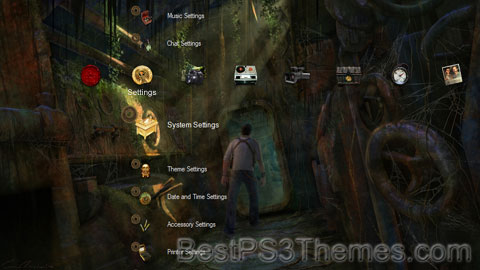
(4 backgrounds)
| Uncharted: Drake's Fortune | |
|---|---|
 North American cover art featuring the titular protagonist Nathan Drake in a jungle | |
| Developer(s) | Naughty Dog |
| Publisher(s) | Sony Computer Entertainment |
| Director(s) | Amy Hennig |
| Designer(s) | Richard Lemarchand Hirokazu Yasuhara |
| Programmer(s) |
|
| Artist(s) | |
| Writer(s) |
|
| Composer(s) | Greg Edmonson |
| Series | Uncharted |
| Platform(s) | PlayStation 3 |
| Release | |
| Genre(s) | Action-adventure, third-person shooter |
| Mode(s) | Single-player |
Uncharted: Drake's Fortune is a 2007 action-adventure game developed by Naughty Dog and published by Sony Computer Entertainment. It is the first game in the Uncharted series and was released in November 2007 for PlayStation 3. The game follows Nathan Drake, the supposed descendant of explorer Sir Francis Drake, as he searches for the lost treasure of El Dorado with journalist Elena Fisher and mentor Victor Sullivan.
The development of Uncharted: Drake's Fortune began in 2005, and saw Naughty Dog altering their approach to development, as they sought to create a humanized video game that was distinct from their other entries, settling on an action-adventure game with platforming elements and a third-person perspective. The team regularly updated or wholly changed various aspects related to the story, coding, and the game's design which lead to delays. The development team found influence for many of the game's aesthetic elements from film, pulp magazines, and movie serials.
Extensively marketed as a PlayStation exclusive, Uncharted: Drake's Fortune received generally favorable reviews, with praise for its technical achievements, cast, characters, story, music, and production values, drawing similarities to blockbuster films. It faced some criticism for its graphical issues, short length, vehicle sections, and marked difficulty. Uncharted: Drake's Fortune sold one million copies after ten weeks of release. It was followed by the sequel Uncharted 2: Among Thieves in 2009, and was re-released on PlayStation 4 as part of Uncharted: The Nathan Drake Collection.
Synopsis[edit]
Setting and characters[edit]
The central character of Uncharted: Drake's Fortune is Nathan Drake (voiced by Nolan North), a renowned adventurer who claims to be the descendant of the famous explorer Sir Francis Drake. Together with his mentor Victor Sullivan (voiced by Richard McGonagle) and journalist Elena Fisher (voiced by Emily Rose), Drake embarks on a quest to discover the hidden riches of El Dorado.[3]
Plot[edit]
Treasure hunter Nathan "Nate" Drake, accompanied by reporter Elena Fisher, recovers the coffin of his self-proclaimed ancestor Sir Francis Drake, having located it from coordinates inscribed on a family heirloom: a ring Nate wears around his neck.[4] The coffin contains Sir Francis' diary, which gives the location of El Dorado. Pirates attack and destroy Nate's boat, but Nate's friend and mentor, Victor "Sully" Sullivan, rescues the two in his seaplane. Fearing Elena's reporting will attract potential rivals, Nate and Sully abandon her at a dock.
Nate and Sully discover an alcove that once held a large statue after following the diary to the indicated spot, and realize that El Dorado is not a city but rather a golden idol.[5] They find a Nazi U-boat, which contains a page from Drake's diary showing the statue was taken to an island. However, mercenaries led by criminal Gabriel Roman (Simon Templeman), to whom Sully owes a substantial debt, and his lieutenant Atoq Navarro (Robin Atkin Downes), intercept Nate and Sully. Sully is shot in the chest and collapses, but Nate manages to escape, encounters Elena, and flies with her to the island.[6]
On the way, anti-aircraft fire forces Elena and Nate to bail out and they are separated. After retrieving supplies from the wrecked seaplane, Nate heads toward an old fort to find Elena. After Nate is briefly captured by pirates led by his old associate Eddy Raja (James Sie), Elena breaks him free and they flee to the island's old customs house. After finding records showing the statue was moved further inland to the monastery, they find that Sully is somehow alive and accompanying Roman and Navarro.[7] Nate and Elena find and rescue Sully who, having survived due to Drake's diary blocking the bullet, explains he was buying time for Nate by misleading Roman.
Searching through a mausoleum, Nate overhears an argument between Roman, Navarro, and Eddy, revealing that Roman hired Eddy to capture Nate and secure the island, with the reward being a share of El Dorado. Following Nate's escape, Roman doubts Eddy's abilities and ignores his claim that something cursed on the island is killing his men, leading him to dismiss Eddy and his crew. Regrouping, Nate and Elena find a passage leading to a treasure vault, in which they find the body of Drake, assuming that he died searching for the treasure. They encounter a terrified Eddy and a crew member, shortly before they are attacked by mutated humans who kill the crew member; despite Nate's efforts, Eddy is also killed when one drags him into a pit.
Nate and Elena escape and find themselves in an abandoned German bunker. Venturing into the base, Nate discovers that the Germans had sought the statue during World War II, but like the Spaniards before them, became cursed by the statue, causing them to become mutants. Sir Francis, knowing of the statue's power, attempted to keep it on the island by destroying the ships and flooding the city, before he too was killed by the mutants.[8]
Nate returns to find Elena has been captured by Roman and Navarro. Regrouping with Sully, he fails to stop them from reaching the statue. Navarro, aware of the curse, tricks Roman into opening the statue, revealing it to be a sarcophagus containing a mummy infected with an airborne mutagenic virus. Upon Roman turning into one of the mutants, Navarro kills him and takes control of his men. Berating Nate's group for not being imaginative, he plans to sell the virus as a biological weapon.[9] Nate jumps onto the sarcophagus and rides it as it is airlifted onto a boat in the bay. He engages and defeats Navarro and manages to sink both the sarcophagus and him to the bottom of the ocean.[10] Sully arrives, and after Nate and Elena display affection towards each other, they leave the island with several chests of treasure.[11]
Gameplay[edit]

Gameplay in Uncharted is a combination of action-adventure gameplay elements and some 3D platforming with a third-person perspective. Platforming elements allow Nate to jump, swim, grab and move along ledges, climb and swing from ropes, and perform other acrobatic actions that allow players to make their way along the ruins in the various areas of the island that Drake explores.[12]
When facing enemies, the player can either use melee and combo attacks at close range to take out foes or can opt to use weapons.[12] Melee attacks comprise a variety of single punches, while combo attacks are activated through specific sequences of button presses that, when timed correctly, offer much greater damage; the most damaging of these is the specific "brutal combo", which forces enemies to drop twice the ammunition they would normally leave.[12] Nate can only carry one pistol and one rifle at a time, and there is a limited amount of ammunition per gun. Picking up a different firearm switches that weapon for the new one. Grenades are also available at certain points, and the height of the aiming arc is adjusted by tilting the Sixaxis controller up or down. These third-person perspective elements were compared by several reviewers to Gears of War,[3][12] in that the player can have Drake take cover behind walls, and use either blind fire or aimed fire to kill enemies. In common with the aforementioned game, Uncharted lacks an actual on-screen health bar; instead, when the player takes damage, the graphics begin to lose color. While resting or taking cover for a brief period, Drake's health level, indicated by the screen color, returns to normal.[12]
The game also includes vehicle sections, where Drake must protect the jeep he and Elena are in using a mounted turret, and where Drake and Elena ride a jet ski along water-filled routes while avoiding enemy fire and explosive barrels. While players direct Drake in driving the jet ski, they may also control Elena by aiming the gun in order to use her weapon — either the grenade launcher or the Beretta, depending on the chapter — in defense, or to clear the barrels from their path.[12]
The game also features reward points, which can be gained by collecting 60 hidden treasures in the game that glimmer momentarily[13] or by completing certain accomplishments, such as achieving a number of kills using a specific weapon, performing a number of headshots, or using specific methods of killing enemies.[14] In subsequent playthroughs of the game, the player can use these rewards points to unlock special options; these include in-game bonuses such as alternate costumes and unlimited ammunition[13] but also non-game extras, such as making-of videos and concept art.[15] There are also several references to other Naughty Dog games, especially the Jak and Daxter series; this is done through the "Ottsel" branding on Drake and Fisher's wetsuits,[16] a reference to the species that mixes otter and weasel found in the game, and the strange relic found in one of the earlier chapters, which is actually a precursor orb from the same series.
The game is censored when playing on a Japanese console to remove blood, which normally appears when shooting enemies; this follows the trend of other censored console games in the region, such as Dead Rising and Resistance: Fall of Man.[17]
Development[edit]
After completing Jak 3, Naughty Dog assembled their most technically talented staff members and began development of Uncharted: Drake's Fortune under the codename Big.[18][19] The game's development commenced in 2005 and it was in full production for about two years, with a small team of engineers working on the game for about a year beforehand.[20] Naughty Dog decided to create a brand new IP rather than opt to develop a PlayStation 3 Jak and Daxter game—they wanted to create a franchise suitable for the new hardware, in order to develop such ideas as realistic human characters instead of stylized ones owing to limitations of previous hardware, as well as create something "fresh and interesting", although termed as 'stylized realism'.[20] Inspiration was drawn from various sources in the action and adventure genres: pulp magazines, movie serials, and more contemporary titles like Indiana Jones and National Treasure.[21] The team felt the sources shared themes of mystery and "what-if scenarios" that romanticized adventure and aimed to include those in Uncharted.[18]

The game was first unveiled at E3 2006.[22] From early previews of the game, inevitable comparisons of elements such as platforming and shooting between Uncharted and the well-known Tomb Raider series were drawn, earning the title the nickname of "Dude Raider".[21][23] However, the developers saw their game as concentrating more on third-person cover-based play, in contrast to Tomb Raider's "auto-aiming" play and greater puzzle-solving elements.[20] Other influences they cited include Resident Evil 4,[24] Kill Switch, and Gears of War.[25] Throughout the game's development the staff tried to remain flexible and detached from the original design concepts; attention was focused on the features that worked well, while features that did not work were removed.[26] The development team intended the game's main setting, the island, to play a big role in the overall experience. Feeling too many games used bleak, dark settings with monochromatic color schemes, they wanted the island to be a vibrant, believable game world that immersed the player and encouraged exploration.[18]
In designing the characters, the artists aimed for a style that was photorealistic.[21] The creators envisioned the main protagonist, Nathan Drake, as more of an everyman character than Lara Croft, shown as clearly under stress in the game's many firefights, with no special training and constantly living at the edge of his abilities.[20][23] Director Amy Hennig felt a heavily armored, "tough as nails" protagonist with a large weapon was not a suitable hero and decided a "tenacious and resourceful" character would portray more human qualities. Supporting characters (Elena Fisher and Victor Sullivan) were included to avoid a dry and emotionless story.[21] Fisher's character underwent changes during development; in early trailers for the game, the character had dark brown hair, but ultimately the color changed to blonde and the style was altered.[27][28] The writing of the story was led by Hennig with help from Neil Druckmann and Josh Scherr.[29] The lead game designer was Richard Lemarchand,[30] with the game co-designed by Hirokazu Yasuhara, a former Sega game designer best known for designing the early Sonic the Hedgehog games.[31]
The game went gold in the middle of October 2007.[20] A demo was then released on November 8 on the PlayStation Network[32] before its final release on November 19 in North America, December 6 in Australia, and December 7 in Europe.[33] The demo was first placed on the North American store, and was initially region-locked such that it would only play on a North American PS3,[34] but this was later confirmed as a mistake, as the developers were apparently unaware that people from different regions could sign up for a North American account and download the demo; a region-free demo was released soon after.[35]
Graphics and technology[edit]
Uncharted uses the Cell microprocessor to generate dozens of layered character animations to portray realistic expressions and fluid movements, which allow for responsive player control.[36] The PlayStation 3's graphics processing unit, the RSX Reality Synthesizer, employed several functions to provide graphical details that helped immerse the player into the game world: lighting models, pixel shaders, dynamic real-time shadowing, and advanced water simulation.[36] The new hardware allowed for processes that the team had never used in PlayStation 2 game development and required them to quickly familiarize themselves with the new techniques; for example, parallel processing and pixel shaders. While Blu-ray afforded greater storage space, the team became concerned with running out of room several times — Uncharted used more and bigger textures than previous games, and included several languages on the disc.[37] Gameplay elements requiring motion sensing, such as throwing grenades and walking across beams, or rear-ending massive logs up the scooter, were implemented to take advantage of the Sixaxis controller.[18] A new PlayStation 3 controller, the DualShock 3, was unveiled at the 2007 Tokyo Game Show, and featured force feedback vibration. Uncharted was also on display at the show with demonstrations that implemented limited support for vibration.[38]
Being Naughty Dog's first PlayStation 3 game, the project required the company to familiarize themselves with the new hardware and resulted in several development mistakes.[37] The switch from developing for the PlayStation 2 to the PlayStation 3 prompted the staff to implement changes to their development technology. Naughty Dog switched to the industry standard language C++ to participate in technology sharing among Sony's first-party developers—the company had previously used their own proprietary programming language GOAL, a Lisp-based language. In rewriting their game code, they decided to create new programming tools as well. This switch, however, delayed the team's progress in developing a prototype, as the new tools proved to be unreliable and too difficult to use. Ten months into full production, the team decided to recreate the game's pipeline, the chain of processing elements designed to progress data through a system. In retrospect, Naughty Dog's Co-President Evan Wells considered this the greatest improvement to the project.[26] Additionally, the animation blending system was rewritten several times to obtain the desired character animations.[18]
Trophies integration[edit]
The game was patched on August 4, 2008 in Europe and North America to version 1.01 to include support for the PlayStation 3's Trophy system.[39] There are 47 trophies in the game that match the medals that can already be won in the game and one further trophy, the Platinum trophy, awarded when all other trophies have been collected; Uncharted was the first Naughty Dog game to include the Platinum trophy type.[40] Similar to other PlayStation 3 titles that receive trophy support via downloaded patches, players must start a new save game to be awarded trophies, regardless of how many medals they received in previous playthroughs. This was enforced because the developers wanted to avoid the sharing of save data in order to gain trophies they did not earn.[41] The patch was described as "incredibly easy" to implement, owing to the game already containing preliminary support for Trophies via its Medals system; it was also stated that these hooks were already included due to Naughty Dog's belief that Sony would roll out the Trophy system before the game's launch in November 2007.[41] Despite mentioning that the game was developed as a franchise and that it lent itself to episodic content,[20] it was later stated that no downloadable content would be made for Uncharted.[42]
PlayStation Home[edit]
During the Closed Beta of PlayStation Home on October 11, 2008, Naughty Dog released an Uncharted themed game space for PlayStation Home. This space is "Sully's Bar" from the game. In this space, users can play an arcade mini-game called "Mercenary Madness", which during the Closed Beta, there were rewards. The rewards were removed with the release of the Home Open Beta. There are also three other rooms in this space: during the Closed Beta, users had to find out codes for the doors that accessed these rooms. The code entry to the rooms was also removed with the release of the Home Open Beta. The three other rooms are the "Artifact Room", "Archives", and "Smuggler's Den". There is an artifact viewer in the Archives and Smuggler's Den rooms. Also in the Archives, there is a video screen that previews Uncharted 2: Among Thieves. The Artifact Room only features seating and different artifacts for users to look at. This space was one of the first five-game spaces of the PlayStation Home Open Beta in North America, which Home went Open Beta on December 11.[43] This space was released to the European version on November 5, 2009, almost a year after the Open Beta release. Naughty Dog has also released a game space for Uncharted's sequel on October 23, making Uncharted the first game series to have a game space for both games in its series.[44]
Reception[edit]
Critical response[edit]
| Aggregator | Score |
|---|---|
| Metacritic | 88/100[45] |
| Publication | Score |
|---|---|
| 1Up.com | 8.5/10[12] |
| Edge | 8/10[46] |
| Famitsu | 36/40[47] |
| Game Informer | 8.75/10[3] |
| GamePro | 4.25/5[48] |
| GameSpot | 8.0/10[15] |
| GameSpy | 4.5/5[14] |
| IGN | 9.1/10[13] |
| PlayStation: The Official Magazine |   [49] [49] |
| PlayStation Universe | 9.0/10[50] |
| Publication | Award |
|---|---|
| IGN | Best Action Game (2007), PS3 Game of the Year (2007), Best Graphics Technology (PS3 2007), Best Original Score (PS3 2007)[51] |
Uncharted: Drake's Fortune received generally favorable reviews from game critics.[45] Game Informer complimented the visuals and dialogue between the characters Drake and Fisher, calling them stunning and entertaining respectively.[28] They further added that the production values appeared high, citing the level of detail and musical score.[52] PlayStation Magazine echoed similar statements about the visuals and compared them to that of Crysis.[18][53]
The overall presentation of the game received unanimous praise from critics, who recognized the game's high production values, describing them as "top-notch",[54] "incredible"[15] or comparing them to those found in Hollywood.[14] When combined with the overall style of the game, this led many reviewers to compare Uncharted to summer blockbuster films,[3][55][56] with the action and theme of the game drawing comparisons to the Indiana Jones film series and Tomb Raider.[15][55] As part of the presentation, the game's story and atmosphere were also received well.[3][55] The depth of the characters was praised, each having "their own tone".[55] The voice acting was also received well, as the cast "nails its characterizations"; overall, the voice acting was described as a "big-star performance",[14] "superb"[56] and "stellar".[3] Game designer Tim Schafer, well known as the creator of the early LucasArts adventure games such as The Secret of Monkey Island, has also lauded the game, saying he "liked it a lot", and jokingly thanked it for teaching him a new fashion tip (Nathan Drake's "half-tucked" shirt).[57]
The technical achievements in creating this presentation were also lauded. The graphics and visuals were a big part of this, including appreciation of the "lush" jungle environments,[3][12][15] with lighting effects greatly adding to them.[56] The game's water effects were also appreciated.[54] Overall, many reviewers commented that, at the time, it was one of the best-looking PlayStation 3 games available.[48] Further to the graphical aspects, both facial animation and the animation of characters,[16][56] such as Nate's "fluid" animations as he performs platforming sections were noted,[3] although the wilder animations of enemies reacting to being shot were over-animated "to perhaps a laug
K84

Orange #2
Orange theme by KURION84
Download: Orange_2.p3t

(3 backgrounds)

Orange most often refers to:
- Orange (fruit), the fruit of the tree species Citrus × sinensis
- Orange blossom, its fragrant flower
- Orange (colour), from the color of an orange, occurs between red and yellow in the visible spectrum
- Some other citrus or citrus-like fruit, see list of plants known as orange
- Orange (word), both a noun and an adjective in the English language
Orange may also refer to:
Arts, entertainment, and media[edit]
Films[edit]
- Game of Life (film), a 2007 film originally known as Oranges
- Orange (2010 film), a Telugu-language film
- The Oranges (film), a 2011 American romantic comedy starring Hugh Laurie
- Orange (2012 film), a Malayalam-language film
- Orange (2015 film), a Japanese film
- Orange (2018 film), a Kannada-language film
Music[edit]
Groups and labels[edit]
- Orange (band), an American punk rock band, who formed in 2002 from California
- Orange Record Label, a Canadian independent record label, founded 2003
Albums[edit]
- Orange (Al Stewart album), a 1972 folk album
- Orange (Jon Spencer Blues Explosion album), a 1994 alternative rock album
- Orange (Watanabe Misato album), a 2003 J-pop album
- Orange (Mario Pavone album), a 2003 jazz album
- Orange (2010 soundtrack), from the Telugu romantic film of the same name
- Orange (Dark Suns album), a 2011 studio album
Songs[edit]
- "Orange" (song), a 2007 comedy rock song by David O'Doherty
- "L'Orange" (song), a 1964 pop song by Gilbert Bécaud
- "Orange", a song by Love Battery on the 1990 album Between the Eyes
- "Orange", a song by Art Alexakis on the 2019 album Sun Songs
- "Orange", a song by Pinegrove on the 2022 album 11:11
- "Orange", a song by Gen Hoshino and Masayasu Wakabayashi on the 2023 EP Lighthouse
Other uses in arts, entertainment, and media[edit]
- Oranges, a 1967 short book by John McPhee
- Orange (TV channel), a former name of New Zealand channel Sky 5, launched in 1994
- Orange, a character in the 2009 web series Annoying Orange
- Orange (manga), a 2012 series
Businesses[edit]
- Orange (animation studio), a Japanese 3DCG animation company
- Orange Music Electronic Company, a British amplifier maker
- Orange S.A., formerly France Télécom, a France-based multinational telecommunications company which owns multiple international operators, including:
- Orange (India)
- Orange Belgium
- Orange Egypt
- Orange España (Spain)
- Orange Jordan
- Orange Morocco
- Orange Polska (Poland)
- Orange Romania
- Orange Slovensko (Slovakia)
- Orange RDC (Democratic Republic of the Congo)
- Orange Tunisia
- Orange UK
People with the name[edit]
- Orange (name), a surname and given name
- James O'Meara (1919–1974), Royal Air Force Second World War flying ace, nicknamed Orange
Places[edit]
Historic[edit]
- Orange Free State, a 19th-century Boer republic; later a province of South Africa
- Principality of Orange (1163–1713), a feudal state in what is now France
Australia[edit]
- Orange, New South Wales, a city
- City of Orange (New South Wales), a local government area based in the city
- Electoral district of Orange, a district in the New South Wales Legislative Assembly
- Orange wine region, a registered Australian Geographical Indication
France[edit]
- Orange (ski resort), a village and resort located in the commune of Saint-Sixt
- Orange, Vaucluse, a commune in the Vaucluse department in the Provence-Alpes-Côte d'Azur region
- Canton of Orange, an administrative division of the Vaucluse department, France
United States[edit]
- Orange, California, a city
- Orange, Connecticut, a town
- Orange, Georgia, an unincorporated community
- Orange, Illinois, an unincorporated community
- Orange, Indiana, an unincorporated community
- Orange, Massachusetts, a town
- Orange (CDP), Massachusetts, a census-designated place in the town
- Orange, Missouri, an unincorporated community
- Orange, New Hampshire, a town
- The Oranges, four municipalities in Essex County, New Jersey, which have "Orange" in their name
- Orange, New Jersey, a township
- Orange, New York, a town
- Orange, North Dakota or Arvilla, an unincorporated community
- Orange, Ohio, a village in Cuyahoga County
- Orange, Coshocton County, Ohio, an unincorporated community
- Orange, Delaware County, Ohio, an unincorporated community
- Orange, Texas, a city
- Orange, Vermont, a town
- Orange, Virginia, a town
- Orange, Wisconsin, a town
- Orange Creek, Florida
- Orange Island (Florida), a prehistoric landmass
Multiple entries[edit]
- Orange Bay (disambiguation)
- Orange City (disambiguation)
- Orange County (disambiguation)
- Orange Lake (disambiguation)
- Orange Park (disambiguation)
- Orange River (disambiguation)
- Orange Township (disambiguation)
Elsewhere[edit]
- Cape Orange, on the coast of Brazil
- Jayawijaya Mountains, a mountain range in the Indonesian part of New Guinea, formerly known as the Orange Range
- Orange Isle, Xiang River, Changsha, Hunan
Software[edit]
- Orange (software), a data analysis software suite
Sports[edit]
- Netherlands national football team, nicknamed "Orange"
- Syracuse Orange ("the Orange"; formerly, the Orangemen), the athletic teams of Syracuse University
- Otto the Orange, the team mascot
Transportation[edit]
Train stations[edit]
- Orange railway station, New South Wales, a train station in Orange, New South Wales, Australia
- Orange station (California), a train station in Orange, California, United States
- Orange station (NJ Transit), a New Jersey Transit station in Orange, New Jersey, United States
- Orange station (Vaucluse), an SNCF station in Vaucluse, Provence-Alpes-Côte d'Azur, France
Vessels[edit]
- Gitana 13, an ocean racing catamaran named Orange in 2002
- HMS Orange, two Royal Navy ships
- Orange II (boat), an ocean racing catamaran
- USS Orange (PF-43), a World War II frigate
Other uses[edit]
- Orange (heraldry), a tincture used in heraldry
- House of Orange-Nassau, a European aristocratic dynasty
- Orange High School (disambiguation)
- Orange Order, a Protestant organization
- Orange Revolution, which occurred in Ukraine in 2004
- War Plan Orange, a series of United States war plans
See also[edit]


- All pages with titles beginning with Orange
- All pages with titles containing Orange
- Orange II (disambiguation)
- L'Orange (disambiguation)
- Orangery, a room or building for fruit trees
- Orangism (disambiguation)
- Oranje (disambiguation)
- Ornge, the air ambulance service for the Canadian province of Ontario

If an internal link led you here, you may wish to change the link to point directly to the intended article.
Earth
Earth theme by Mawen
Download: Earth.p3t

(2 backgrounds)
.jpg) The Blue Marble, Apollo 17, December 1972 | |||||||||||||||||||||||||||||||||||||||||||||||||||||||||||||||||
| Designations | |||||||||||||||||||||||||||||||||||||||||||||||||||||||||||||||||
|---|---|---|---|---|---|---|---|---|---|---|---|---|---|---|---|---|---|---|---|---|---|---|---|---|---|---|---|---|---|---|---|---|---|---|---|---|---|---|---|---|---|---|---|---|---|---|---|---|---|---|---|---|---|---|---|---|---|---|---|---|---|---|---|---|---|
| The world, the globe, Sol III, Terra, Tellus, Gaia, Mother Earth | |||||||||||||||||||||||||||||||||||||||||||||||||||||||||||||||||
| Adjectives | Earthly, terrestrial, terran, tellurian | ||||||||||||||||||||||||||||||||||||||||||||||||||||||||||||||||
| Symbol |
DarkStalkersDarkStalkers theme by YASAI Download: DarkStalkers.p3t
Redirect to:
Raquel GibsonRaquel Gibson theme by 1_BAD_SOLDIER Download: RaquelGibson.p3t
Redirect to:
Cell (Splinter Cell)The Cell theme by Terry Hunter Download: Cell.p3t
P3T Unpacker v0.12 This program unpacks Playstation 3 Theme files (.p3t) so that you can touch-up an existing theme to your likings or use a certain wallpaper from it (as many themes have multiple). But remember, if you use content from another theme and release it, be sure to give credit! Download for Windows: p3textractor.zip Instructions: Download p3textractor.zip from above. Extract the files to a folder with a program such as WinZip or WinRAR. Now there are multiple ways to extract the theme. The first way is to simply open the p3t file with p3textractor.exe. If you don’t know how to do this, right click the p3t file and select Open With. Alternatively, open the p3t file and it will ask you to select a program to open with. Click Browse and find p3textractor.exe from where you previously extracted it to. It will open CMD and extract the theme to extracted.[filename]. After that, all you need to do for any future p3t files is open them and it will extract. The second way is very simple. Just drag the p3t file to p3textractor.exe. It will open CMD and extract the theme to extracted.[filename]. For the third way, first put the p3t file you want to extract into the same folder as p3textractor.exe. Open CMD and browse to the folder with p3extractor.exe. Enter the following: Washington RedskinsWashington Redskins theme by battleCat3000 Download: WashingtonRedskins.p3t
Redirect to:
G4 GirlsG4 Girls theme by 1_BAD_SOLDIER Download: G4Girls.p3t
P3T Unpacker v0.12 This program unpacks Playstation 3 Theme files (.p3t) so that you can touch-up an existing theme to your likings or use a certain wallpaper from it (as many themes have multiple). But remember, if you use content from another theme and release it, be sure to give credit! Download for Windows: p3textractor.zip Instructions: Download p3textractor.zip from above. Extract the files to a folder with a program such as WinZip or WinRAR. Now there are multiple ways to extract the theme. The first way is to simply open the p3t file with p3textractor.exe. If you don’t know how to do this, right click the p3t file and select Open With. Alternatively, open the p3t file and it will ask you to select a program to open with. Click Browse and find p3textractor.exe from where you previously extracted it to. It will open CMD and extract the theme to extracted.[filename]. After that, all you need to do for any future p3t files is open them and it will extract. The second way is very simple. Just drag the p3t file to p3textractor.exe. It will open CMD and extract the theme to extracted.[filename]. For the third way, first put the p3t file you want to extract into the same folder as p3textractor.exe. Open CMD and browse to the folder with p3extractor.exe. Enter the following: Indianapolis ColtsIndianapolis Colts theme by Tru Blu Designz Download: IndianapolisColts.p3t
The Indianapolis Colts are a professional American football team based in Indianapolis. The Colts compete in the National Football League (NFL) as a member club of the league's American Football Conference (AFC) South division. Since the 2008 season, the Colts have played their games in Lucas Oil Stadium. Previously, the team had played for over two decades (1984–2007) at the RCA Dome. Since 1987, the Colts have served as the host team for the NFL Scouting Combine. The Colts have competed as a member club of the NFL since their founding in Baltimore, Maryland, in 1953, after then-owner Carroll Rosenbloom purchased the assets of the NFL's last founding Ohio League member Dayton Triangles–Dallas Texans franchise. They were one of three NFL teams to join those of the American Football League (AFL) to form the AFC, following the 1970 merger. While in Baltimore, the team advanced to the playoffs ten times and won three NFL Championship games in 1958, 1959, and 1968. The Baltimore Colts played in two Super Bowl games, losing to the New York Jets in Super Bowl III and defeating the Dallas Cowboys in Super Bowl V. The Colts relocated to Indianapolis in 1984 and have since appeared in the playoffs sixteen times, won two conference championships, and played in two Super Bowl games; they defeated the Chicago Bears in Super Bowl XLI, and lost to the New Orleans Saints in Super Bowl XLIV (all four Super Bowls that the Colts have played in took place at the home stadium for the Miami Dolphins; while based in Baltimore, Super Bowls III and V were held at the Orange Bowl in Miami, and while based in Indianapolis, Super Bowls XLI and XLIV were at what is now Hard Rock Stadium in Miami Gardens). Franchise history[edit]Baltimore Colts[edit]The All America Football Conference began play in the 1946 season. In its second year, the franchise assigned to the Miami Seahawks was relocated to Maryland's major commercial and manufacturing city of Baltimore. After a fan contest, the team was renamed the Baltimore Colts and used the team colors of silver and green. The Colts played for the next three seasons in the old AAFC until they agreed to merge with the old National Football League (of 1920–1922 to 1950) when the NFL was reorganized. The Baltimore Colts were one of the three former AAFC powerhouse teams to merge with the NFL at that time, the others being the San Francisco 49ers and the Cleveland Browns. This Colts team, now in the "big league" of professional American football for the first time, although with shaky financing and ownership, played only in the 1950 season of the NFL, and was later disbanded. Carroll Rosenbloom era (1953–1971)[edit].jpg) In 1953, a new Baltimore-based group, heavily supported by the city's municipal government and with a large subscription-base of fan-purchased season tickets, led by local owner Carroll Rosenbloom won the rights to a new Baltimore NFL franchise.[7][8] Rosenbloom was awarded the remains of the former Dallas Texans team, who themselves had a long and winding history, with a small part of the franchise starting as the Boston Yanks in 1944, merging later with the Brooklyn Tigers, a franchise that had a far more deep and rich history, being previously known as the Dayton Triangles, one of the original old NFL teams established even before the League itself, in 1913. That team later became the New York Yanks in 1950, and many of the players from the New York Yankees of the former competing All-America Football Conference (1946–49) were added to the team to begin playing in the newly merged League for the 1950 season. The Yanks then moved to Dallas in Texas after the 1951 season having competed for two seasons, but played their final two "home" games of the 1952 season as a so-called "road team" at the Rubber Bowl football stadium in Akron, Ohio. The NFL considers the Texans and Colts to be separate teams, although many of the earlier teams shared the same colors of blue and white. Thus, the Indianapolis Colts are legally considered to be a 1953 expansion team.  Weeb Ewbank years (1954–1962)[edit]The current version of the Colts football team played their first season in Baltimore in 1953, where the team compiled a 3–9 record under first-year head coach Keith Molesworth. The franchise struggled during the first few years in Baltimore, with the team not achieving their first winning record until the 1957 season.[8] NFL champions (1958–1959)[edit]However, under head coach Weeb Ewbank and the leadership of quarterback Johnny Unitas, the Colts went on to a 9–3 record during the 1958 season and reached the NFL Championship Game for the first time by winning the NFL Western Conference.[9][10] The Colts faced the New York Giants in the 1958 NFL Championship Game, which is considered to be among the greatest contests in professional football history.[11] The Colts defeated the Giants 23–17 in the first game to utilize the overtime rule, a game seen by 45 million persons.[12] Following the Colts first NFL championship, the team posted a 9–3 record during the 1959 season and once again defeated the Giants in the NFL Championship Game to claim their second title.[8] Don Shula years (1963–1969)[edit]Following the two championships in 1958 and 1959, the Colts did not return to the NFL Championship for four seasons and replaced the head coach Ewbank with the young Don Shula in 1963.[13] In Shula's second season the Colts compiled a 12–2 record, but lost to the Cleveland Browns in the NFL Championship. NFL champions (1968)[edit]In 1968 the Colts returned with the continued leadership of Unitas and Shula and went on to win the Colts' third NFL Championship and made an appearance in Super Bowl III.  Leading up to the Super Bowl and following the 34–0 trouncing of the Cleveland Browns in the NFL Championship, many were calling the 1968 Colts team one of the "greatest pro football teams of all time"[14] and were favored by 18 points against their counterparts from the American Football League, the New York Jets.[15] The Colts, however, were stunned by the Jets, who won the game 16–7 in the first Super Bowl victory for the young AFL. The result of the game surprised many in the sports media[16] as Joe Namath and Matt Snell led the Jets to the Super Bowl victory under head coach Weeb Ewbank, who had previously won two NFL Championships with the Colts. Don McCafferty years (1970–1972)[edit]Rosenbloom of the Colts, Art Modell of the Browns, and Art Rooney of the Pittsburgh Steelers agreed to have their teams join the ten AFL teams in the American Football Conference as part of the AFL–NFL merger in 1970.[8] Super Bowl V champions (1970)[edit]The Colts immediately went on a rampage in the new league, as new head coach Don McCafferty led the 1970 team to an 11–2–1 regular-season record, winning the AFC East title. In the first round of the NFL Playoffs, the Colts beat the Cincinnati Bengals 17–0; one week later in the first-ever AFC Championship Game, they beat the Oakland Raiders 27–17. Baltimore went on to win the first post-merger Super Bowl (Super Bowl V), defeating the National Football Conference's Dallas Cowboys 16–13 on a Jim O'Brien field goal with five seconds left to play.[17] The victory gave the Colts their fourth NFL championship and first Super Bowl victory. Following the championship, the Colts returned to the playoffs in 1971 and defeated the Cleveland Browns in the first round, but lost to the Miami Dolphins in the AFC Championship. Robert Irsay era (1971–1996)[edit]Citing friction with the City of Baltimore and the local press, Rosenbloom traded the Colts franchise to Robert Irsay on July 13, 1972, and received the Los Angeles Rams in return.[18] Under the new ownership, the Colts did not reach the postseason for three consecutive seasons after 1971, and after the 1972 season, starting quarterback and legend Johnny Unitas was traded to the San Diego Chargers.[8] Following Unitas' departure, the Colts made the playoffs three consecutive seasons from 1975 to 1977, losing in the divisional round each time. The Colts' 1977 playoff loss in double overtime against the Oakland Raiders was famous for the fact that it was the last playoff game for the Colts in Baltimore and is also known for the Ghost to the Post play. These consecutive championship teams featured 1976 NFL Most Valuable Player Bert Jones at quarterback and an outstanding defensive line, nicknamed the "Sack Pack". Following the 1970s success, the team endured nine consecutive losing seasons beginning in 1978. In 1981, the Colts defense allowed an NFL-record 533 points, set an all-time record for fewest sacks (13), and also set a modern record for fewest punt returns (12).[19] The following year, the offense collapsed, including a game against the Buffalo Bills where the Colts' offense did not cross mid-field the entire game. The Colts finished 0–8–1 in the strike-shortened 1982 season, thereby earning the right to select Stanford quarterback John Elway with the first overall pick. Elway, however, refused to play for Baltimore, and using leverage as a draftee of the New York Yankees baseball club, forced a trade to Denver.[20] Behind an improved defense the team finished 7–9 in 1983, but that would be their last season in Baltimore. Relocation to Indianapolis[edit] The Baltimore Colts played their final home game in Baltimore on December 18, 1983, against the Houston Oilers. Irsay continued to request upgrades to Memorial Stadium or construction of a new stadium.[21] As a result of the poor performance on the field and the stadium issues, fan attendance and team revenue continued to dwindle. City officials were precluded from using tax-payer funds for the building of a new stadium, and the modest proposals that were offered by the city were not acceptable to either the Colts or the city's MLB franchise the Orioles. However, all sides continued to negotiate.[21] Relations between Irsay and the city of Baltimore deteriorated. Although Irsay assured fans that his ultimate desire was to stay in Baltimore, he nevertheless began discussions with several other cities willing to build new football stadiums, eventually narrowing the list of cities to Indianapolis and Phoenix.[22] Under the administration of mayors Richard Lugar and then William Hudnut, Indianapolis had undertaken an ambitious effort to reinvent itself into a 'Great American City'.[23] The Hoosier Dome, which was later renamed the RCA Dome, had been built specifically for, and was ready to host, an NFL expansion team.[24] Meanwhile, in Baltimore, the situation worsened. The Maryland General Assembly intervened when a bill was introduced to give the city of Baltimore the right to seize ownership of the team by eminent domain. As a result, Irsay began serious negotiations with Hudnut to move the team before the Maryland legislature could pass the law. Indianapolis offered loans as well as the Hoosier Dome and a training complex.[25] After the deal was reached, moving vans from Indianapolis-based Mayflower Transit were dispatched overnight to the team's Maryland training complex, arriving on the morning of March 29, 1984. Once in Maryland, workers loaded all of the team's belongings, and by midday the trucks departed for Indianapolis, leaving nothing of the Colts organization that could be seized by Baltimore.[26] The Baltimore Colts' Marching Band had to scramble to retrieve their equipment and uniforms before they were shipped to Indianapolis as well.[27] The move triggered a flurry of legal activity that ended when representatives of the city of Baltimore and the Colts organization reached a settlement in March 1986. Under the agreement, all lawsuits regarding the relocation were dismissed, and the Colts agreed to endorse a new NFL team for Baltimore.[23] _(crop).jpg) Upon the Colts' arrival in Indianapolis over 143,000 requests for season tickets were received in just two weeks.[28] The move did not change the recent fortune of the Colts, with the team appearing in the postseason only once in the first 11 seasons in Indianapolis. During the 1984 season, the first in Indianapolis, the team went 4–12 and accounted for the lowest offensive yardage in the league.[29] The 1985 and 1986 teams combined for only eight wins, including an 0–13 start in 1986 which prompted the firing of head coach Rod Dowhower, who was replaced by Ron Meyer. The Colts, however, did receive eventual Hall of Fame running back Eric Dickerson[30] as a result of a trade during the 1987 season, and went on to compile a 9–6 record, thereby winning the AFC East and advancing to the postseason for the first time in Indianapolis; they lost that game to the Cleveland Browns. Following 1987, the Colts did not see any real success for quite some time, with the team missing the postseason for seven consecutive seasons. The struggles came to a climax in 1991 when the team went 1–15 and was just one point away from the first all-losing season in the history of a 16-game schedule.[31] The season resulted in the firing of head coach Ron Meyer and the return of former head coach Ted Marchibroda to the organization in 1992; he had coached the team from 1975 to 1979. The team continued to struggle under Marchibroda and Jim Irsay, son of Robert Irsay and general manager at the time. It was in 1994 that Robert Irsay brought in Bill Tobin to become the general manager of the Indianapolis Colts.[32] Under Tobin, the Colts drafted running back Marshall Faulk with the second overall pick in the 1994 NFL draft[33] and acquired quarterback
| ||||||||||||||||||||||||||||||||||||||||||||||||||||||||||||||||